wayground logo

Free Printable Worksheets

Font size

S
M
L
XL
Worksheets

Earth Science Quiz

Total questions: 35

Worksheet time: 50mins

Name
Class
Date
1.

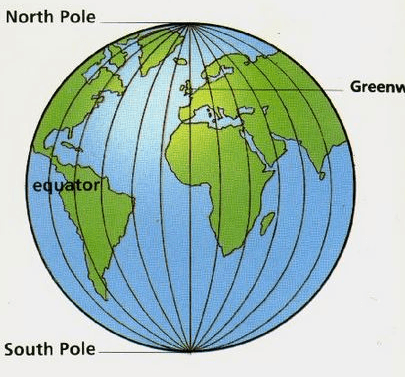
Which is listed first, latitude or longitude?

a)
Longitude
b)
Altitude
c)
Latitude
d)
Temperature
2.

Which lines are parallel to the equator?

a)
Lines of latitude
b)
Lines of longitude and latitude
c)
Lines of altitude
d)
Lines of longitude
3.

Is 110°W an example of latitude or longitude?

a)
Latitude
b)
Longitude
4.

Is 33°N an example of latitude or longitude?

a)
Longitude
b)
Latitude
5.

What is the latitude of the equator?

4 lines
6.

What is the longitude of the prime meridian?

4 lines
7.

Both dry land and the ocean floor is a layer of solid rock that makes up which layer of the Earth?

a)
Earth's crust
b)
Outer core
c)
Atmosphere
d)
Magma layer
8.

Which is generally denser, continental or oceanic crust?

a)
Neither is denser
b)
They have the same density
c)
Continental crust
d)
Oceanic crust
9.

Describe the Earth's mantle.

4 lines
10.

Why does the earth have layers?

a)
Because aliens built it that way
b)

Due to the process of differentiation in density during its formation.

c)
The earth is actually just a giant onion
11.

How do you find the volume of an irregularly shaped object like a rock?

a)
Use the water displacement method
b)
Use a ruler to measure the length, width, and height and calculate the volume
c)
Estimate the volume based on the size of the rock
d)
Cut the rock into smaller pieces and measure the volume of each piece
12.

How do igneous rocks form? Describe the process.

a)
From the decay of organic matter
b)
From the cooling and solidification of magma or lava.
c)
From the compression of sediment
d)
From the evaporation of water
13.

What can crystal size tell us about where an igneous rock formed?

a)
It can indicate the color of the rock
b)
It can indicate the rate at which the rock cooled
c)
It can indicate the type of minerals present
d)
It can indicate the age of the rock
14.

What are the two main types of igneous rocks and what makes them different?

4 lines
15.

If magma (liquid rock) cools off, what main type of igneous rock does it form?

a)

extrusive igneous rock

b)

volcanic rock

c)

intrusive igneous rock

d)

sedimentary rock

16.

If lava (liquid rock) cools off, what main type of igneous rock does it form?

a)
extrusive igneous rock
b)
intrusive igneous rock
c)

metamorphic rock

d)

sedimentary rock

17.

What is the difference between magma and lava?

a)
Magma is beneath the Earth's surface, while lava is on the Earth's surface.
b)
Magma is a type of rock, while lava is a type of liquid
c)
Magma is hotter than lava
d)
Magma and lava are the same thing
18.

List 2 specific examples of intrusive igneous rocks:

a)
Marble and Limestone
b)
Sandstone and Shale
c)
Basalt and Obsidian
d)

Granite and Gabbro

19.

List 2 specific examples of extrusive igneous rocks:

a)

Basalt, Granite

b)
Obsidian, Pumice
c)
Limestone, Sandstone
d)
Granite, Marble
20.

What is the geographical area on Earth where most of the earthquakes and volcanoes occur? What is the term used to describe this pattern?

a)
Arctic Ring of Snow
b)
Pacific Ring of Fire
c)
Indian Loop of Lava
d)
Atlantic Circle of Ice
21.

Location D is located at which coordinates?

a)

30oN, 90oW

b)

90oN, 30oW

c)

10oN, 40oW

d)

30oN, 90oE

22.
a)
The map show the lines of longitude.
b)
The map shows the lines of latitude.
23.
Which of the following letter is at approximately 60 degrees S, 40 degrees W? 
a)
A
b)
D
c)
E
d)
H
24.

"litho" means

a)

rock

b)

weak

c)

dense

d)

heavy

25.

"astheno" means

a)

weak

b)

rock

c)

heavy

d)

dense

26.

The continental crust is formed mostly from rocks like _____________.

a)

Basalt

b)

Slate

c)

Granite

d)

Marble

e)

Pumice

27.

Temperature _____________________ as you go deeper into the earth.

a)

increases

b)

decreases

c)

goes up and down depending on the layer

d)

stays the same

28.

Pressure ______________________ as you go deeper into the Earth

a)

increases

b)

decreases

c)

goes up or down depending on the layer

d)

stays the same

29.

What are the two types of crust?

a)

Oceanic

b)

Thick

c)

Continental

d)

Tectonic Plate

30.

Due to extreme pressure, the inner core of the Earth is

a)

Solid

b)

Liquid

c)

Gas

d)

Plasma

31.
At which point should your eyes be when you read a graduated cylinder? (Hint: see the letter next to the eye)
a)
A
b)
B
c)
C
32.
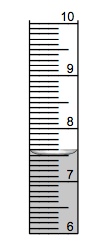
What is the volume of the liquid in this graduated cylinder?
a)
8.5 mL 
b)
7.5 mL 
c)
8 mL 
d)
.1 mL
33.
What is the volume of liquid in this graduated cylinder?
a)
40.0 mL
b)
40.3 mL
c)
43.0 mL
d)
44.0 mL
34.
What two types of measurements make up DENSITY
a)
Mass and Volume
b)
Temperature and Mass
c)
Grams and Centimeters
d)
Volume and Weight
35.
If an object has a density of .6 g/mL and you put it into water, will it sink or float?  
a)
sink
b)
float