
 Worksheets
HISTORY, THEORY AND PROFESSIONAL PRACTICE
Total questions: 30
Worksheet time: 15mins
Which of the following influences on architecture refers to the arrangement of natural and architectural features of an area?
geology
topography
psychology
geography
The controversial “hostile architecture” or “hostile design” is used to prevent _________________.
vandalism
unwanted behavior
discrimination
creativity
The oldest art form can be found where?
caves
churches
catacombs
bones
The presence of defensive walls in ancient settlements reflects the following conditions except what?
no unity between cultures or cities
wars and attacks are prevalent
low political stability
presence of organized religion
The Mission Revival Style in the Philippines emerged during what period?
early American colonial period
late Japanese colonial period
Spanich colonial period
under Marcos regime
An architecture apprentice should secure _________________ before presenting preliminary sketches to a client.
downpayment
service agreement
license
space program
An architect finished the construction documents of a residential building but the client ran out of money due to business bankcruptcy. How much is the architect entitled to collect?
none due to force majeure
90% of his professional fee
100% of his professional fee
85% of his professional fee
The client requests for a walk-thru digital presentation of the final design to be uploaded in the client’s website. Which of the following is true?
The cost of the walk-thru presentation is always embedded in the basic regular design fee.
The cost of the walk-thru presentation should be free.
The walk-thru presentation should always be supervised by the architect.
The cost of the walk-thru presentation is separate from the architect’s design fee.
Who determines the cost and time of the project?
client
architect
project manager
consultant
An experienced architect is hired to provide systematic process making sure that all building systems are planned, designed, installed and tested properly and according to the buildings operational needs. What architectural practice document applies to his/her service?
SPP Document 202
SPP Document 203
SPP Document 205
SPP Document 206
A businessman client wants to secure the service of an architect specializing in architectural lighting but he/she currently has no proposed project yet. What should the client do?
determine first the project
get the architect’s business details
get a retainer agreement
ask the architect for any project ideas
Who can best interpret a construction drawing?
construction manager
designer
client
architect
According to the laws, who among these entities does not necessarily have civil liability?
construction manager hired by the owner
contractor hired by the owner
architect hired by the contractor as construction supervisor
designing engineer hired by the owner
A construction manager is typically hired by the _______________.
contractor
project manager
client
architect
When a client hires a project manager in constructing a building, what is the main responsibility of the project manager?
overall time control
overall cost control
overall construction control
overall personnel control

Which of the following figures is Art Deco?
Figure A
Figure E
Figure C
Figure D

Refer to Figure C, in which country did this particular art movement start?
United States
France
Netherlands
Italy
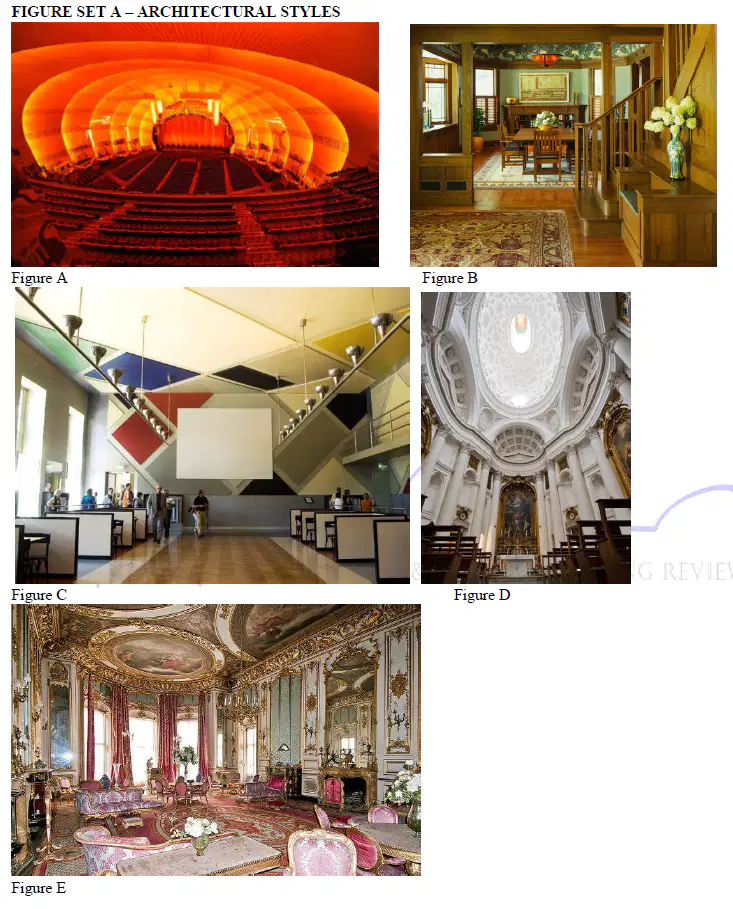
Which of the following figures is Arts and Craft Movement?
Figure A
Figure B
Figure D
Figure E
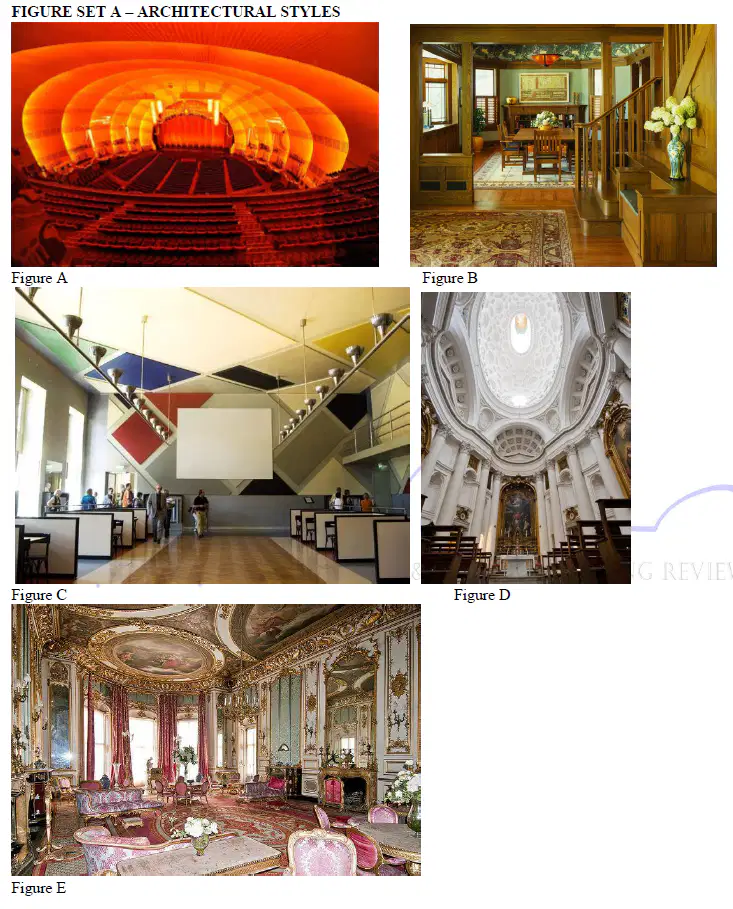
Which of the following figures is Rococo?
Figure C
Figure A
Figure B
Figure E
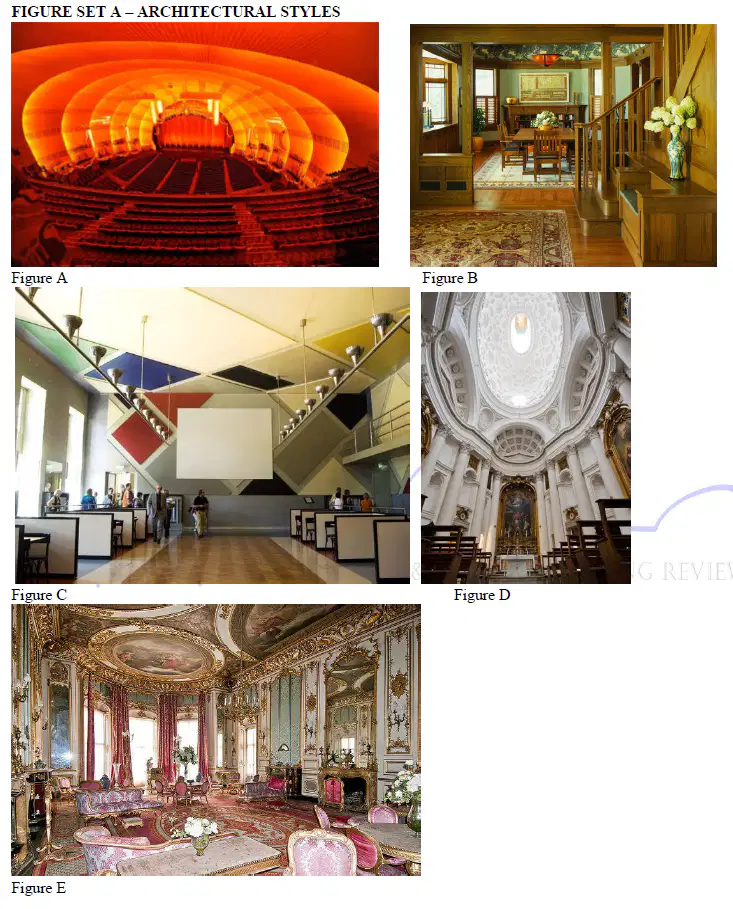
Refer to Figure D, the interior shows what architectural style?
Renaissance
Baroque
Rococo
Neoclassicism
Which of the following is an example of overhead plane?
wall
roof
ground
slab
Architectural styles and movements are all reflections of the social and cultural conditions of its period. Which term means the “spirit of age”?
tectonics
ontology
zeitgeist
genius loci
____________ is a Japanese aesthetic concept of appreciating the imperfection of objects, materials and in general, life.
zen
ken
shinto
wabi-sabi
In architecture, “pastiche” means what?
imitation of style
production of design concept
open concept
meaning of a space
The term “genius loci” means what?
spirit of age
spirit of place
spirit of nature
spirit of meaning
Based on Laws of the Indies, the planning of a colonial town is centered around _____________.
church
plaza mayor
government office
hospital
Which type of house was a result of American colonialism?
aduana
bahay na bato
accessoria
tsalet
Who is known as the most famous neo-vernacular architect in the Philippines?
Felipe Mendoza
Leandro Locsin
Franciso Mañosa
Angel Nakpil
_______________ is a construction technique using lime mortar and stone and was introduced by the Spaniards, especially in Ivatan houses.
arkitektura mestiza
sinadumparan
tajuk pasung
cal y canto
Which is an example of mission revivalist architecture?
Picache Building
Gabaldon Schools
Insular Ice Plant
Insular Life Building

