
 Worksheets
10-minute Quiz : Chapter 64 Instrumental analytical methods
Total questions: 10
Worksheet time: 10mins
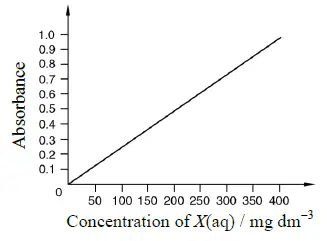
Direction: Questions 1 and 2 refer to a colorimetric experiment conducted to determine the concentration of a coloured chemical species X in an aqueous solution of a substance.
The calibration curve used in the colorimetric study of X is shown in the diagram. What is the concentration of X in a solution sample of the substance if the solution sample has an absorbance of 0.85?
Direction: Questions 1 and 2 refer to a colorimetric experiment conducted to determine the concentration of a coloured chemical species X in an aqueous solution of a substance.
Assuming that the solution sample mentioned in question 1 has been diluted 100 times with deionized water before the absorbance measurement, what is the mass of X, in g, in the 1.0 cm³ of undiluted solution sample of the substance?

Which of the following characteristic infrared radiation wavenumber ranges can be used to distinguish between two carbon compounds, X and Y, as shown in the diagram?
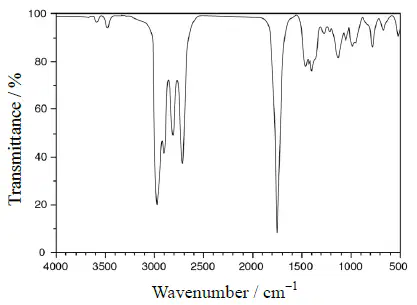
The infrared spectrum of a carbon compound is shown in the diagram. Which of the following compounds would give this spectrum?
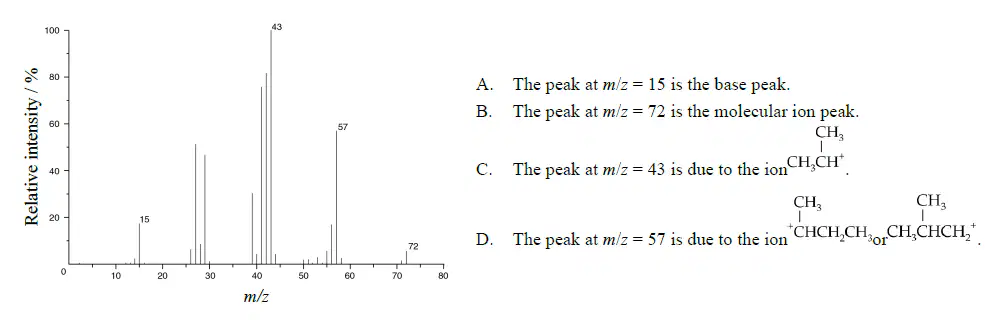
The mass spectrum of methylbutane is shown in the diagram. Which of the interpretations of the mass spectrum of methylbutane is INCORRECT?
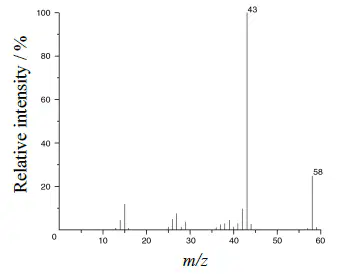
Z is a carbon compound with a molecular formula C₃H₆O. The mass spectrum of Z is shown in the diagram. Given that Z gives a positive result in the 2,4-dinitrophenylhydrazine test, which of the following compounds could Z be?
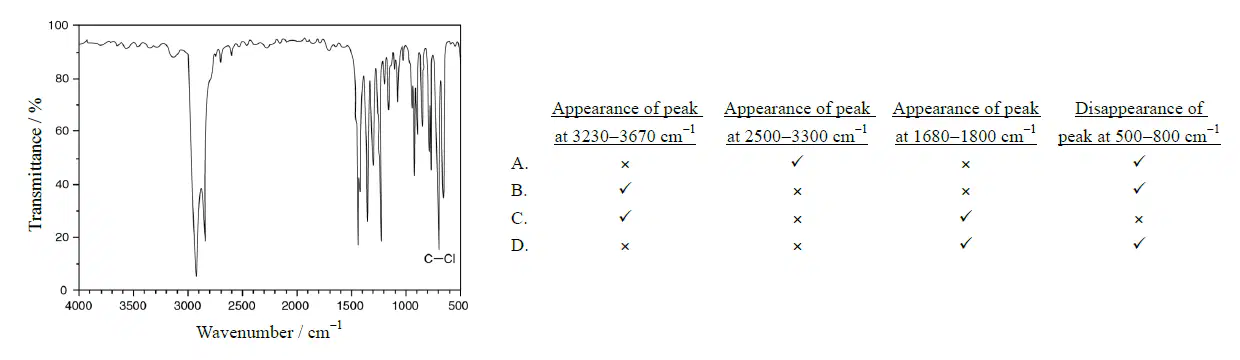
V is an alcohol that can be synthesized through hydrolysis by heating U (which is a chloroalkane) with sodium hydroxide solution. The infrared spectrum of U, with the absorption peak corresponding to the C–Cl bond labelled, is shown in the diagram. After the hydrolysis, the crude product, i.e. alcohol V, is analysed by infrared spectroscopy. Which of the combinations of changes in the infrared spectrum can indicate that the crude product does not contain U?

Compounds P and Q are a pair of chain isomers. Which of the following statements correctly describes the difference between P and Q?
A. P can turn K₂Cr₂O₇(aq)/H⁺(aq) from orange to green, but Q cannot.
B. Q can form a silver mirror with Tollens’ reagent, but P cannot.
C. A strong absorption peak corresponding to the C≡C bond appears at around 2070 to 2250 cm⁻¹ in the infrared spectrum of Q, but P does not.
D. P has a higher boiling point than Q at atmospheric pressure.
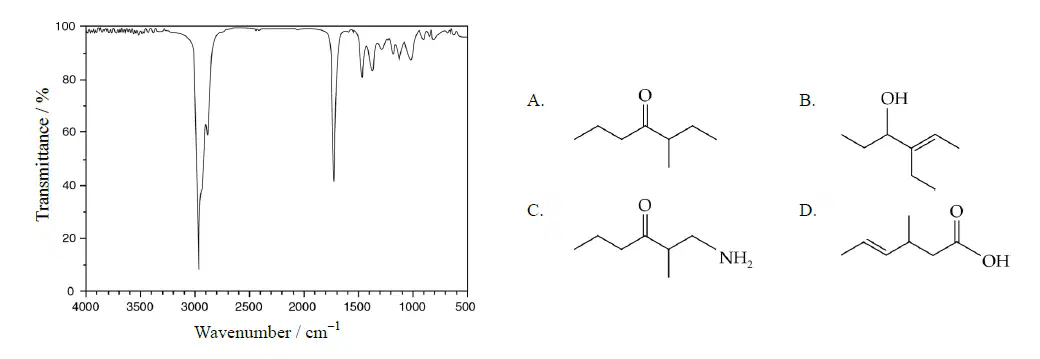
The molecular structure of an unknown carbon compound J is analysed by using infrared spectroscopy, and the infrared spectrum obtained is shown in the diagram. Which of the compounds could J be?

