
 Worksheets
CHS universal3
Total questions: 101
Worksheet time: 1hrs 10mins
Which refrigerant contains chlorine?
A) R-12
B) R-1234yf
C) R-134a
D) none of them
The release of any CFC, HCFC, or HFC refrigerant during ________ is illegal.
A) the installation of manifold gauges equipped with low-loss fittings
B) theft of equipment
C) the connection of a recovery machine equipped with low-loss fittings
D) all of the above
Oxygen or compressed air should never be used to pressurize a system because ________.
A) oxygen or compressed air can explode when mixed with compressor oil or some refrigerants
B) oxygen or compressed air is too corrosive
C) oxygen or compressed air displace refrigerant
D) oxygen or compressed air displace oil
How does the GWP of R-441A compare to the GWPs of R-410A?
A) The GWP of R-441A is significantly higher.
B) The GWP of R-441A is significantly lower.
C) They are both blends and the GWPs are about equal.
D) They are both blends and the GWP of R-410A is just slightly higher.
Recovery cylinders are labeled to indicate the refrigerant inside to ________.
A) avoid accidental mixing of recovered refrigerants and allow a recycler to identify the contents
B) allow the technician's company to determine the amount of refrigerant recovered for recordkeeping purposes
C) determine if the refrigerant must be reclaimed or is clean
D) both A and B
All CFC, HCFC, and HFC refrigerant recovery devices must ________.
A) be portable
B) contain a heavy-duty splash shield
C) have a two-stage vacuum pump
D) meet EPA standards
HCFC refrigerants are made up of ________.
A) Helium, chloroform, fluorine, and chlorine
B) Hydrogen, chlorine, ferrite, and calcium
C) Hydrogen, chlorine, fluorine, and carbon
D) Hydrogen, chlorine, fluorine, and calcium
If a system cannot maintain a vacuum, the system ________.
A) should be charged immediately before air leaks in
B) has been adequately evacuated for charging
C) could have a leak or still be evaporating off trapped refrigerant or moisture
D) needs a new compressor
A system is considered dehydrated when ________.
A) a micron-gauge shows you have reached and held a vacuum of 500 microns or less with the vacuum pump isolated from the system
B) a micron-gauge shows you can maintain a vacuum of at least 500 microns, for at least 5 minutes, while the vacuum pump is operating
C) the manifold suction gauge is bottomed-out at 29.9 in. hg for at least an hour
D) the vacuum pump sound is indicating that nothing else is being pumped out
If R-410A was added to an R-22 system, ________.
A) vent the R-410A because it is higher pressure
B) vent the mixture because it cannot be reclaimed
C) recover the mixture in a separate recovery tank
D) top off the system with either R-22 or R-410A because the mixture cannot be reclaimed
What is a violation of the Clean Air Act or EPA's regulations?
A) Failing to keep required records
B) Failing to meet the required evacuation levels before opening or disposing of appliances
C) Knowingly releasing CFC, HCFC, or HFC refrigerants while repairing appliancesD) All of the above
D) All of the above
Never operate a hermetic compressor when the system ________.
A) is under a light load
B) has a condenser exposed to temperatures above 105 °F
C) is evacuated
D) will be operating continuously under maximum nameplate-rated load
HFC refrigerants contain ________.
A) Helium, fluoride, and chlorine
B) Hydrazine, fluoride, and chlorine
C) Helium, fluorine, and carbon
D) Hydrogen, fluorine, and carbon
Which refrigerant depletes the ozone layer?
A) R-600a
B) R-1234yf
C) R-22
D) R-410A
All non-exempt refrigerants ________.
A) deplete the stratospheric ozone layer
B) contain chlorine
C) must be recovered before opening or disposing of appliances
D) are toxic to sea life
Always ________ when operating refrigerant recovery or recycling equipment.
A) wear safety glasses
B) wear protective gloves
C) follow all safety precautions (for the equipment)
D) all of the above
What provides the cooling in a vapor compression refrigeration system?
A) The refrigerant turning into a liquid.
B) The compression of the refrigerant vapor.
C) The vaporization of the liquid refrigerant.
D) The condensation of the refrigerant as it gives off heat in the condenser.
Which gas would cause the least damage when used for leak checking?
A) Nitrogen and R-134a
B) Compressed air and R-410A
C) Dry nitrogen alone
D) Dry nitrogen and R-407C
Non-toxic refrigerants can still cause death because ________.
A) they are heavier than air and can cause asphyxia
B) they are flammable
C) they are lighter than is air and can cause asphyxia
D) they can become toxic when mixed with air
________ can combine to cause a fire or explosion when working with flammable hydrocarbon refrigerants.
A) Electrical wiring and water vapor
B) A sufficient concentration of the refrigerant in the space and an ignition source
C) A leak from the system and corrosion at the leak source
D) Warm temperatures and oil
Never heat a recovery tank with an open flame because ________.
A) EPA regulations do not allow reclaimers to accept visibly burned tanks
B) the high temperature can cause the pressure relief valve to vent, the tank to explode, or the refrigerant to decompose
C) SNAP regulations require extra clean-up of burnt refrigerant
D) all of the above
Why are flammable HFO refrigerants classified as A2L and not A2?
A) Only the liquid is flammable.
B) They have low flammability, being less flammable than HC refrigerants.
C) They have lingering flammability.
D) They have low GWP.
A compound pressure gauge measures pressure in ________.
A) psia and psig
B) psia and microns
C) psig and inches of mercury
D) psia and mm of mercury
What is one of the most serious results of loss of the stratospheric ozone layer?
A) Increased hurricanes
B) Increased tornadoes
C) Increased rates of skin cancer
D) Decreased ground-level ozone
State and local governments ________.
A) cannot make any laws related to refrigerant recovery
B) can establish laws to reduce the federal refrigerant recovery requirements
C) can make laws that are stricter requirements than the federal regulations
D) can temporarily suspend the prohibition on the manufacture of R-22 for up to 6 months
Why is venting an "exempt refrigerant" legal?
A) Because the EPA has determined that the refrigerant does not pose a threat to the environment if released
B) Because EPA has not yet made it illegal to vent that particular refrigerant
C) Because the refrigerant is not yet SNAP approved
D) Because the environmental analysis is not yet complete
Which of the following are examples of a small appliances?
Home refrigerator and window AC unit
Chiller and centrifugal
Heat pump and convenience store refrigerator
A microwave
To satisfy the rules on refrigerant recovery from a small appliance, the technician can evacuate the small appliance to what minimum level?
0 psig
10 inches of mercury vacuum
4 inches of mercury vacuum
5 psig
What type of recovery equipment uses a self contained recovery unit to remove refrigerant from an appliance?
passive recovery equipment
self-contained (active) recovery equipment
This is not the correct answer
This is the correct answer, wink wink.
How can a technician speed up the recovery process on a small appliance with an inoperative compressor?
recover from both the high side and low side of the system
recover from the low side only
heat the recovery tank
recover from the high side only
What maintenance procedures should be performed on recovery equipment?
check for leaks
all answers are correct
replace filters as required
check for proper oil level
What should be done when filling a graduated charging cylinder with refrigerant?
recover the refrigerant vapor that is vented from the top of the cylinder
heat the cylinder
close the vent valve on the top of the cylinder
use a pump to transfer refrigerant from the tank to the graduated charging cylinder
What is the straight piece of tubing (process tube or stub) on a small appliance used for?
To measure the temperature of the system
To vent the refrigerant into the atmosphere
To attach a piercing valve in order to access the refrigerant
To open the unit and measure the pressure
Which of the following can increase the efficiency of system dependent recovery?
turn the recovery cylinder upside down
pack the recovery cylinder in ice or cold water
use longer service hoses
heat the recovery cylinder
What is done with nitrogen used to flush debris from a system, after recovery?
it must be recovered into a separate tank
it can be vented
it can be put back in its cylinder for re-use
it will require reclaiming
Type I certification defines small appliances as products that are manufactured, fully charged, and hermetically
sealed in a factory with pounds or less of refrigerants.
5
7
10
15
In order to service small appliances, a technician must be certified
Type II
Type III
Type I or Universal
All of the above
Once you become certified, the law states that you must repair all leaks in small appliances.
True
False
It depends on the size of the leak.
Only if the refrigerant is a CFC.
When using nitrogen, the nitrogen tank must be equipped with
an automatic shut-off.
low loss fittings.
a regulator and pressure relief valve.
a purge device.
Under conditions of ARI 740-1993, recovery devices manufactured before November '15, 1993, must
be able to remove 80% of the refrigerant charge or achieve 4" Hg vacuum
be able to remove 90% of the refrigerant charge or achieve 4" Hg vacuum, if the compressor is in operation.
be able to remove 80% of the refrigerant charge or achieve 4'' Hg vacuum, if the compressor is not operating.
be able to remove 70% of the refrigerant charge or achieve. 4" Hg vacuum.
When using system dependent (passive) recovery, the EPA requires
80% of the refrigerant to be removed if the compressor is operating.
80% of the refrigerant to be removed if the compressor is not operating.
90% of the refrigerant to be removed if the compressor is not operating.
70% of the refrigerant to be removed if the compressor is operating.
What may cause a pungent odor in a CFC or HCFC system?
A burnt compressor.
An overcharged system.
A defective filter dryer.
A dead mouse.
EPA definition of a small appliance would include
a small residential window air conditioner.
a home dehumidifier.
a water cooler.
all of the above.
________ would be considered a lower flammability refrigerant.
R-1234yf
L-20
R-717
All the above
Piercing access valves should always be removed after recovery on small appliances because _______
they are too expensive to let on.
they leak eventually.
it's really okay to just leave them on.
they are too ugly to leave on.
The following is not considered a "small appliance" _______
residential split system
vending machine
drinking water coolers
home refrigerator
The shipping papers included with refrigerant cylinders being shipped to the reclaimer should include ___________
the total number of cylinders.
the total refrigerant recovered so far that year by the company.
the name of each technician who recovered the refrigerant.
the EPA certification number of each technician who handled the refrigerant.
ARI 740 deals with
recovery equipment.
venting CFCs
technicians becoming certified to buy refrigerants.
homeowners maintaining refrigerant logs on all pieces of equipment in the home that contain refrigerant.
What is a small appliance defined as by the EPA?
A low pressure appliance with 30 psig or lower
A pre-assembled unit, hermetically sealed, and factory charged with 5 lbs of refrigerant or less
An appliance containing 5 lbs of refrigerant or more
A toaster
Your recovery/recycling machine has R-22 refrigerant in it. You now have to recover refrigerant from an R-410A unit. What must be done before recovery?
Change the recovery cylinder on the recovery machine.
Change the expansion valve on the recovery machine.
Change the filter and expansion valve on the recovery machine.
Remove the R-22 from the recovery unit and change the filter.
You are changing out the compressor of a system containing 40 pounds of R-404A. In addition to isolating the compressor, which of the following procedures should you follow?
Simply remove the compressor and cap the ends.
Evacuate the isolated section of the system to atmospheric pressure, then remove the compressor.
Evacuate the isolated section of the system to 0 psig and if system pressure does not rise after a few minutes, remove the compressor.
Evacuate the isolated section of the system to 5 inches of vacuum and when the system's pressure rises out of the vacuum, remove the compressor.
Why do gauge set hoses used for field service work have self-sealing connectors or hand valves?
To minimize the chance of an explosion during refrigerant recovery.
To prevent vapor lock during vapor transfer to recovery cylinder.
To minimize refrigerant release when hoses are connected and disconnected.
To prevent vapor lock during liquid transfer to recovery cylinder.
Why could a recycling or recovery machine that uses a hermetic compressor overheat when drawing deep vacuums?
It runs faster than other equipment with oil less compressors.
The motor relies on the flow of refrigerant through the compressor for cooling.
It has a higher compression ratio limit than other equipment.
The oils used in hermetic compressors are a lower viscosity than the oils used in other equipment.
Which part of a belt-driven non-hermetic compressor is most likely to leak if the compressor has not been used for several months?
Suction service valve
Rotating shaft seal
One or both of the king valves
Head gasket on discharge side
Which of the following statements about recycling and recovery equipment used for stationary refrigeration is FALSE?
It must be tested by an EPA-approved third party
Purchases of such equipment must be reported to the EPA
It must be equipped with low-loss fittings
Equipment designed to recover flammable refrigerant must meet a specific UL safety standard
Which of the following should be replaced if a system is opened for servicing?
Filter drier
Thermostat
Metering devic
Crankcase heater
Which of the following repairs would always be considered "major" under EPA's regulations?
Replacement of an evaporator coil.
Replacement of a filter-drier.
Replacement of a Schrader valve core.
Replacement of a condenser fan motor.
Which of the following refrigerants would be used in a low-pressure appliance?
R-22
R-123
R-410A
R-407A
When should refrigerant be removed from the condenser outlet?
When the condenser is below the receiver.
When the condenser is on the roof.
When the condenser is inoperative.
When the evaporator has a small leak.
1. When is it against EPA regulations to use system-dependent recovery equipment?
When the compressor of the appliance is operational.
When the ambient temperature is over 105°F.
When the appliance contains over 15 pounds of refrigerant.
When the appliance is leaking.
When can appliances containing refrigerants be recovered to atmospheric pressure?
For major repairs such as replacing the compressor, condenser, or evaporator.
The repair is followed by an evacuation of the appliance to the environment.
Leaks in the appliance make recovery to the prescribed level unattainable.
The appliance is being disposed of and recycled.
What will back-seating a suction shutoff valve close?
Suction line and compressor port
Compressor and gauge port
Compressor port
Gauge port
What should systems that use R-407C be leak checked with?
Any available CFC.
Any available HCFC.
Pressurized nitrogen and a trace amount of R-407C.
Pressurized nitrogen and a trace amount of R-22.
What should be done before transferring refrigerant to an empty cylinder?
The refrigerant should be chilled.
The refrigerant should be mixed.
The cylinder should be heated.
The cylinder should be evacuated.
What must an owner of a commercial refrigeration appliance with a charge of 2000 pounds of R-22 do once the leak rate threshold has been exceeded?
Take further action by repairing, retiring, mothballing, or retrofitting the appliance.
Check to see if it has leaked above the mandatory retirement threshold.
File a report to EPA describing their efforts to repair the appliance.
Retrofit the appliance to an exempt substitute refrigerant.
What level of vacuum should be pulled when evacuating a vapor compression system to ensure all moisture has been removed?
2 mm Hg.
1 mm Hg.
1000 microns.
500 microns.
What is the first thing to do when a new system has been assembled {built up), and is ready for testing?
Pull a vacuum.
Pressurize with an inert gas and leak check.
Pressurize with the refrigerant to be used in the system.
Introduce an initial charge of refrigerant and start the compressor.
What is the component directly following the condenser in a refrigeration system using a thermal expansion valve?
Receiver
Compressor
Accumulator
Evaporator
What is a moisture indicating sight glass useful for?
Determining the type of refrigerant.
Checking for moisture in refrigerant.
Providing sub-cooling.
Determining the type of oil used.
What can happen when using a large vacuum pump to evacuate a system?
Trapped oil can freeze.
Trapped refrigerant can freeze.
Water in system can freeze.
The valve seats can freeze.
What action must an owner/operator take if a supermarket system containing 50 or more pounds of R22 leaks more than 125% of its full charge in a calendar year?
Retrofit the appliance with a substitute refrigerant.
Recover the refrigerant and leak check the appliance with a trace gas.
Retire the appliance until it can be replaced with a new one.
Submit a report to EPA describing efforts to identify leaks and repair the appliance.
To determine if the system is leaking more than the allowable rate, the EPA allows the use of which one of the following methods to determine the full charge?
Use of the calculations based on power consumption, in kWh.
Use of the calculations based on compressor horsepower
Use of calculations based on component and pipe sizes.
Use of the calculations based on the BTU capacity of the system.
Refrigerant has been recovered from an air-conditioning system and held in a refillable cylinder, in order to replace the condenser coil. The refrigerant;
may be charged back into the system.
may be sold as is to another equipment owner.
must be reclaimed.
must be destroyed.
After a leak repair of a supermarket rack using 3000 lbs of R-22 and a successful initial verification test, when must a follow-up leak verification test be conducted?
The same day.
The next day.
Within 10 days.
Within 30 days.
An initial leak verification test failed after repairing a leak in a rack refrigeration system for a supermarket using an HCFC refrigerant. What would be the next step(s)?
Immediately retrofit or retire the appliance.
Conduct additional repairs within the 30-day repair window or mothball the appliance.
Conduct a follow-up verification test.
Report the amount of refrigerant added to the system to the EPA.
Before making a major repair, technicians must evacuate an appliance or component containing more than 200 pounds of R-410A to which of the following levels?
0 psig
25 mm Hg absolute
10 inches of Hg vacuum
15 inches of Hg vacuum
When charging a low-pressure chiller, first introduce the refrigerant as a vapor until ________.
A) the system pressure reaches 10 psig
B) the saturation temperature of the refrigerant being charged increases above 32 °F
C) the system pressure reaches 15 psig
D) either A or C
A hydrostatic tube test kit is used to ________.
A) find if there is a leak in the tube
B) flush water from tubes
C) expand replacement tubes into the chiller core
D) clean deposits from the water-side of the chiller
When recharging a chiller, refrigerant is first added as a vapor followed by liquid refrigerant to avoid ________.
A) acid buildup
B) oil subcooling and subsequent oil waxing
C) freezing of the water in the chiller barrels
D) over pressurization of the system
A purge unit is used to ________.
A) remove refrigerant from the system
B) remove acid from the system
C) vent excess pressure in the system
D) remove non-condensable gasses from the system
Which safety precautions should be adhered to for low-pressure systems?
A) Use gloves and safety goggles when working with liquid refrigerant.
B) Break system vacuums with compressed air.
C) De-gas oil before reusing.
D) Never use a refrigerant leak detector on chiller barrels.
Low-pressure systems must be evacuated to ________ before being discarded.
A) 0 psig
B) 15 inches of water vacuum
C) 500 microns
D) 25 mm of Hg absolute
To check for leaks in the water box (with water removed), place the probe ________.
A) at the outlet of the purge unit
B) around the vent valve
C) at the leak test plug
D) in the drain valve opening
What is the Safety classification of R-123?
A) A1
B) A2
C) A2L
D) B1
An industrial process refrigerant system containing 600 pounds has a substantial leak that is leaking at a rate above the leak rate threshold. Unless granted additional time, what must be completed within 30 days?
A) Repair the appliance so that it leaks below the threshold and conduct the initial verification test.
B) Notify the EPA of the leak.
C) Fix the leak and perform both the initial and follow-on verification tests.
D) Schedule the repair and notify the EPA of the expected repair time.
________ indicates air in a low-pressure system.
A) High head pressure
B) High vibration
C) Excessive cooling
D) Low suction pressure
A "high efficiency purge unit" is a ________.
A) device that discharges both non-condensables and acid
B) unit that discharges a low percentage of refrigerant with the air it removes
C) unit that uses less than 10 watts at all times
D) unit that uses less than 3 amps at all times
If possible, the temperature of the equipment room where the chiller is located ________.
A) should be increased to speed recovery
B) should be decreased to condense more liquid
C) should be stable before starting recovery
D) should be monitored closely during recovery

At 23.8 in Hg, R-123 boils at approximately:
A) 3 °F
B) 15 °F
C) 48 °F
D) 74 °F
The saturation pressure corresponding to 32 °F for R-123 is ________.
A) 26 inches of Hg vacuum
B) 20 inches of Hg vacuum
C) 15 inches of Hg vacuum
D) 20 psig
When working with low-pressure systems, the high-pressure cut off should be set to no more than ________ to avoid damaging the system or activating the pressure blow off device (rupture disk).
A) 100 psig
B) 50 psig
C) 10 psig
D) 500 micron
What can you do to prevent air from entering an evacuated system?
A) Run the purge unit, even when the system has been evacuated.
B) Introduce nitrogen into the evacuated system to maintain the system pressure slightly above atmospheric pressure.
C) Operate the system at least daily.
D) Any of the above techniques will work.
Which of the following statements about R-1233zd is TRUE?
A) It is a SNAP approved replacement for low-pressure centrifugal compressor systems.
B) It can be used in new equipment where R-123 might have been used.
C) It is flammable.
D) Both A and B are true.
The rupture discs on the low-pressure chiller and on the recovery tank should relieve at ________ to prevent damage to the system during refrigerant transfer into or out of the system.
A) 500 microns
B) 10 psig
C) 15 psig
D) 25 psig
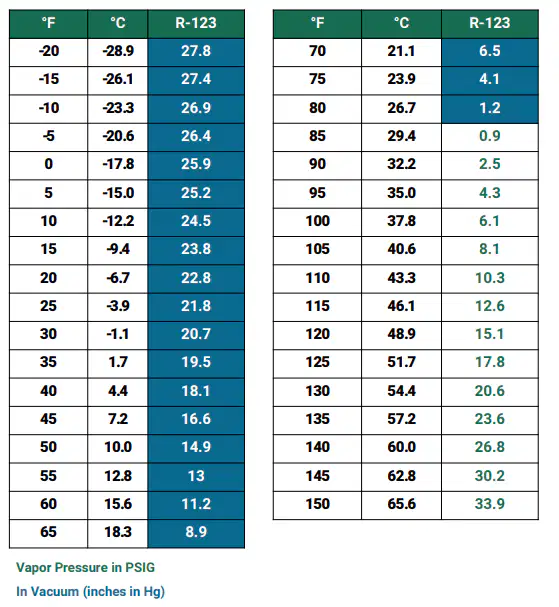
R-123 at a pressure of 13 inches Hg vacuum has a saturation temperature of ________.
A) 25 °F
B) 32 °F
C) 40 °F
D) 55 °F
When evacuating a system and the freezing of moisture in the system is preventing you from achieving a deep vacuum, it may be necessary to prevent freezing by ________.
A) increasing the system pressure with air
B) increasing the system pressure carbon dioxide
C) increasing the system pressure with nitrogen
D) any of the above
To raise the pressure of a low-pressure refrigeration system for leak checking, you can ________.
A) add nitrogen to increase the pressure
B) add a high-pressure refrigerant (trace gas) to increase the pressure and let the purge unit remove it later
C) heat the system by circulating hot water, raising the temperature of the room, or using heating blankets
D) seal the purge unit so the system pressurizes itself
For a commercial refrigeration system with a charge of 50 pounds or more of refrigerant, a substantial (or threshold) leak rate will be reduced to ________ after January 1, 2019.
A) 5%
B) 10%
C) 20%
D) 30%
For a comfort cooling system with a charge of 50 pounds or more of refrigerant, a substantial (or threshold) leak rate will be reduced to ________ after January 1, 2019.
A) 5%
B) 10%
C) 20%
D) 30%
When disposing a system with a normal charge of more than 5 pounds and less than 50 pounds, the disposal record must be kept by the technician for ________.
A) 18 months
B) 3 years
C) 30 months
D) 5 years
The maximum test pressure for leak testing a low-pressure centrifugal chiller is ________.
A) 2000 microns
B) 2500 microns
C) 10 psig
D) 35 psig

