
 Worksheets
Earth and Space Review
Total questions: 33
Worksheet time: 17mins
Name
Class
Date
1.
Our sun is what size, compared to other stars?
a)
medium/average
b)
large
c)
small
d)
very large
2.

Use the diagram to answer this question: What season is it in the Southern Hemisphere?
a)
winter
b)
spring
c)
summer
d)
fall
3.
What causes day and night?
a)
the sun orbiting Earth
b)
the moon orbiting Earth
c)
Earth orbiting the sun
d)
Earth rotating on its axis
4.
How long does it take the Earth to rotate once on its axis?
a)
12 hours
b)
365 days
c)
24 hours
d)
30 days
5.
The planets in the solar system are in constant orbit around the sun. Which force is responsible for maintaining these orbits?
a)
magnetic force
b)
force of friction
c)
gravitational force
d)
electrical force
6.
At which time would you see the longest shadow?
a)
noon
b)
sunrise
c)
3:00 pm
7.
The shortest shadow would occur at...
a)
noon
b)
sunrise
c)
3:00 pm
8.
Why does Earth have seasons?
a)
the Moon orbits Earth
b)
Earth is tilted on its axis and orbits the sun
c)
Earth is rotating on its axis
d)
it is closer or farther from the sun
9.
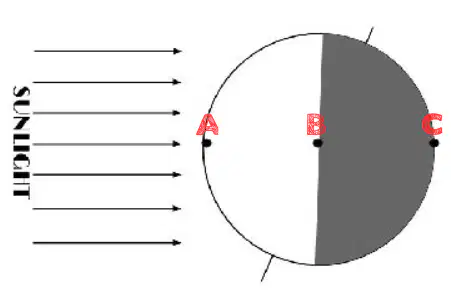
At which point would you be experiencing night?
a)
Circle A
b)
Circle B
c)
Circle C
10.
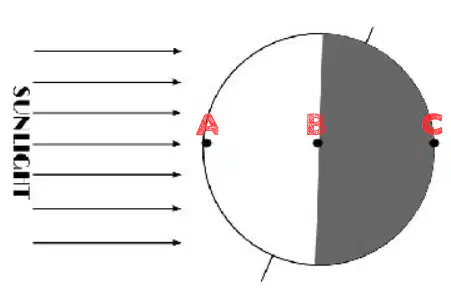
At which point would you be experiencing noon?
a)
Circle A
b)
Circle B
c)
Circle C
11.
The movement of Earth around the Sun is called...
a)
orbit
b)
rotation
c)
axis
d)
equator
12.
When the sky is clear, an observer on Earth can see the star Sirius. From Earth, Sirius appears blue in color but the sun appears yellow. What is another way Sirius is different from the sun?
a)
The sun is inside the solar system, but Sirius is outside it.
b)
The sun is made of very hot gases, but Sirius is made of ice.
c)
The sun produces its own light and heat, but Sirius reflects light.
d)
The sun is at the center of Earth's orbit, but Sirius orbits around the sun.
13.
How long does it take Earth to travel around the Sun?
a)
365 days
b)
12 hours
c)
24 hours
d)
30 days
14.
Polaris does not seem to move as Earth rotates.
a)
True
b)
False
15.
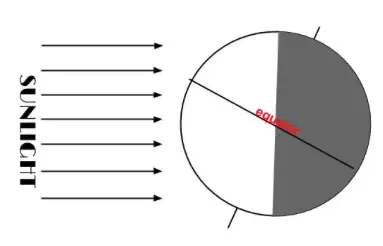
Using the diagram, which season is it in the Northern Hemisphere?
a)
winter
b)
spring
c)
summer
d)
fall
16.
Why do nighttime stars appear so much smaller than the sun?
a)
The sky is much darker at night.
b)
The stars are actually smaller.
c)
The moon blocks out most starlight.
d)
The stars are much farther away.
17.
How many stars are in our solar system?
a)
hundreds
b)
millions
c)
one
d)
thousands
18.
Which of the following correctly describes our sun?
a)
planet
b)
galaxy
c)
star
d)
meteor
19.
Look at the diagrams in each answer. Which diagram correctly shows the orbit of Earth (E) and the moon (M) around the sun (S)?
a)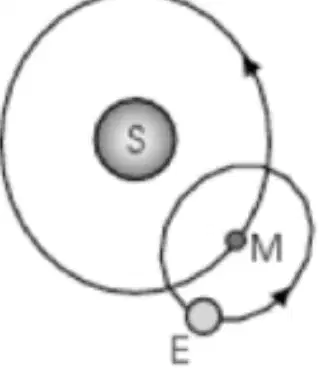
Option 1
b)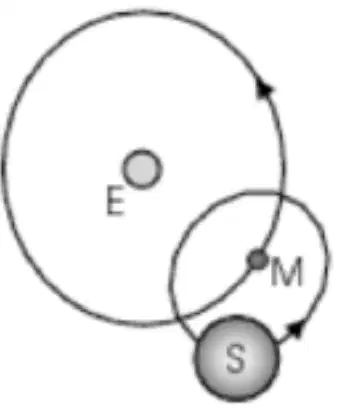
Option 2
c)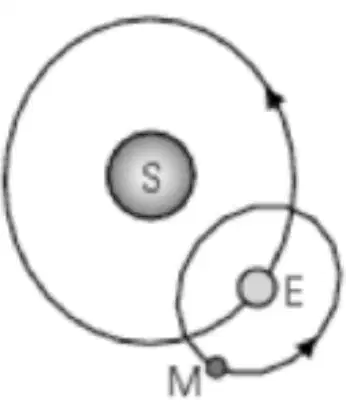
Option 3
d)
Option 4
20.
On the equator, there is...
a)
more daylight than nighttime.
b)
more nighttime than daylight.
c)
different amounts of light in different seasons.
d)
equal amounts of daylight and nighttime.
21.
What is the angle of Earth's tilt?
a)
25.3˚
b)
45.5˚
c)
23.5˚
d)
21˚
22.
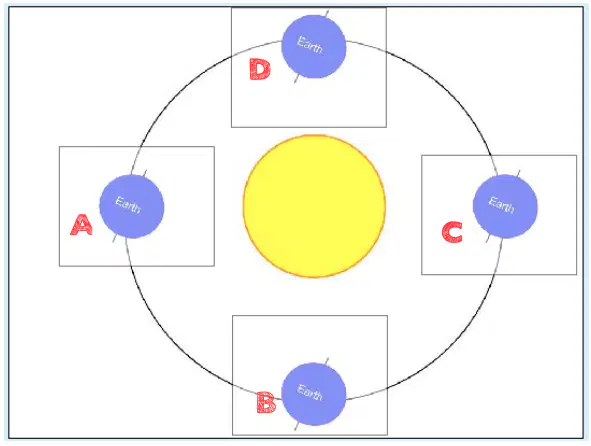
Which season is it in the northern hemisphere at location A?
a)
winter
b)
spring
c)
summer
d)
fall
23.

Which season is it in the northern hemisphere at location C?
a)
winter
b)
spring
c)
summer
d)
fall
24.
What is the largest object in our solar system?
a)
the sun
b)
Earth
c)
the moon
d)
Jupiter
25.
Choose the vocabulary word that matches the definition: a natural object that revolves around planet
a)
moon
b)
axis
c)
solar flare
d)
asteroid
e)
comet
26.
Choose the vocabulary word that matches the definition: a frozen mass of different types of ice and dust orbiting the sun
a)
comet
b)
axis
c)
solar flare
d)
moon
e)
asteroid
27.
Choose the vocabulary word that matches the definition: an imaginary line around which an object spins
a)
axis
b)
solar flare
c)
moon
d)
asteroid
e)
comet
28.
Choose the vocabulary word that matches the definition: an explosive eruption of waves and particles into space
a)
axis
b)
solar flare
c)
moon
d)
constellation
e)
space probe
29.

The diagram shows three celestial objects and the orbital paths of two of the objects. Which table correctly identifies in this diagram?
a)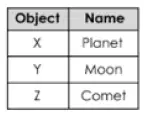
Option 1
b)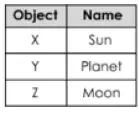
Option 2
c)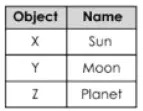
Option 3
d)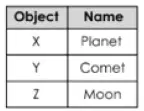
Option 4
30.
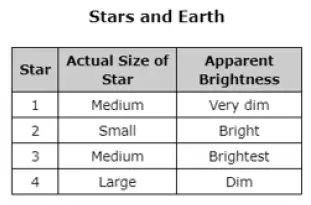
The table shows the actual sizes of four stars and how bright each star appears from Earth. Which star from the table could be the sun?
a)
star 1
b)
star 2
c)
star 3
d)
star 4
31.
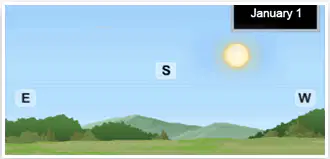
Look at the picture. It is January 1 in the Northern Hemisphere. What time of day would the sun be in this position?
a)
5:30 am
b)
9:45 am
c)
3:35 pm
d)
9:00 pm
32.
Fill in the blank: In the Northern Hemisphere, June 21 has ______________ than December 21.
a)
longer days and more direct sunlight
b)
longer days and less direct sunlight
c)
shorter days and more direct sunlight
d)
shorter days and less direct sunlight
33.
Winter is colder than summer because during the winter ___________________.
a)
Earth's axis is more tilted
b)
daylight hours are fewer and the Sun's rays are less direct
c)
Earth is farther from the Sun
d)
the Sun emits less energy
100 %

