
Font size
 Worksheets
Weather Unit
Total questions: 60
Worksheet time: 1hrs 8mins

Maps of predicted weather conditions are shown.
Which answer choice best describes the weather at location X on Day 1 and Day 2?
Day 1: cold and (a)
Day 2: clear and (b)

cold front
warm front
high pressure
low pressure

cold air moving into an area
warm air moving into an area
humid air over an area
dry air over an area
A weather front is
another name for an air mass
the boundary between two air masses
a climate region

What type of front does this symbol indicate?
Warm Front
Cold Front
Stationary Front
Occluded Front

What type of front does this symbol indicate?
Warm Front
Cold Front
Stationary Front
Occluded Front
What type of front can cause multiple days of rain in an area?
Warm
Cold
Stationary
Occluded
What type of front causes thunderstorms in the summer?
Warm
Cold
Stationary
Occluded
Cold air is more dense than warm air and sinks.
True
False

Select the
correct weather front name for this diagram?
Warm Front
Cold Front
Stationary Front
Occluded Front

Select the type of front that matches the diagram.
Warm Front
Cold Front
Stationary Front
Occluded Front

Select the type of front that matches the diagram.
Warm Front
Cold Front
Stationary Front
Occluded Front
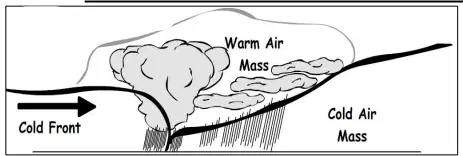
Select the type of front that matches the diagram.
Warm Front
Cold Front
Stationary Front
Occluded Front


a fast-moving warm air mass overtakes a slower cold air mass; the warm air moves over the cold air
cold front
warm front
stationary front
occluded front
sinking air where clouds cannot form
high pressure
warm front
low pressure
cold front
cool, humid air masses form over the icy cold North Atlantic Ocean
Continental Polar
Maritime Polar
Continental Tropical
Maritime Tropical
hot, dry air masses form mostly in summer over dry areas of the southwest and northern Mexico
Continental Polar
Maritime Polar
Continental Tropical
Maritime Tropical
when a faster cold air mass runs into a slower warm air mass; the denser cold air slides under the lighter warm air; warm air pushed up
stationary front
occluded front
warm front
cold front
rising air, which allows clouds to form
high pressure
cold front
low pressure
warm front
large air masses form over Canada and Alaska and can bring bitterly cold weather with low humidity
Continental Polar
Maritime Polar
Continental Tropical
Maritime Tropical

What happens during atmospheric convection?
Cool air circles pockets of warm air.
Warm air circles pockets of cool air.
Warm air rises and cool air sinks.
Cool air rises and warm air sinks

Convection currents from uneven heating of the Earth's surface cause _______.
Fossils
Volcanoes
Mountains
Wind
Which statement correctly defines wind?
The movement of air from areas of low pressure to areas of high pressure
The movement of air to a colder area in the atmosphere.
The movement of air from areas of high pressure to areas of low pressure.
The movement of air pushed around and bouncing off Earth's surface.


Why do mountain climbers often wear masks at high altitudes?
The air is less dense, so there is less oxygen to breathe.
The air pressure is higher, making it harder to breathe.
The temperature is too high, requiring filtered air.
The air contains too much oxygen, which can be harmful.
What type of weather would a continental tropical air mass bring?
Dry and cold weather
Wet and cold weather
Dry and warm weather
Wet and warm weather

In the map above the label L indicates an area of low:
temperature
pressure
altitude
rainfall
The boundary between cold and warm air masses is called a/an
flood
front
climate
storm
High pressure systems are associated with what type of weather?
Associated with cool, wet weather
Associated with cloudy, warm, dry weather
Associated with clear, cool, dry weather
Associated with cloudy, warm, wet weather
The weather map shows isobars very close together (a steep pressure gradient). Which of these is most likely occurring?
strong winds
low visibility
very low temperatures
very dry air
Air Pressure Gradient
a large body of air in the troposphere with similar characteristics of pressure, moisture, and temperature
the amount of difference in air pressure over a specific distance; the greater the pressure gradient, the greater the speed of wind
a weather instrument used to measure wind speed
the weight overlying atmosphere pushing down on a given unit of area
3. The Sun strikes the Earth the most at the Equator and the least at the poles. This causes warm air to ____________ from the equator and cold air to ___________ at the poles.
a. stay, leave
b. leave, stay
c. rise, sink
d. sink, rise
5. What is humidity?
Water, in liquid or solid form, that falls from the atmosphere.
The atmospheric conditions, along with short-term changes, of a certain place at a certain time.
The amount of water vapor in the air.
The force that a column of air applies on the air or a surface below it.
10. What is the source for global winds and convection in the atmosphere?
a. unequal heating of the Earth by the Sun
b. the rotation of Earth
c. the moon’s gravity
d. continental

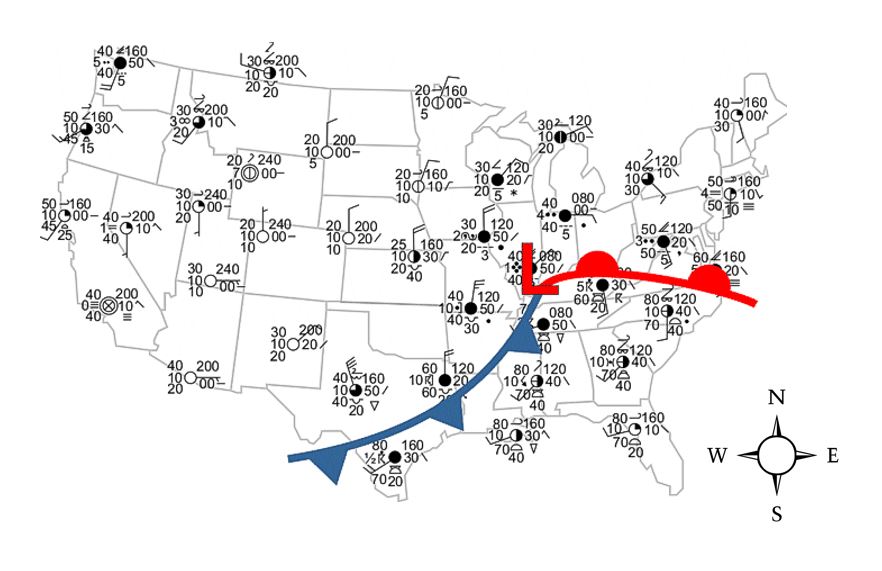
What type of front is over Texas?
warm front
cold front
stationary front
occluded front

Which state will experience thunderstorms today?
Texas
North Dakota
Florida
Kansas

What does the H mean on a weather map
temperature
High air pressure
wind
nothing
What directions do the Blue H move in
inwards
counter clockwise
Clockwise
Outwards

What does the L mean on a weather map?
lower air pressure
high air pressure
lower tempatures
cool map feature
What direction does the red L move in?
Left
Inwards
counter clockwise
outwards


Which city has the LOWEST air pressure?
Atlanta, Georgia
Cheyenne, Wyoming
Lansing, Michigan
Phoenix, Arizona

When air pressure is rapidly falling what does that indicate?
Humidity is increasing
Temperature is decreasing
Skies are clearing up
A storm is approaching

These weather maps show conditions in North Carolina on two days and the table gives weather conditions. Data from the weather maps and the table can be used to conclude that –
air masses usually travel from east to west.
high temperatures can follow a cold front.
a warm front usually follows a cold front.
cold fronts are associated with precipitation and colder temperature.
Air masses are identified on the basis of temperature and A) wind velocity B) type of precipitation C) atmospheric transparency D) moisture content
wind velocity
type of precipitation
pressure
moisture content

Which type of weather front is affecting Texas(TX)? What type of weather should they expect?
Cold front, light rain
cold front, clear sky
warm front, heavy rain
Cold front, thunderstorm with heavy rain

