wayground logo

Free Printable Worksheets

Font size

S
M
L
XL
Worksheets

8th Grade Math Review (RM G8 V1)

Total questions: 150

Worksheet time: 6hrs 16mins

Name
Class
Date
1.
A type of transformation where a figure is “flipped” over a line of symmetry. A reflection produces a mirror image of a figure.
a)
rotation
b)
translation
c)
dilation
d)
reflection
2.
A transformation that “turns” a figure about a fixed point at a given angle and a given direction.
a)
rotation
b)
translation
c)
reflection
d)
dilation
3.
Determine how to translate triangle ABC to triangle A'B'C'. 
a)
right 2, down 5
b)
right 2, down 9
c)
left 2, up 9
d)
left 2, down 9
4.
Which answer shows a reflection across the y-axis?
a)
a
b)
b
c)
c
d)
d
5.
How many degrees was the figure rotated?
a)
90 degrees counterclockwise 
b)
180 degrees
c)
270 counterclockwise 
6.
If the quadrilateral is translated 4 units to the left and 5 units down what is the coordinates for Point A'?
a)
(4,0)
b)
(0,4)
c)
(-1,5)
d)
(5,-1)
7.
Determine where X' would be if you translated X 3 units to the left and 9 units down.
a)
(-4, 4)
b)
(-10, 2)
c)
(-4, -5)
d)
(-1, 5)
8.
Translations, reflections and rotations are all known as ________________________.
a)
Geometry
b)
Transformations
c)
Congruent
9.

What is this picture an example of?

a)

Reflection

b)

Translation

c)

Rotation

d)

Dilation

10.
Point (-5,2) is reflected over the y axis.  Where is the new point located?
a)
(5,2)
b)
(-5,-2)
c)
(-5,2)
d)
(5,-2)
11.
The result of a transformation.
a)
Pre-image
b)
Image
12.
The original figure prior to a transformation.
a)
Pre-image
b)
Image
13.
What direction is the x-axis?
a)
horizontal
b)
vertical
c)
diagonal
d)
straight
14.
A slide is also called a _________.
a)
Translation
b)
Reflection
c)
Rotation
d)
Transformation
15.
Identify the transformation from ABCD to A'B'C'D'.
a)
Translation
b)
Reflection across the y-axis
c)
Reflection across the x-axis
d)
90o counter clockwise Rotation
16.
Is the picture being reflected in the y-axis or x-axis?
a)
y-axis
b)
x-axis
17.

Describe the transformation in the image.

a)

Translation

b)

Reflection

c)

Rotation

18.
Describe the transformation.
a)
translation: right 4 and up 6
b)
reflection across x=-2
c)
translation right 6 and down 1
d)
reflection across y=-2
19.
Describe the transformation.
a)
translation: right 3 and down 2
b)
felfection across y=-x
c)
rotation 180 degrees about the origin
d)
rotation 90 degrees clockwise about the origin
20.

Identify the correct picture which represents a 90o clockwise rotation about the origin.

a)
b)
c)
d)
21.

A dilation is which of the following:

a)

only an enlargement

b)

only a reduction

c)

either an enlargement or a reduction

d)

neither an enlargement nor a reduction

22.

A dilation always produces a congruent figure.

a)

True

b)

False

23.

A dilation always produces a similar figure. Similar figures have the same ______ but different ______.

a)

measure; shapes

b)

sizes; shapes

c)

value; measures

d)

shape; sizes

24.

Did the image enlarge, reduce or none of the above?

a)

Enlarge

b)

Reduce

c)

None of the above

25.

Does the image show a Dilation? If yes, did the image enlarge, reduce or none of the above?

a)

Yes, enlarge

b)

Yes, reduce

c)

No

26.

Under a dilation, which scale factor will result in a congruent image?

a)

-2

b)

0

c)

1

d)

1/2

27.

An image is dilated at a scale factor of 1.5. This means the dilation is an enlargement and the dilated image will be bigger.

a)

True

b)

False

28.

State the coordinate of the image of the given point B (4,9) under a dilation with center at the origin with the given scale factor of 2.

a)

B' (2 , 4.5)

b)

B' (-8 ,-18)

c)

B' (8 ,18)

d)

B' (9 ,4)

29.

Dilate the figure by a scale factor of 3 with the origin as the center of dilation. What are the coordinates of the image?

A(3,3) B(6,6) C(9,3)

a)

A'(9,9) B'(18,18) C'(27,9)

b)

A'(6,6) B'(9,9) C'(12,6)

c)

A'(0,0) B'(3,3) C'(6,0)

d)

A'(1,1) B'(2,2) C'(3,1)

30.
Find the measure of the angle indicated. 
a)
139°
b)
66°
c)
138°
d)
116°
31.
a)
100°
b)
80°
c)
90°
d)
180°
32.
What are complementary angles?
a)
Angles that add up to 180°
b)
Angles that add up to 90°
c)
Angles that are equal to each other
d)
Angles that are opposite of each other when lines intersect.
33.
What are supplementary angles?
a)
Angles that add up to 180°
b)
Angles that add up to 90°
c)
Angles that are equal to each other
d)
Angles that are opposite of each other when lines intersect
34.
What are vertical angles?
a)
Angles that are adjacent to each other
b)
Angles that add up to 180°
c)
Angles that are opposite of each other when lines intersect
d)
Angles that add up to 90°
35.
If angle ∠ABD is 67°. What is ∠DBC?
a)
180°
b)
90°
c)
67°
d)
23°
36.
Which are pairs of vertical angles?
a)
∠COB & ∠COA
b)
∠AOD & ∠AOC
c)
∠COB & ∠AOD
d)
∠BOD & ∠AOD
37.
If ∠COB is 124°, then what is ∠BOD? How are they related?
a)
56°, they are supplementary
b)
90°, they are complementary
c)
124°, they are vertical
38.
Find the value of x
a)
-5
b)
28
c)
19
d)
-3
39.
Vertical angles are always
a)
acute
b)
total 180 degrees
c)
congruent (equal measures)
d)
adjacent angles
40.
Name the relationship: complementary, linear pair, vertical, or adjacent
a)
A
b)
B
c)
C
d)
D
41.

Is the scenario proportional or non-proportional?

a)

Proportional

b)

Non-Proportional

42.

Is the scenario proportional or non-proportional?

a)

Proportional

b)

Non-Proportional

43.

Is the scenario proportional or non-proportional?

a)

Proportional

b)

Non-Proportional

44.

Is the scenario proportional or non-proportional?

a)

Proportional

b)

Non-Proportional

45.

Is the rule proportional or non-proportional?

a)

Proportional

b)

Non-Proportional

46.

Is the rule proportional or non-proportional?

a)

Proportional

b)

Non-Proportional

47.

Is the rule proportional or non-proportional?

a)

Proportional

b)

Non-Proportional

48.

Is the rule proportional or non-proportional?

a)

Proportional

b)

Non-Proportional

49.

Is the table proportional or non-proportional?

a)

Proportional

b)

Non-Proportional

50.

Is the table proportional or non-proportional?

a)

Proportional

b)

Non-Proportional

51.

Is the table proportional or non-proportional?

a)

Proportional

b)

Non-Proportional

52.

Is the table proportional or non-proportional?

a)

Proportional

b)

Non-Proportional

53.

Is the graph proportional or non-proportional?

a)

Proportional

b)

Non-Proportional

54.

Is the graph proportional or non-proportional?

a)

Proportional

b)

Non-Proportional

55.

Is the graph proportional or non-proportional?

a)

Proportional

b)

Non-Proportional

56.

Is the graph proportional or non-proportional?

a)

Proportional

b)

Non-Proportional

57.

What does "m" represent in y=mx+b?

a)

y-intercept

b)

slope

c)

unit rate

d)

distance

58.

What does "b" represent in y=mx+b?

a)

slope

b)

unit rate

c)

y-intercept

d)

distance

59.

Using the slope intercept form what is the equation of the line: m= 4

y-intercept= (0,6)

4 lines
60.

Using the slope intercept form what is the equation of the line: m= 1/4

y-intercept= (0,-2)

4 lines
61.

What is the slope in y=3x+7

a)

7

b)

3

62.

What is the equation of a line when m = -7 and b = -8?

a)

y = -7x + 8

b)

y = -7x - 8

c)

y = 7x - 8

d)

y = 7x + 8

63.

What is the equation of a line with a slope of 2 and a y-intercept of -5?

a)

y = 5x - 2

b)

y = 2x - 5

c)

y = -2x - 5

d)

y = 2x + 5

64.

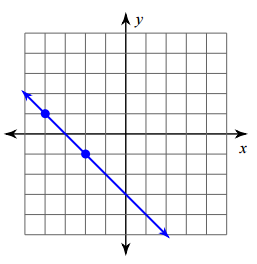
Find the slope of the line.

a)

-2

b)

2

c)

-1

d)

1

65.

Find the slope:

a)

3/4

b)

4/3

c)

-3/4

d)

-4/3

66.

Find the slope:

a)

3/4

b)

4/3

c)

-3/4

d)

-4/3

67.

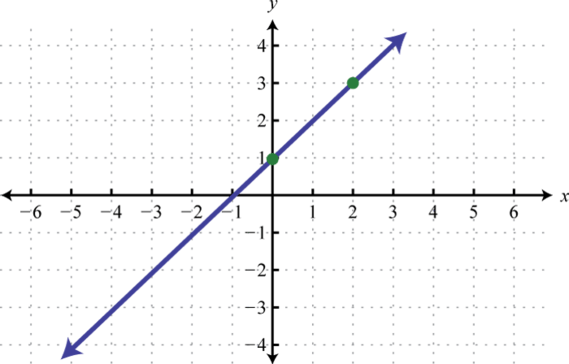
What is the y-intercept of the line graphed below?

a)

3

b)

4

c)

-3

d)

4/3

68.

What is the y-intercept of this graph?

a)

(0,1)

b)

(0,-2)

c)

(0,0)

d)

(0,3)

69.

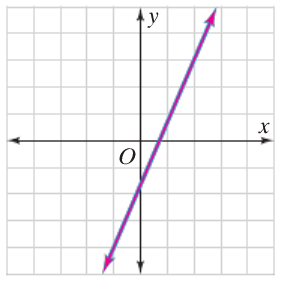
What is the equation of this line?

a)

y = 2x +2

b)

y = 2x -2

c)

y = -x + 2

d)

Cannot be Determined

70.

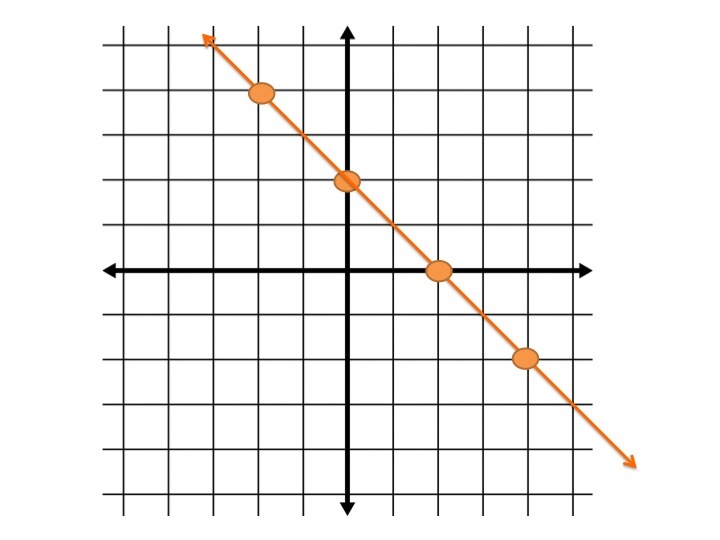
Write the equation of the line.

a)

y= -1x-3

b)

y= -3x-1

c)

y=-1/3x-1

d)

y= -3x-3

71.

Write the equation for the line in slope-intercept form.

a)

y= -1x+3

b)

y= 4x+3

c)

y=1/4x+3

d)

y= -4x+3

72.
x + 4 = -3
a)
-1
b)
4
c)
-7
d)
8
73.
5 = f - 2
a)
4
b)
7
c)
-3
d)
2
74.
35 = y - 3
a)
-38
b)
-4
c)
32
d)
38
75.
w - 4 = 18
a)
22
b)
14
c)
-14
d)
-22
76.
3x + 7
The variable is:
a)
7
b)
3
c)
x
d)
-4
77.
-5y + 8
The coefficient of the variable is 
a)
y
b)
8
c)
-5
d)
2
78.
6 x = -30
x=
a)
2
b)
7
c)
-5
d)
5
79.
Distribute to simplify -3( x + 7)=
a)
5x + 9
b)
-3x + 21
c)
-3x - 21
d)
3x+ 21
80.
-4x = -36
x=
a)
4
b)
5
c)
-9
d)
9
81.
m/5 = -3
m divided by 5 is equal to negative three
m= 
a)
-5
b)
2
c)
-15
d)
-3
82.
-10k = 50
k =
a)
-500
b)
-5
c)
-7
d)
3
83.

Warm-up: 


Solve the equation: 4x9=7x 4x-9=7x\  


(a)  

84.

What is the first step to solve this equation:

11 - 3x = 44

a)

Add 3 to both sides

b)

Subtract 11 from both sides

c)

Add 11 to both sides

d)

Divide 3 on both sides.

85.

What is the first step to solve this equation:

10 + 7x = 44 -2x

a)

Add 2x to both sides

b)

Subtract 2x from both sides

c)

Add 10 to both sides

d)

Divide 7 on both sides.

86.

7x = 4x + 33

(a)  

87.

8w - 8 = -4w + 16

(a)  

88.

-5k + 10 = -2k - 14

a)

k = 8

b)

k = -8

c)

k = 2

d)

k = -2

89.
Solve for f:
f - 4 = 6f + 26
a)
f = -5
b)
f = 5
c)
f = 6
d)
f = -6
90.
Solve for x:
5x - 14 = 8x + 4
a)
x = 6
b)
x = -6
c)
x = -18/13
d)
x = 10/3
91.

Solve the equation

12x - 15 = 3(2x+3)

(a)  

92.
Solve:
5y+34 = -2(-7y+1)
a)
y = -4
b)
y = 9
c)
y = 4
d)
y = 36/19
93.

7x3=7x+57x-3=7x+5  

a)

No Solution

b)

Infinite Solutions

c)

x=2x=2  

d)

x=8x=8  

94.

5x + 6 = 2 + 3x

a)

one solution x = -2

b)

no solutions

c)

infinite solutions

d)

one solution x = 2

95.

6x+5=8+4x+2x6x+5=8+4x+2x  

a)

No Solution

b)

Infinite Solutions

c)

x=3x=3  

d)

x=13x=13  

96.
3x + 15 = 3(x + 5)
a)
No Solution
b)
x = 15
c)
Infinitely Many Solutions
97.

6x - 8x + 5 = -2(x + 2) + 7

a)

One solution

b)

No solution

c)

Infinitely Many

98.

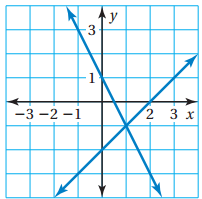
What is the solution for x given the graph to the systems of equations

(a)  

99.

What is the solution to the systems of equations shown in the graph?

a)

1 Solution x=-1/2

b)

1 Solution y=-1/2

c)

Many Solutions

d)

No Solution

100.

What is the solution for y based on the system:

(a)  

101.

Find the answer using substitution: Please list your answer as a coordinate (x,y)

(a)  

102.

Find the answer to the systems using substitution: List the solution as a coordinate (x,y):

(a)  

103.

Solve the given systems of equations using elimination: Write you answer as a coordinate (x,y).

(a)  

104.

Find the answer to the systems using elimination: List the answer as a coordinate (x,y):

(a)  

105.

Solve the systems with any method you choose: Check all that apply:

a)

x= -5/2

b)

y=-5/2

c)

No Solutions

d)

Infinitely Many Solutions

e)

x=0

106.

Solve the systems with any method you choose: Check all that apply:

a)

x= -5/2

b)

y=-5/2

c)

No Solutions

d)

Infinitely Many Solutions

e)

x=0

107.
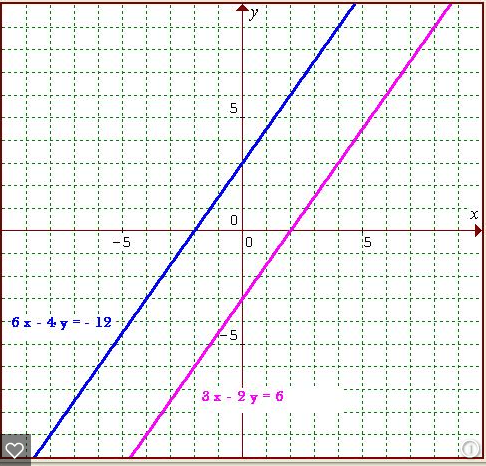
What is the solution?
(Hint:  Both lines are graphed over each other)
a)
One Solution
b)
No solution
c)
Infinitely Many Solutions
108.
This system has _____ solutions
a)
no
b)
1
c)
2
d)
Infinitely many
109.
What is the solution? 
a)
1
b)
-2
c)
(1, 2)
d)
(1, -1)
110.
Is this a function?
a)
Function
b)
Not a Function
111.
Is this a function?
a)
Function
b)
Not a Function
112.
Is this a function? Explain.
a)
Yes; each x-value has one corresponding y-value.
b)
No; it is not a straight line.
c)
Yes; it passes the vertical line test.
d)
No; there is a line connecting the dots.
113.
Is this mapping a function or not a function? 
a)
Function
b)
Not a Function 
114.
Is this mapping a function or not a function? 
a)
Function
b)
Not a Function
115.
Is this set of ordered pairs a function or not a function? 
a)
Function
b)
Not a Function 
116.
Is this set of ordered pairs a function or not a function? 
a)
Function
b)
Not a Function 
117.
A relation where every input in matches with exactly one output is called what?
a)
Relation
b)
Linear
c)
Exponential
d)
Function
118.
All of the y values or outputs are called what?
a)
Domain
b)
Range
c)
Relation
d)
Function
119.
Is the relation a function? Why.
a)
Yes, because the x-value 11 has two y-values pair with it.
b)
Yes, because each x-value has only one y-value paired with it.
c)
No, because the x-value 11 has two y-values pair with it.
d)
No, because each x-value has only one y-value paired with it.
120.
* answer choices will be out of order * (click on the picture to make it bigger)
a)
A
b)
B
c)
C
d)
D
121.
What is the domain of this function?
a)
D=[-1,3)
b)
D= [-2,8)
c)
D= {-1, 0 , 1 , 2, 3}
d)
D=(2,0)U(0,2)U(2,4)U(4,6)U(6,8)
122.
* answer choices will be out of order * (click on the picture to make it bigger)
a)
A
b)
B
c)
C
d)
D
123.
Which of the following describes a function?
a)
Has repeating x-values
b)
Doesn't pass vertical line test
c)
Each x-value has exactly one corresponding y-value
d)
Multiple x-values to one y-value
124.
Does the graph represent a function?
a)
Yes, because the vertical line test shows there are no repeating input values
b)
No, because the vertical line test shows there are repeating input values
125.
What is the range of the following graph?
a)
all real numbers
b)
all integers
c)
any real number greater than zero
d)
it can not be determined
126.
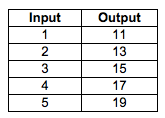
Find the rate of change
a)
1
b)
2
c)
11
d)
Not a constant slope/Non-Linear
127.
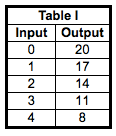
Find the rate of change
a)
3
b)
-3
c)
20
d)
Not a constant slope/Non-Linear
128.
What is the initial value in this equation?
y=8x+6
a)
8
b)
6
129.
What is the rate of change in the equation?
y=8x+6
a)
8
b)
6
130.
Tim bought a new phone.  He paid $125 on the day of purchase, then $50 per month until it was paid off. What is the initial value in this situation?
a)
50
b)
125
131.
Tim bought a new phone.  He paid $125 on the day of purchase, then $50 per month until it was paid off. What is the rate of change in this situation?
a)
50
b)
125
132.

Which function has the GREATEST rate of change?

a)
b)
c)
d)
133.

Which function has the GREATEST initial value?

a)
b)
c)
d)
134.

Which function has the GREATEST initial value?

a)
b)
c)
d)
135.

What is a possible scenario for the given table?

a)

You have $8 and get $5 more each day!

b)

You have $16 and get $2 more each day!

c)

You have $2 and get $6 more each day!

d)

You have $6 and get $2 more each day!

136.

Choose the correct table. You have $30 and each day you spend $3.50 on lunch.

a)
b)
c)
137.

What has the GREATER rate of change. y = 5x +15 OR the graph

a)

y = 5x + 15

b)
138.

What has the GREATER rate of change.

a)

y = 7x + 10

b)

Someone who starts with $6 and gets $8 each day.

c)

y = 5x + 20

d)

Someone who starts with $8 and gets $6 each day.

139.

What has the greater rate of change?

a)
b)

y = 19x +39

140.

What is the greater rate of change.

a)
b)
c)

If you start with 60 points and get 1 point per assignment.

d)

y = 1x + 50

e)

They're all the same!

141.

What is the greater initial value?

a)
b)
c)

If you start with 60 points and get 1 point per assignment.

d)

y = 1x + 50

e)

They're all the same!

142.

Graphs that go in a straight line are considered to be (a)   .

143.

Graphs can only do a few things. What are they?

a)

Increase

b)

Decrease

144.

The intervals the graph is increasing is at

a)

When x is between 0 and 2

b)

When x is between 4 and 5

c)

When x is between 5 and 6

d)

When x is between 0 and 6

145.

The intervals the graph is decreasing is at

a)

When x is between 0 and 2

b)

When x is between 4 and 5

c)

When x is between 6 and 10

d)

When x is between 0 and 6

146.

The intervals the graph is constant at

a)

When x is between 0 and 2

b)

When x is between 4 and 5

c)

When x is between 6 and 10

d)

When x is between 2 and 4

147.

The graph is linear

a)

Everywhere; [0,10]

b)

In 3 spots; [0,2], [4,5], [5,6]

c)

In 2 spots; [0,2], [5,6]

d)

In one spot; [6,10]

148.

The graph is nonlinear

a)

[0,10]

b)

[0,2], [4,5], [5,6]

c)

[0,2], [5,6]

d)

[6,10]

149.

Select all that apply to the image.

a)

The function is linear and increasing between days 0 and 9.

b)

The function is linear and decreasing between days 9 and 14.

c)

The function is nonlinear between days 0 and 6.

d)

The function is neither increasing nor decreasing between days 0 and 6.

e)

The function decreases for more days than it increases.

150.

Which description is best represented by the graph?

a)

Adan added the same amount of money to his savings account for 6 days. Then, for the next 3 days, he increased how much he added to the account each day. Lastly, he decreased the amount of money he added to his account each day.

b)

Adan started with about $55 dollars in his savings account. He didn’t add anything to it for 6 days. Then he got some birthday money and added money to his savings account over 3 days, after which he started to take money out of his account to make purchases