
 Worksheets
Haircolor Quiz
Total questions: 70
Worksheet time: 37mins
What product is a combination of equal parts of permanent color mixture and shampoo used the last 5 minutes of service?
color filler
hair pre softener
soap cap
shampoo tint
What is an example of natural or vegetable hair color obtained from the leaves or bark of plants?
Henna
tint
toner
demipermanent color
A _______ is an oxidizing agent that, when mixed with an oxidation hair color, supplies the necessary oxygen gas to develop color molecules and create a change in hair color.
activator
accelerator
prohibitor
developer
What is the most commonly used developer in haircolor?
peroxide
hydrogen peroxide
water
chlorine
The measure of potential oxidation of varying strengths of hydrogen peroxide is
density
value
volume
percentage
Chemical compounds that lighten hair by dispersing, dissolving, and decolorizing the natural hair pigment
dispersers
dissolvers
decolorizers
lighteners
The system used by colorists to analyze the lightness or darkness of a hair color is _____.
the color wheel
the level system
melanin distribution
the primary color system
All haircoloring products require a patch test, with the exception of _____.
semipermanent colors
temporary colors
permanent colors
demipermanent colors
Demipermanent colors are also known as _____.
temporary colors
no-lift, deposit-only colors
formulated colors
tonal colors
Dye precursors that combine with hydrogen peroxide to form larger, permanent dye molecules are called _____.
aniline derivatives
base colors
primary colors
demipermanent colors
Clients with hair in questionable condition who request chemical services should be required to sign a _____.
release statement
record card
color card
receipt
You should NEVER apply hair color to a client if the scalp has any obvious signs of _____.
dandruff
demarcations
abrasions
fading
The technique of coloring strands of hair darker than the natural color is _____.
lowlighting
accelerating
highlighting
baliage
A patch test is generally conducted behind the ear or _____.
On the inner forearm
on the neck
on the inner wrist
inside the elbow

The method used to analyze the lightness or darkness of a hair color, whether natural or artificial, is called ___________
the law of color
the level system
the color wheel
primary color system

What system is used to understand the relationship among colors?
the law of color
the level system
the color wheel
the modular patch

The pure or fundamental colors (red, yellow, and blue) are...
primary
neutral
dominant
main

Colors that are predominantly blue are called _____________
warm
cool
neutral
primary

Colors with a predominance of red are ___________
warm
cool
neutral
primary

Colors achieved by mixing equal parts of two primary colors are _____________
tertiary
secondary
primary
neutral
Equal parts of blue and yellow create
blue-green
green
bluish
violet
Equal parts of red and yellow create ____________
brown
green
blue
orange
Equal parts of red and blue create ____________
black
violet
green
orange
Mixing a secondary color with its neighboring primary color on the color wheel, in equal parts, creates _____________-
Neutral
complimentary
tertiary
secondary compliment

Primary and secondary colors positioned opposite each other are _______________
neutral
complimentary
contradictory
opposite

Which of the following describes the warmth or coolness of a color?
mixed melanin
contributing pigment
tone
value or depth
The strength of a color is referred to as ___________
level
value
depth
intensity
Hair coloring products fall into four categories: temporary, semipermanent _________ and _________
permanent and perpetual
permanent and demipermanent
demipermanent and perpetual
vegetable and demipermanent
What is used to raise the cuticle of the hair so tint can penetrate to the cortex?
Hair conditioner
color filler
alkalizing agent
medicated shampoo
Which type of hair color product uses the largest pigment molecules?
permanent
temporary
demipermanent
semipermanent
Colored mousses and gels are referred to as _____________
permanent
semipermanent
demipermanent
temporary
The hair color that partially penetrates the hair shaft and stains the cuticle layer, slowly fading with each shampoo, is known as _____________
permanent
semipermanent
demipermanent
temporary
Hair color that is ideal for covering unpigmented hair, refreshing faded color, depositing tonal changes without lifting, and correcting color is _______________
permanent
demipermanent
temporary
semipermanent
Hair color that remains in the hair shaft and cannot be easily shampooed out is called _________________
permanent
demipermanent
semipermanent
temporary
The tint formula in permanent hair color contains uncolored dye _____________, or aniline derivatives, which are small compounds that can diffuse in the hair shaft.
successors
precursors
activators
developers
The level system helps to identify how light or dark natural hair color is. What are the levels?
1 - 14
1 - 10
0 - 12
1 - 12

What makes gray hair?
It is caused by a change in the skin.
Grey hair is a myth.
Too much pigment is produced.
Loss of pigment in the follicle.
What is the definition of The Law of Color?
A system for understanding color relationships.
It is the color wheel.
It is a system for understanding how light or dark hair is.
It determines underlining pigment.
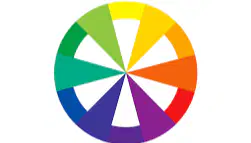
When one part primary is mixed with one part a neighboring secondary you get?
Tertiary colors
Complementary colors
Intensified colors
A color with hue
Pick the color wheel that shows complementary colors.


Hair color has two main types that they fall into. One type needs a component to activate the color, the other type does not. What do we call these types?
Demi and permanent
Permanent and oxidative
Non oxidative and semi
Oxidative and non oxidative
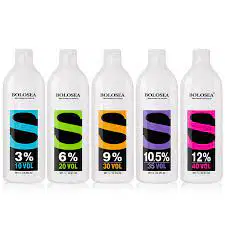
Permanent and demi color need this product for the color to work. What is the product called?
Developer
Hydrogen
Processor
Levels
Two types of color do not use hydrogen peroxide to make the color work. What are those two colors called?
Demi permanent
Semi permanent
Temporary
Permanent
Semi permanent hair color is a non-oxidative hair color, what does that mean? Click all that apply
Depending on how porous the hair is, is how long it will last in the hair.
It needs developer to work.
It has no lifting power.
The color is a deposit color.

Which picture shows where semi permanent color sits in the hair?
1.
2.
3.
4 and 5

One is temporary color and the other is demi color. Pick which one is the demi color.
Left
Right
Demi colors do not use ammonia as an alkalizing agent, so that means the level of developer is.....
Very high
20 volume
40 Volume
20 Volume or lower
Permanent color can do two process at once. What are those two processes?
Deposit and shine
Lighten and deposit
Lighten and gloss
Gloss and shine
Permanent hair color uses ammonia as an alkalizing agent, this means that the color can do what?
Cause no damage
Lighten previously colored hair
Lighten natural color
Does not need developer

One is semi permanent and one is permanent color. Which side is permanent color?
Right
Left
This is a dye precursor, it is a small molecule that moves the undeveloped color pigment into the cortex. What is this molecule called?
Aniline derivatives
Oxidizer
Hydrogen peroxide
Non-oxidative
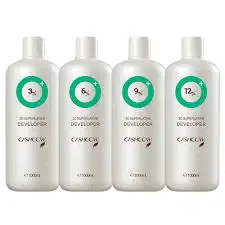
The main ingredient in developer is what?
Aniline derivative
Permanent color
Metallic salt
Hydrogen peroxide

Volume describes the what of the developer?
Concentration
Type of hydrogen peroxide
Strength and amount of aniline
Concentration and strength

Each developer has lifting power. When mixed with color what is 20 volume used for? Click all that apply
Three levels of lift
Two levels of lift
One level of lift
Grey coverage

What is 10 volume used for? Click all that apply
Color deposit
One level of lift
Grey coverage
Two levels of lift
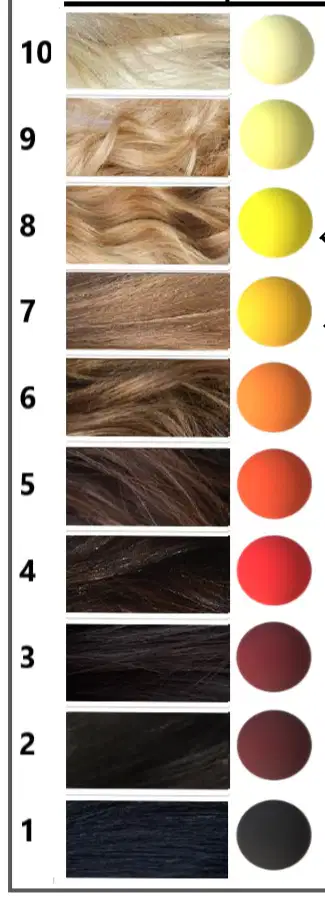
What is this?
Level Chart only
Level and underlying pigment chart
Level and color chart
Underlying pigment chart only
The hair can go through how many levels of lift?
8
4
10
11

Is it safe to process hair beyond the pale yellow stage?
Yes, the hair can take anything
No, the hair could explode
No, the hair may fall a part
Yes, you can then charge for extra treatments

This step is the most critical step in any color service. What is it?
Mixing the color
Draping the client
Greeting the client
A through consultation with the client
Pick out the questions that are part of a color consultation. Click all that apply
Have you had any previous chemical services?
What are you using at home to take care of your hair?
Do you have well water?
What type of lighting are you in most of the day?

What is happening in this picture?
A picture filter
A reaction to hair color
A MRSA infection
An eczema flare

How could this have been prevented?
Doing a patch test 48-72 hours before color application.
Doing a patch test 6 hours before color application.
Doing a patch test 12-24 hours before color application.
Doing a patch test 24-48 hours before color application.
When doing a patch test, what two areas are used to apply the color too?
Behind the ear and under the arm
Inside elbow and behind the ear
Inside elbow and jaw line
Behind the ear and inside the knee

What is happening in this picture?
A highlight service
A patch test
A preliminary strand test
A block color application

What does this stand tell us about the clients hair?
More than one answer may be correct. Click all that apply
It would be unable to take a lightening service.
The hair is in a very porous state.
The hair will be fine to lighten.
The hair be able to take any color service.
Which one of these are safe to perform a color service on?


When mixing color you should do the following.
Mix up the color according to directions.
Mix different color lines together.
How ever you like, doesn't matter.
With out gloves.
Pick out the correct retouch application.


When formulating color any thing above this many levels is a lightener application.
8
5
10
4
When doing a color correction going darker, what needs to be done before putting on your target color?
A porosity filler.
A color filler.
A color remover.
A moisturizing treatment.

