
 Worksheets
BIOLOGY: Cell Structure
Total questions: 20
Worksheet time: 12mins
What is the basic unit of life?
atom
molecule
organism
cell
Name the organelle known as the 'powerhouse' of the cell.
ribosomes
mitochondria
nucleus
endoplasmic reticulum
What is the function of the cell membrane?
Regulates what enters and exits the cell, provides protection and support, and allows for cell communication.
Stores energy for the cell
Regulates body temperature
Produces proteins for the cell
What are the three main parts of a cell?
chloroplast, Golgi apparatus, endoplasmic reticulum
cell wall, mitochondria, vacuole
cell membrane, cytoplasm, nucleus
ribosome, lysosome, centriole
What is the function of the nucleus in a cell?
Control center of the cell
Energy production
Waste storage
Cell movement
What is the difference between plant and animal cells?
Cell wall and chloroplasts
Cell membrane and cytoplasm
Vacuole and endoplasmic reticulum
Nucleus and mitochondria
Explain the role of ribosomes in a cell.
Ribosomes regulate cell division in a cell.
Ribosomes store genetic information in a cell.
Ribosomes synthesize proteins in a cell.
Ribosomes produce energy in a cell.
What is the function of the endoplasmic reticulum?
Protein and lipid synthesis, and transportation of molecules within the cell
Cell division and replication
Energy production and storage
Waste elimination and excretion
Describe the structure and function of the mitochondria.
The mitochondria is a single-membrane-bound organelle responsible for producing glucose through photosynthesis.
The mitochondria is a double-membrane-bound organelle responsible for producing energy in the form of ATP through cellular respiration.
The mitochondria is a storage organelle responsible for storing water and nutrients.
The mitochondria is a type of ribosome responsible for protein synthesis.
What is the importance of the Golgi apparatus in a cell?
Regulates cell metabolism
Stores genetic information
Helps in cell movement and locomotion
Plays a role in processing, packaging, and distributing proteins and lipids

The diagram shows the structures visible in a plant cell when it is examined under an electron microscope.
Identify the parts labelled A to J.
(a)
What does it mean to be selectively permeable?
Allows some, but not all molecules to cross
Allows all molecules to cross but still regulates how much goes through
It chooses what day it has a certain hairstyle
Rarely allows molecules to cross without the help of channel proteins

Which structures do plant cells have that animal cells do NOT have?
cell wall
large central vacuole
chloroplasts
all of these
What are the two types of cells?
Prokaryotic and Eukaryotic
Protons and Neutrons
Membranes and Bacteria
All living things are made of _________.
Air
Cells
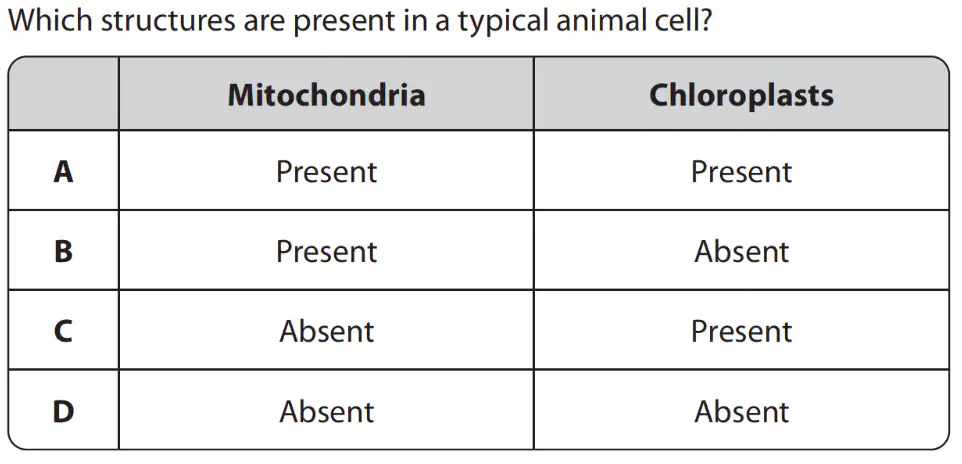
A
B
C
D

A
B
C
D

