
 Worksheets
PRACTICE TEST: Quarter 3 (Potential E, Newtons Laws & Ref Point)
Total questions: 87
Worksheet time: 1hrs 2mins
What is a reference point in relation to the position of an object?
The ending point of an object's position
The starting point to describe the location of an object
The midpoint of an object's position
The highest point of an object's position
How is an object's position determined in 2 dimensions?
By observing the color of the object
By choosing a reference point and specifying directions
By measuring the weight of the object
By counting the number of objects around it
What is displacement in relation to motion?
The process of changing position
The total distance an object travels in a given amount of time
The difference between the initial and final position of an object
The speed and direction of a moving object
How is speed measured?
By counting the number of steps taken by the object
By measuring the temperature of the object
By observing the shape of the object
By calculating the total distance traveled divided by the total time taken
What is velocity in relation to motion?
The difference between the initial and final position of an object
The speed and direction of a moving object
The process of changing position
The total distance an object travels in a given amount of time
What does a graph show in relation to motion?
The color of the object
The shape of the object
How an object's position changes during each time interval
The weight of the object
What is the formula for average speed?
Total distance traveled divided by the total time taken
Total distance traveled multiplied by the total time taken
Total time taken divided by the total distance traveled
Total time taken multiplied by the total distance traveled

After completing one trip on a roller coaster, the roller coaster's ________ is zero.
displacement
reference point
length
distance
The starting point you choose to describe the location, or position of an object
Reference Point
Distance
Displacement
Position
An object's distance in a certain direction from a reference point
reference point
distance
displacement
position
Motion is:
the starting point you choose to describe the location, or position of an object
an object's distance in a certain direction from a reference point
the process of changing position
how far an object moves


Segment D-E The bus is _________________.
at rest
returning (to original position)
moving forward
Segment E-F The bus is _________________.
at rest
returning (to original position)
moving forward
What is the speed and direction of an object referred to as?
Force
Velocity
Acceleration
Magnitude
What is the SI unit for acceleration?
meters per second
newtons
meters per second squared
kilograms
What is a force described as?
A change in mass
A change in direction
A change in speed
A push or pull that can change velocity and direction
What does Newton's Second Law of Motion state?
The acceleration of an object equals the net force acting on the object multiplied by the object's speed
The acceleration of an object equals the net force acting on the object divided by the object's speed
The acceleration of an object equals the net force acting on the object divided by the object's mass
The acceleration of an object equals the net force acting on the object multiplied by the object's mass
What is friction?
A force that increases the sliding motion of two surfaces
A force that decreases the sliding motion of two surfaces
A force that has no effect on the sliding motion of two surfaces
A force that changes the direction of two surfaces
What is a free-body diagram used for?
To understand systems of objects with any amount of applied forces
To understand systems of objects with only one applied force
To understand systems of objects with no applied forces
To understand systems of objects with balanced forces
What is the sum of all the forces acting on an object called?
Contact force
Balanced force
Frictional force
Net force
What does Newton's first law of motion state?
An object in motion will stop moving, and an object at rest will start moving without any force
An object in motion will stay in motion, and an object at rest will stay at rest unless acted upon by a force
An object in motion will change direction, and an object at rest will start moving in the opposite direction
An object in motion will change speed, and an object at rest will start moving at a constant speed
What are balanced forces?
Forces that have no effect on the motion of an object
Forces that increase the motion of an object
Forces that decrease the motion of an object
Forces that cancel each other out
What are unbalanced forces?
Forces that cancel each other out
Forces that decrease the motion of an object
Forces that have no effect on the motion of an object
Forces that increase the motion of an object
What is the formula for acceleration?
a = F/m
a = F - m
a = F + m
a = F * m
What is the reason for an object's motion to change according to Newton's Second Law of Motion?
The magnitude of the object and the direction of the object
The contact force acting upon the object and the friction of the object
The speed of the object and the direction of the object
The net force acting upon the object and the mass of the object
What is the effect of friction on the motion of an object?
Friction increases the sliding motion of two surfaces
Friction has no effect on the sliding motion of two surfaces
Friction decreases the sliding motion of two surfaces
Friction changes the direction of two surfaces
How do multiple forces change the motion of an object according to a free-body diagram?
Add the forces in opposite directions
Divide the forces in opposite directions
Subtract the forces in opposite directions
Multiply the forces in opposite directions
What happens when an object is pulled or pushed according to the CER?
The motion of the object remains constant
The motion of the object changes
The direction of the object changes
The mass of the object changes

When two forces act in the same direction, how would you calculate the net force?
Subtract the forces
Balance the forces
Add the forces
Divide the forces

Calculate the net force for the diagram.
800 N down unbalanced
600N down balanced
400 N down unbalanced
400 N up unbalanced

What is the Net Force and the direction of the object's movement as a result of the net force?
9N, Right
9N, Left
3N, Right
3N, Left

What is the Net Force and the direction of the object's movement as a result of the net force?
5N, Right
5N, Left
9N, Right
9N, Left

What is the Net Force and the direction of the object's movement as a result of the net force?
11N, Right
11N, Left
1N, Left
1N, Right
What is Newton's 3rd Law of Motion?
An object at rest will stay at rest unless acted upon by an external force
Objects in motion tend to stay in motion
For every action, there is an equal and opposite reaction
Force is equal to mass times acceleration
How is Newton's 3rd Law modeled?
By drawing a free body diagram
By analyzing the motion of celestial bodies
By conducting experiments in a laboratory
Through the use of mathematical equations
What are force pairs?
Forces that act on the same object
Forces that are always unbalanced
Forces that depend on each other
Forces that two objects apply to each other
What is a normal force?
The force that pushes in the opposite direction of the object's motion
The force that pushes in the same direction as the object's motion
The force that pushes parallel to the object's surface
The force that pushes perpendicular to the object's surface
How does Newton's 3rd Law explain collision of objects?
It determines the direction of motion after a collision
It describes the speed of objects after a collision
It explains the forces applied to each object during a collision
It states that objects in a collision will always stick together
What are the types of collisions?
Direct and indirect collisions
Elastic and inelastic collisions
Linear and angular collisions
Frontal and rear collisions
In an elastic collision, what happens to the colliding objects?
They bounce off each other after the collision
They stick together after the collision
They stop moving after the collision
They change direction after the collision
What is the force pair when a block is pushed on the ground?
The block pushes down on the ground
The ground pushes down on the block
The block pushes up on the ground
The ground pushes up on the block
What is the force pair when a person pushes on a wall?
The person pushes back on the wall
The wall pushes back on the person
The person pulls the wall towards them
The wall pulls the person towards it
What is the force pair when a tennis ball is hit with a racket?
The ball pushes on the racket
The racket pushes on the ball
The racket pulls the ball towards it
The ball pulls the racket towards it
What is the force pair when a man pushes on the floor?
The floor pushes up on the man
The man pushes down on the floor
The man pushes up on the floor
The floor pushes down on the man
What is the force pair when a man pushes on a wall?
The man pushes back on the wall
The wall pulls the man towards it
The wall pushes back on the man
The man pulls the wall towards them
What is the force pair when a block is pushed on the ground?
The block pushes up on the ground
The block pushes down on the ground
The ground pushes up on the block
The ground pushes down on the block
What is the force pair when a person pushes on a wall?
The person pushes back on the wall
The person pulls the wall towards them
The wall pulls the person towards it
The wall pushes back on the person
What is the force pair when a tennis ball is hit with a racket?
The ball pushes on the racket
The racket pushes on the ball
The ball pulls the racket towards it
The racket pulls the ball towards it
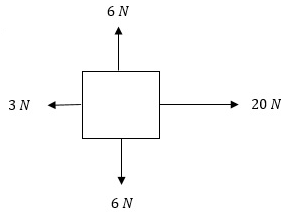
What is the net force of this diagram?
17 N, right
17 N, left
23 N, right
12 N, up
Circle the guy who successfully pushes the box.

What is a noncontact force?
A force that requires two objects to touch each other
A force that one object can apply to another object without touching it
A force that only occurs in outer space
A force that can only be seen with a microscope
Which of the following is an example of a gravitational noncontact force?
Rubbing a balloon on your hair
A magnet moving a paperclip
A pencil dropping to the ground
Boiling water in a pot
What type of noncontact force is demonstrated when a magnet moves a paperclip?
Which example illustrates an electric-static noncontact force?
A pencil falling off a desk
A paperclip sticking to a magnet
Rubbing a balloon on your hair
The moon orbiting the Earth
What is kinetic energy?
The energy stored in an object at rest
The energy due to an object's motion
The energy released during a chemical reaction
The energy absorbed during a phase change
How does the mass of an object affect its kinetic energy?
The more mass an object has, the less kinetic energy it has
The mass of an object does not affect its kinetic energy
The more mass an object has, the more potential energy it has
The more mass an object has, the more kinetic energy it has
What is the relationship between kinetic energy and the speed of an object?
The more kinetic energy an object has, the less speed it has
The more kinetic energy an object has, the more speed it has
The speed of an object does not affect its kinetic energy
The more speed an object has, the less kinetic energy it has
What is gravity?
The amount of matter in an object
A unit of measurement
An attractive force that exists between all objects that have mass
The gravitational force exerted on an object
What is mass?
The gravitational force exerted on an object
The pull between an object and the earth
The amount of matter in an object
A unit of force
What is weight?
The amount of matter in an object
The pull between an object and the earth
A unit of force
The gravitational force exerted on an object
How is weight measured?
Kilograms (kg)
Meters per second squared (m/s²)
Newtons (N)
Pounds (lbs)
According to the image, what two factors have a pull on each other due to gravity?
An object and the moon
An object and the sun
An object and earth
An object and a black hole
What is a field in the context of gravity?
A specific area where sports are played
A mathematical concept with no physical representation
A region of space that has a physical quantity such as force at every point
A historical term with no relevance to modern science
Which of the following has a gravitational field surrounding it?
Only planets like Earth
Only large objects like stars and galaxies
Only objects with a mass greater than a car
Both Earth and a pencil
What is potential energy?
The energy an object has due to its motion
The energy stored in an object due to its position or arrangement
The energy released when a chemical reaction occurs
The energy transferred from one object to another due to temperature difference
On what does the amount of potential energy depend?
The color of the object
The temperature of the object
The positions of objects or particles
The size of the object
Which of the following is an example of potential energy?
A rolling ball
A compressed spring
A melting ice cube
A burning candle
What happens to the elastic potential energy of a spring as its shape is changed?
A) It decreases
B) It remains the same
C) It increases
D) It is converted to kinetic energy
What will a spring always try to do when its shape is changed?
A) It will try to remain in its new shape
B) It will try to return to its original resting, or static, shape
C) It will break
D) It will expand indefinitely
What is an example of a closed system as it relates to potential energy?
A book sitting on a table
A rubber band releasing an object
A car engine running
A tree growing in a forest
What type of system involves the environment surrounding an object?
Isolated System
Closed System
Open System
Static System
According to the material, what affects the potential energy of a system?
The color of the system
The temperature of the system
The change in the system's position
The age of the system
Which of the following is NOT a type of potential energy due to forces in fields?
Gravitational potential energy
Electric potential energy
Magnetic potential energy
Kinetic potential energy
What are potential energies due to?
The color of objects
Fields created by objects
The temperature of objects
The smell of objects
What is the term used to describe potential energy that is due to the force of gravity?
Electric potential energy
Magnetic potential energy
Gravitational potential energy
Chemical potential energy
What is gravitational potential energy?
The energy an object has due to its motion
Stored energy due to the interactions of objects in a gravitational field
The energy an object has due to its temperature
The energy released during chemical reactions
Gravitational potential energy exists between which objects?
Only between objects in motion
Between all objects, but is only significant between objects and Earth
Only between objects in outer space
Only between objects of the same mass
How does the distance from the center of the gravitational field affect the gravitational potential energy of an object?
The closer the object is to the center, the more gravitational potential energy it has
Distance from the center does not affect gravitational potential energy
The farther away the object is from the center, the less gravitational potential energy it has
The farther away the object is from the center, the more gravitational potential energy it has
What does the gravitational potential energy of an object depend on?
The object's color and shape
The object's mass and position
The object's temperature
The object's speed
What happens to the potential energy of an object as its height increases?
It remains constant
It decreases
It increases
It fluctuates unpredictably
How does the potential energy of an object change as its mass decreases?
It increases
It remains constant
It decreases
It becomes zero
What kind of relationship do mass and gravitational potential energy have?
Inverse
Proportional
Quadratic
No relationship

