
Font size
 Worksheets
Osteology and Arthrology Mastery Quiz
Total questions: 33
Worksheet time: 21mins
What is the tough, fibrous tissue that covers long bones?
Periosteum
Endosteum
Shaft
Medullary cavity
Which of the following is NOT a type of joint found in the human body?
Synovial
Fibrous
Cartilaginous
Elastic
What is the primary function of the skeletal system?
To produce heat
To regulate blood sugar levels
To support and protect the body
To facilitate digestion
During bone development, what process describes the transformation of cartilage into bone?
Ossification
Calcification
Mitosis
Apoptosis
Which joint allows for the widest range of motion?
Fibrous joint
Synovial joint
Cartilaginous joint
What is the term for the growth plate in long bones?
Epiphysis
Diaphysis
Metaphysis
Epiphyseal plate
Parietal bone of the skull is classified under
Irregular bone
Flat bone
Below is the example of long bones, except
Radius
Tibia
Scaphoid
Proximal phalange
The following bone is classified under axial skeleton:
Mandible
Sternum
Scapula
Coccyx
This is where the transition from cartilage to bone happens BEFORE birth
primary ossification center
secondary ossification center
tertiary ossification center
quaternary ossification center
This is where the transformation of cartilage to bone happens AFTER birth
primary ossification center
secondary ossification center
tertiary ossification center
quaternary ossification center

Which of these is a short bone?
Femur
Patella
Scapula
Ulna
What is the function of sesamoid bones?
Protect tendons from compressive forces
Provide stability and support
Leverage
Points of attachment for muscles
What is the shape of an irregular bone?
Cylinder-like
Cube-like
Thin and curved
Complex
What is the largest sesamoid bone?
(a)
Which bones protect the spinal cord?
Cranial bones
Sternum
Scapulae
Vertebrae
The joints that allow the most movement are called
Fixed
Fibrous
Cartilaginous
Synovial
Sesamoids are found in all of these locations except?
Knee
Beneath the 1st metatarsal
Elbow
Base of the thumb
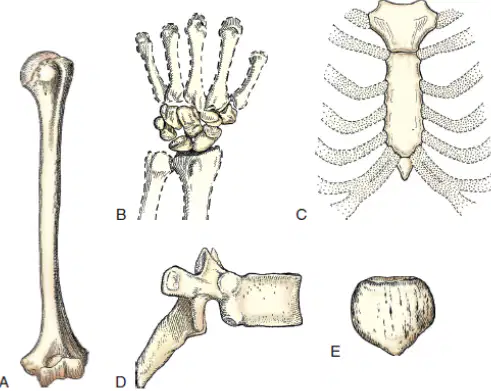
What type of bone is letter B?
Irregular
Long
Flat
Short
What type of bone is letter D?
Irregular
Long
Flat
Short
What type of bone is letter C?
Irregular
Long
Flat
Short

