
 Worksheets
Unit 2, Quiz #3: Imperial Motives, Methods, and Forms
Total questions: 10
Worksheet time: 5mins
The _______________ Revolution increased the demand for raw materials, inexpensive labor, and new markets, creating a strong economic motivation for New Imperialism.
Scientific
Industrial
Agricultural
Communist
Which motive is demonstrated by the following quote:
“I contend that we [Europeans] are the finest race in the world and the more of the world we inhabit the better it is for the human race.”
-Cecil Rhodes, 1877
Ideological
Economic
Political
Religious
King Leopold II of Belgium claimed that his interest in the Congo was to promote humanitarian policies and stop the slave trade; however, in reality he…
Never established a presence in the Congo River Valley
Set up factories in the Congo
Exploited Africans by forcing them to collect rubber sap
Focused on promoting Christianity
Which of the following was the goal of the Berlin Conference?
Promote humanitarian programs in Africa
Avoid conflict among European nations over territory in Africa
Avoid conflict between European nations and Africans
End the African slave trade
When nations established colonies, indirect control relied on which of the following?
Governing through existing local leaders who carried out imperial policies
Granting colonies full independence while maintaining trade agreements
Settling large numbers of citizens from the imperial nation to dominate the population
Replacing local rulers with officials from the imperial nation
Which of the following was a primary cause of conflict and war between the British and both the Boer settlers and the Zulu Kingdom in South Africa during the late 1800s?
British efforts to expand control over land and valuable natural resources such as gold and diamonds
British attempts to promote democratic self-government for African societies and Boer republics
Zulu and Boer demands for increased industrial trade with Britain
Religious conflicts caused by British attempts to convert the Boer and Zulu populations to Anglicanism
What was the primary motive for British imperial involvement in Egypt?
To gain access to large deposits of gold and diamonds
To spread Christianity through missionary activity
To acquire land for large-scale British settlement
To maintain access to the Suez Canal and protect their trade route to India
Which of the following best describes the British East India Company in its early years?
A government agency created to directly rule India
A private joint-stock company granted exclusive trading rights in India
A humanitarian organization formed to improve social and economic conditions in India
An trade partnership between Britain and independent Indian states
Which of the following best describes participation in the Berlin Conference (1884–1885)?
European powers met to divide Africa and excluded African leaders from the negotiations
European and African leaders met together to negotiate borders and trade agreements
Only African rulers attended to request protection from European countries
European powers invited African representatives but allowed them only limited voting rights
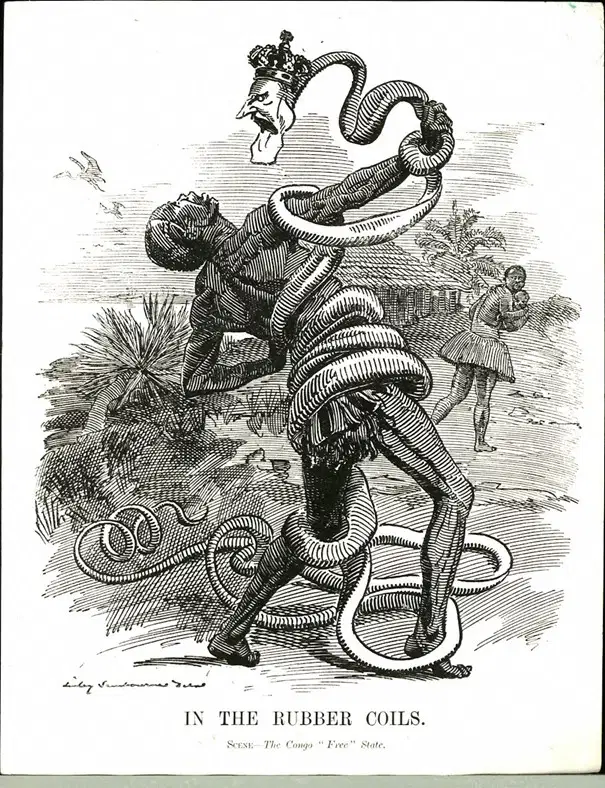
What is the main message (the point) of the political cartoon “In the Rubber Coils” regarding King Leopold II’s rule in the Congo?
European control in Africa created stability and economic opportunity for the Congolese people.
Industrialization in Europe encouraged trade partnerships with African.
Local resistance in the Congo was largely effective in preventing economic exploitation
The demand for valuable natural resources resulted in the harsh treatment of the Congolese people

