
 Worksheets
How to Make Slime - Test Prep
Total questions: 12
Worksheet time: 6mins
Name
Class
Date
1.
According to the author, why do kids like slime?
a)
It lasts forever.
b)
It makes them feel good.
c)
It smells good.
d)
It makes great gifts.
2.
Part A – What does “disposable” mean as used in Paragraph 4?
a)
able to use with baking soda
b)
able to pour in a cup or bowl
c)
able to throw away
d)
able to use many times
3.
Part B - Using the definition from Part A, which one of these is “disposable”?
a)
a car
b)
a table
c)
a paper plate
d)
a soda
4.
The “optional” ingredient is discussed in Paragraph 5. What does “optional” mean?
a)
You don’t have to use it.
b)
You must use it.
c)
Everyone uses it.
d)
Your parent will make you use it.
5.
What happens if you use too much food coloring? Select TWO answers.
a)
It will make the slime smell funny.
b)
It will make the slime feel too wet.
c)
The slime will color your hands.
d)
The slime won’t last very long.
e)
The slime will stain other surfaces.
6.
Which word lets the reader know that the last ingredient will be used?
a)
First
b)
Next
c)
Then
d)
Finally
7.
Why should slime be kept away from young children?
a)
They do not like the way it feels.
b)
They might eat it.
c)
It’s not their turn.
d)
It’s only meant for adults.
8.
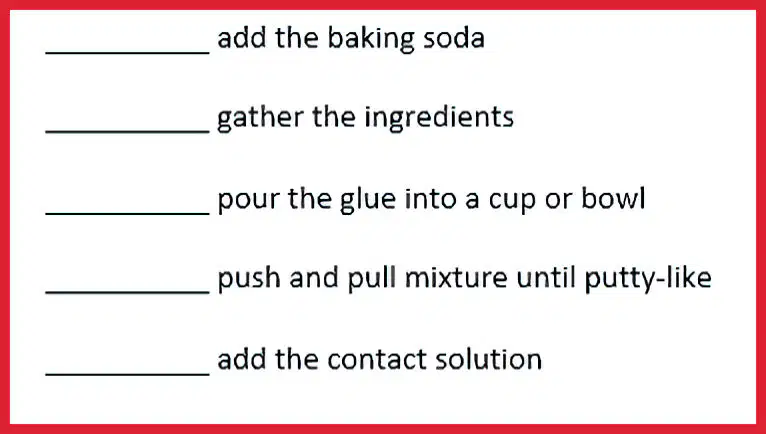
These steps are not in the correct order. Which is the correct order for making slime?
a)
3, 1, 5, 4, 2
b)
1, 2, 5, 3, 4
c)
1, 5, 4, 2, 3
d)
3, 1, 2, 5, 4
9.
What is the author’s purpose for writing this passage?
a)
to teach readers how to make slime
b)
to show readers the different colors to make slime
c)
to teach readers how to use baking soda
d)
to show readers when to use the kitchen
10.
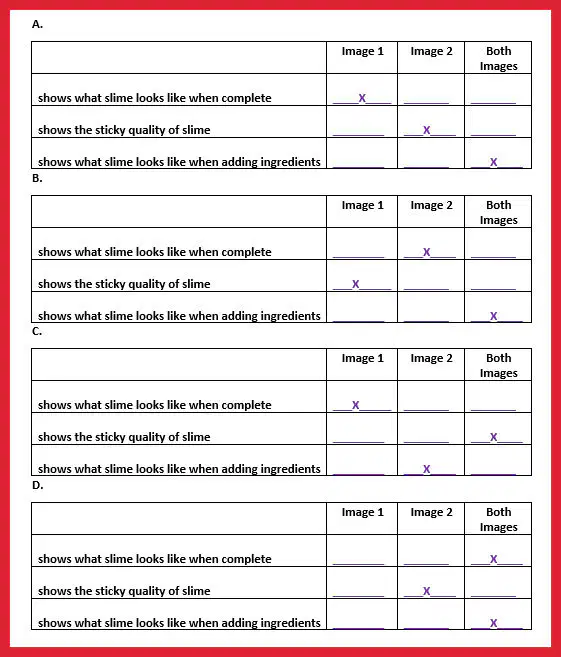
Table Match - Select the table that shows how the images contribute to the ideas in this passage.
a)
A
b)
B
c)
C
d)
D
11.
Part A – Which describes the structures of Passage 2 - History of the Emoji, and Passage 3 - How to Make Slime?
a)
They both are based on true information.
b)
They both are made-up stories.
c)
Passage 2 is based on true information, and Passage 3 is a made-up story.
d)
Passage 3 is based on true information, and Passage 2 is a made-up story.
12.
Part B - Select THREE correct statements about Passage 2 - History of the Emoji, and Passage 3 - How to make slime.
a)
They both share information.
b)
Passage 3 shows how to do something.
c)
Passage 2 shows how something was created.
d)
They both have characters.
e)
Passage 2 solves a mystery.
100 %

