
 Worksheets
History of the Emoji - Test Prep
Total questions: 14
Worksheet time: 7mins
Name
Class
Date
1.
Why do you think the author included the illustration below the title?
a)
to tell a joke
b)
to show what emojis are
c)
to show off her art skills
d)
to show why she wrote the article
2.
What caused Japan to become interested in emojis?
a)
They knew people liked sending pictures.
b)
They knew people liked writing letters.
c)
They knew people liked drawing pictures.
d)
They knew people liked writing stories.
3.
What made Shigetaka Kurita famous?
a)
He worked for NTT DoCoMo.
b)
He was a weather man.
c)
He invented the cell phone.
d)
He invented emojis.
4.
Read these sentences from Paragraph 2: "At the time, Japan’s cell phone users were sending a lot of pictures to each other. The phone companies noticed this habit." What does the word “habit” mean?
a)
picture
b)
drawing
c)
behavior
d)
problem
5.
Read these sentences from Paragraph 4: "The team decided that text messaging needed to be more personal. They observed that it was difficult to show how you feel in messages." What does the word “observe” mean?
a)
to notice
b)
to complain
c)
to decide
d)
to explain
6.
Part A - What does the word “emoji” mean?
a)
picture smile
b)
smile happy
c)
picture character
d)
fun drawing
7.
Part B - Which sentence helps you define the word in Part A?
a)
The team decided that text messaging needed to be more personal.
b)
They observed that it was difficult to show how you feel in messages.
c)
Shigetaka Kurita’s solution was the creation of the emoji.
d)
Emoji means “picture” (e) and “character” (moji).
8.
Part A - How did the other companies feel about creating smileys for Shigetaka Kurita?
a)
They were excited.
b)
They were not interested.
c)
They were unsure.
d)
They were angry.
9.
Part B - Which sentence BEST shows the feeling in Part A?
a)
Shigetaka Kurita contacted many companies to draw his smiley idea.
b)
No one wanted to design it.
c)
So, he decided to design it himself with his team.
d)
They came up with 176 characters to show objects and describe how people feel.
10.
What is the author’s purpose for writing this article?
a)
to get people to buy more phones
b)
to inform people about how emojis got started
c)
to tell a story about a funny emoji
d)
to explain why people send phone pictures
11.
Part A - How did the creation of emojis sell more phones?
a)
You must buy the phone to get the emojis.
b)
The emojis made the price lower.
c)
You need to buy emojis to get points for the phone.
d)
The emojis helped the phone take pictures.
12.
Part B - Which sentences helped you answer Part A? Select TWO.
a)
These emojis came with the new cell phones.
b)
So, if you wanted to use emojis, you had to buy their latest phone.
c)
Users could choose which emojis to insert into their text messages.
d)
These emojis became very popular in Japan, and soon spread around the world.
13.

Table Match - Which table correctly describes Passage 1 - The Cell Phone and Passage 2 - History of the Emoji?
a)
A
b)
B
c)
C
d)
D
14.
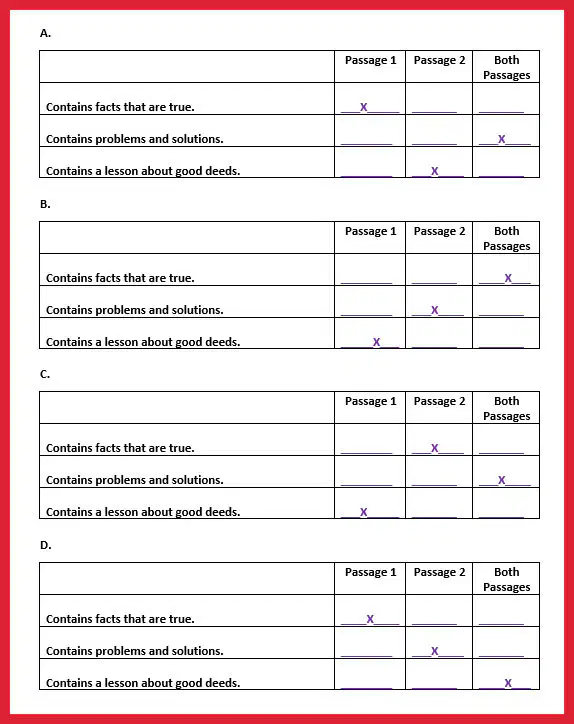
Table Match - Which table correctly describes Passage 1 - The Cell Phone and Passage 2 - History of the Emoji?
a)
A
b)
B
c)
C
d)
D
100 %

