
 Worksheets
Rotation & Revolution Quiz
Total questions: 10
Worksheet time: 5mins
Name
Class
Date
1.
Martin is writing a report for science class about how the tilt of Earth affects living organisms. Which subject should Martin include in his report that is directly affected by Earth's tilt?
a)
night and day
b)
cloud formation
c)
phases of the moon
d)
changing of the seasons
2.
As the Earth revolves around the sun, the tilt of its axis changes the angle that the sun's rays strike the surface, therefore causing a change of
a)
phases
b)
eclipses
c)
seasons
d)
tides
3.
What season is it in North Carolina when the northern hemisphere is tilted toward the sun?
a)
spring
b)
summer
c)
fall
d)
winter
4.
The amount of time it takes for Earth to rotate once on its axis is referred to as a
a)
day
b)
month
c)
year
d)
hour
5.
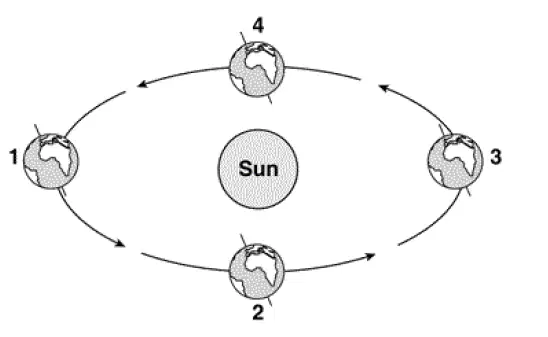
Use the diagram to answer the question below: At which positions will the Earth have spring and fall?
a)
positions 1 and 2
b)
positions 2 and 4
c)
positions 3 and 4
d)
positions 4 and 1
6.
There are four seasons in a year. Which reason is most responsible for the changing seasons on Earth?
a)
The way the Earth tilts on its axis.
b)
The way the Earth rotates on its axis.
c)
Changes in the distance between the Earth and sun.
d)
The position of the moon as it revolves around Earth.
7.
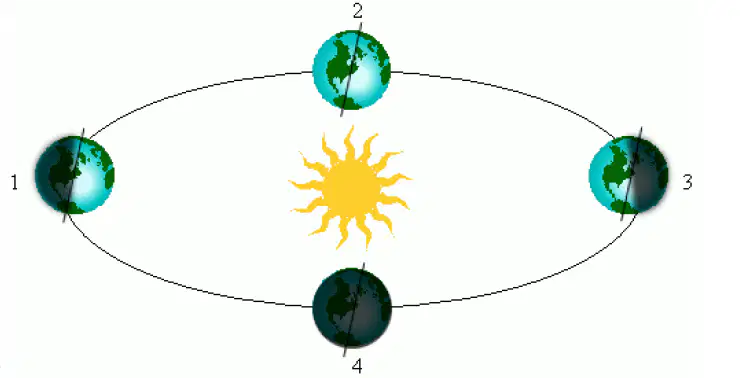
Which position of the Earth in the diagram below shows the winter season for the United States?
a)
position 1
b)
position 2
c)
position 3
d)
position 4
8.
Which factor listed below has no affect on Earth's seasons?
a)
The tilt of Earth on its axis
b)
The revolution of Earth around the sun
c)
The revolution of the moon around the Earth.
d)
The energy that the Earth receives from the sun.
9.
It takes 365.25 days for
a)
Earth to travel half way around the sun
b)
Earth to rotate once on its axis
c)
The moon to complete one orbit around the Earrth
d)
The Earth to complete one orbit around the sun
10.
When the northern hemisphere is tilted toward the sun, the days are
a)
warmer and shorter
b)
colder and longer
c)
warmer and longer
d)
colder and shorter
100 %

