
 Worksheets
Unit 7/Lesson 21 Test Review
Total questions: 15
Worksheet time: 8mins
Name
Class
Date
1.
1. How did Missouri’s application as a state with slavery in 1819 challenge U.S. law?
a)
It did not have a state constitution.
b)
States west of the Mississippi River were to be states with slavery.
c)
It did not have the population required for statehood.
d)
States north of the Ohio River were to be free states.
2.
2. What was an effect of the Missouri Compromise?
a)
It temporarily ended the slavery debate.
b)
It required Southern states to pay higher taxes.
c)
It led to the South seceding from the Union.
d)
It upset the balance of states with and without slavery.
3.

3. What was the significance of the 36˚30´ parallel?
a)
It separated the North from the South.
b)
It indicated where slavery was allowed and banned.
c)
It showed the borders of the United States.
d)
It indicated the northern border of Missouri.
4.
4. What did Southern senators fear would happened if there were more free states than states with slavery?
a)
losing respect
b)
losing tax revenue
c)
losing voting power
d)
losing future elections
5.

5. In what way did the Compromise of 1850 appease the South?
a)
It provided an end to the trade of enslaved people in Washington, D.C.
b)
It created new taxes for railroad construction.
c)
It required the Underground Railway to be disbanded.
d)
It included a law requiring the return of people who had escaped slavery.
6.

6. All of these were reasons the Fugitive Slave Law failed except...
a)
plantation owners did not want enslaved people returned.
b)
People who caught fugitives from slavery were driven back to the South.
c)
Northerners refused to obey the law.
d)
many enslaved people moved to Canada.
7.

7. What was the impact of the publication of Uncle Tom’s Cabin?
a)
It caused enslaved people to revolt in Kentucky.
b)
It turned many more people against slavery.
c)
Congress agreed that slavery should be abolished.
d)
The South became more resolved to secede from the Union.
8.

8. How did the Kansas-Nebraska Act nullify the Missouri Compromise?
a)
It changed the borders of Missouri.
b)
It allowed slavery in new Northern territories.
c)
It required that all of Missouri be free.
d)
It established new interstate trade rules.
9.

9. Which of these was a result of the Kansas-Nebraska Act?
a)
It led to a violent struggle over slavery in Kansas.
b)
It settled the slavery issue in Nebraska.
c)
It calmed the country's dispute over slavery.
d)
It required that the new territories would be free states.
10.

10. What was the Supreme Court’s decision in the Dred Scott case?
a)
that slavery diminished the national character
b)
that African American rights were protected by the Constitution
c)
that African Americans did not have the right to sue in federal court
d)
that slavery should be abolished by executive order
11.

11. What did John Brown hope to achieve by his raid at Harpers Ferry?
a)
to create a rebellion led by enslaved people that would bring an end to slavery
b)
to bring attention to the conflict between the North and the South
c)
to bring the two sides together to form a new compromise
d)
to create a revolution that would lead to a war between the states
12.
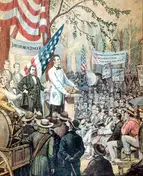
12. How did the Lincoln-Douglas debates of 1858 impact Lincoln’s political future?
a)
He won the senate race in Illinois.
b)
He became known throughout the nation.
c)
He was seen as a poor candidate for public office.
d)
He felt discouraged and removed himself from politics for a time.
13.

13. What was apparent following the presidential election of 1860?
a)
The nation was divided over slavery.
b)
Lincoln was popular throughout the nation.
c)
There was little support for abolitionists in the North.
d)
Southern states were eager to abolish slavery.
14.

14. Which event turned the secession crisis into a civil war?
a)
the election of Abraham Lincoln
b)
John Brown's raid on Harpers Ferry
c)
Preston Brooks' attack on Charles Sumner
d)
South Carolina's shelling of Fort Sumter
15.
15. "A house divided against itself cannot stand. I believe this government cannot endure permanently half slave and half free. I do not expect the Union to be dissolved; I do not expect the house to fall; but I do expect it will cease to be divided. It will become all one thing, or all the other."
What does the word "house" in Lincoln’s statement refer to?
a)
His house
b)
The White House
c)
The United States
d)
His church
100 %

