
Font size
 Worksheets
(ES) Properties of Water - Vocabulary and Concepts #1
Total questions: 50
Worksheet time: 13hrs 30mins

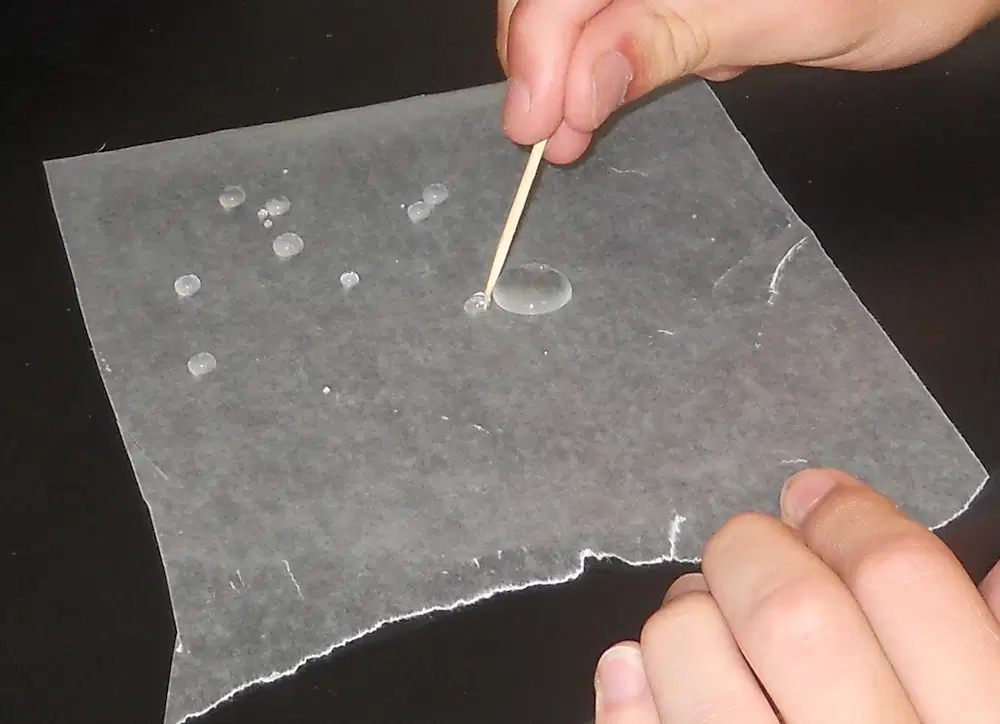
When you tilt the wax paper, why does water easily slide around on its surface while staying in a droplet shape?
High cohesion between water molecules
High adhesion with wax paper
Low cohesion between water molecules
High adhesion with wax paper
Low cohesion between water molecules
Low adhesion with wax paper
High cohesion between water molecules
Low adhesion with wax paper
If water does not adhere to a substance/object, what claim could you most likely make about that substance/object?
It is polar
It is nonpolar
It is more dense than water
It is less dense than water


The ability of water molecules to stick to each other, creating surface tension is called:
Cohesion
Adhesion
Insulation
Ph

What characteristic is shown in the image?
Polarity
Hydrogen Bonds
Cohesion
Adhesion


Which of the following interactions are taking place at the dotted lines in the diagram?
Polar covalent bonds
Intermolecular force
Ionic bonds
Electrostatic force

Why does water move from the roots to the leaves of plants?
Solutes push the water up the plant.
Capillary action pulls the water molecules like a chain against gravity.
Water is pulled by gravity through the plant body.
The high specific heat of water allows water to move freely through the plant.

Water is polar because.....
The unequal sharing of electrons gives the water molecule a slight negative charge near its oxygen atom and a slight positive charge near its hydrogen atoms.
The molecule has two poles, which one results in the poles being colder than other regions of the molecule.
The unequal sharing of electrons gives the water molecule a slight negative charge near its hydrogen atoms and a slight positive charge near its oxygen atom.
The water molecule is neutral and therefore the two poles cancel each other out.
Select all that apply: A polar molecule has these characteristics.
A molecule with partial charges (+/- ends)
mixes with water
equal sharing of electrons
unequal sharing of electrons
Mixes with oil
No partial charges. Do not mix with water.
Equal sharing of electrons.
Polar
Nonpolar
Covalent
Ionic
Select all answers that apply: What is a nonpolar molecule?
Partial charges
No partial charges
Does not mix with water
Equal sharing of electrons
high chance of mixing with a substance like oil or wax
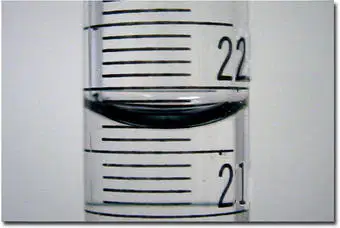
The curve in this meniscus is caused by the attraction between the water and the glass known as
solute
surface tension
cohesion
adhesion
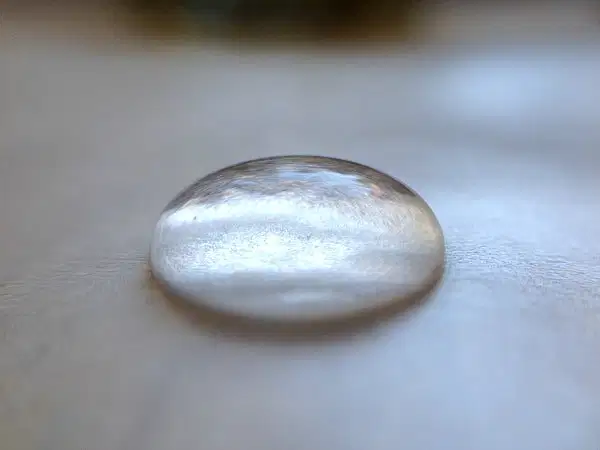
Which two characteristics of arise from the chemistry of water and lead to it forming droplets as seen in the image?
cohesion
adhesion
high heat capacity
it is a universal solvent
high surface tension
A type of strong chemical bond in which two atoms share one or more pairs of valence electrons.
Covalent bond
Hydrogen bond
Ionic Bond
Water Bond
A solute is
the liquid in which a substance dissolves
a sign of respect used in the military
a song played in the band
the substance being dissolved
When salt is mixed with water, salt is the
solvent.
nonpolar.
solution.
solute.
A measure of how difficult it is to stretch or break the surface of a liquid.
cohesion
surface tension
solute
solvent

This is a picture of water as a __________.
gas
liquid
solid
solvent
What are the properties that cause water to move against gravity in plants?
cohesion
covalent bonds
high heat capacity
adhesion
____________ pulls on the electrons more than the hydrogen atoms due to a high electronegativity.
Hydrogen
Oxygen
Gravity
Cohesion
Water's _________________ enables it to dissolve and transport important molecules throughout the body.
high heat capacity
versatility as a solvent
expansion upon freezing
cohesion
Capillary Action
The property of water that allows ice to float on the surface of liquid water
The property of water that allows it to dissolve polar substances
When water molecules stick to other surfaces
The property of water that allows water to move up a thin tube (or the stem of a plant) by itself
What is the relationship between the diameter of a tube and height of a capillary water column?
The smaller the diameter of a tube, the smaller the height of the water column
The smaller the diameter of a tube, the larger the height of the water column
The diameter of a tube does not relate directly to the heigh of the water column inside it
Water displays many important properties such as...
-A solid state that is less dense than a liquid state
-Cohesion
-Surface tension
-Having a high heat capacity/heat of vaporization
-Being a universal solvent
These properties arise due to which of the following:
Water is a nonpolar substance
Hydrogen and oxygen bond ionically which leads to these properties
Due to its polarity, water molecules interact with one another through hydrogen bonding
Oxygen and hydrogen bond covalently and share electrons equally
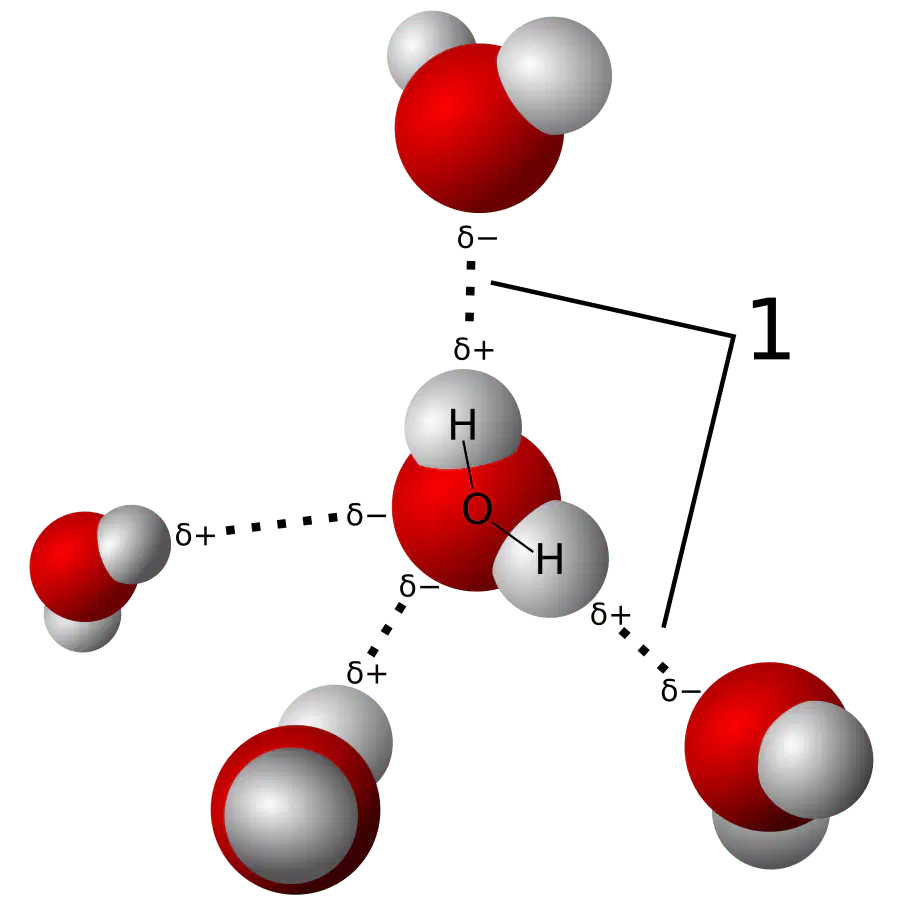
Hydrogen bonds are an example of an...
Intramolecular force
Intermolecular force
The polar covalent bond between oxygen and hydrogen is an example of an....
Intramolecular force
Intermolecular force
The polar covalent bond between hydrogen and oxygen occurs because...
Oxygen and hydrogen are nonmetal atoms
Oxygen is more electronegative and pulls electrons closer to itself
Electrons are transferred from the hydrogen atoms to the oxygen atom
Oxygen and hydrogen are metal atoms

An insect like a water strider can skate along the top of a pond because:
covalent bonds result in water cohesion
hydrogen bonds result in water cohesion
ionic bonds result in water cohesion
hydrogen bonds result in water adhesion
What property of water results in the accumulation of small amounts of water into larger amounts of water? The results in the rivers, lakes, streams, and even the oceans.
Cohesive Behavior
Expansion Upon Freezing
Ability to Moderate Temperature
Universal Solvent
Which of the following apply to intramolecular forces...
forces within a molecule that hold atoms together.
non polar covalent bonds
polar covalent bonds
hydrogen bonds
forces that cause neighboring molecules or compounds to stick to one another
Which of the following apply to intermolecular forces...
forces within a molecule or compound that hold atoms together.
non polar covalent bonds
polar covalent bonds
hydrogen bonds
forces that cause neighboring molecules or compounds to stick to one another

During the winter when lakes freeze over the fish and other animals living in it survive. Which property of water?
high specific heat
capillary action
greatest density at 4 oC
surface tension

Water traveling up a plant is what property of water?
surface tension
cohesion
specific heat index
capillary action

Water molecules require a lot of energy to separate one from the others. What is this property of water and what is the factor causing it?
hydrogen bonding
Water covers what percent of Earth's surface?
3%
50%
70%
9%
Which best explains why all of the Earth’s freshwater is not available for human use?
Most of Earth's freshwater is only in lakes
Most of Earth’s freshwater is underground.
Most of Earth’s freshwater is still in the water cycle.
Most of Earth’s freshwater is frozen water.
What effect does the water cycle have on the total amount of water on Earth?
The total amount of water on Earth is constantly increasing.
The total amount of water on Earth is constantly decreasing.
The total amount of water on Earth remains relatively constant.
The total amount of water on Earth changes due to periods of global warming and cooling.
Where is MOST of Earth's available freshwater stored?

Most of the Earth's water is in __________

The graphic shows that only 3% of the Earth's water is fresh water. The graphic also shows that of this 3%, almost all of it is contained in two reservoirs. What are the two reservoirs that contain almost all of Earth's fresh water?
glaciers and groundwater
streams and estuaries
marshes and swamps
lakes and rivers

