
 Worksheets
Earthquake Engineering Unit Assessment
Total questions: 19
Worksheet time: 10mins
Name
Class
Date
1.
True or false:
Energy from earthquakes is carried by waves.
a)
True
b)
False
2.
True or false:
Whenever there is an earthquake you will always find a volcano nearby
a)
True
b)
False
3.
True or false:
Some earthquakes are caused by what humans do.
a)
True
b)
False
4.
True or false:
Earthquakes happen every day.
a)
True
b)
False
5.
True or false:
Earthquakes are spread out fairly evenly across the world.
a)
True
b)
False
6.
True or false:
Earthquakes generally happen along tectonic boundaries.
a)
True
b)
False
7.
True or false:
In an earthquake, it is usually safer to be in a town rather than the countryside.
a)
True
b)
False
8.
True or false:
When engineers design buildings to withstand earthquakes, they need to consider how big the loads will be on the buildings.
a)
True
b)
False
9.
True or false:
In an earthquake area, the way a building is constructed is more important than its age or weight.
a)
True
b)
False
10.
True or false:
Heaviest buildings are always the most stable.
a)
True
b)
False
11.
What is an earthquake?
a)
An earthquake is the movement of the Earth’s tectonic plates making seismic waves.
b)
An earthquake is the eruption of molten rock from the inside of the Earth’s crust.
c)
An earthquake is the creation of new land formed by molten rock pushing through gaps in the Earth’s crust.
d)
An earthquake is a huge wave of water that can wash away whole cities.
12.

When engineers plan their designs for any building they have to be sure that it won’t fall down.
Look at the diagram below.
From your experiences in the classroom when you built structures to support sandbags, which shape do you think engineers would find helps to give the most strength and stability to their designs for buildings?
a)
square
b)
rectangle
c)
triangle
d)
circle
13.

Engineers also have to consider the effects of different types of loads (forces) on the building. Which of these four loads does not change from day to day?
a)
The dead load—the weight of all the building materials
b)
The live load—the weight of the furniture and people in the building
c)
The horizontal load—external forces such as wind
d)
The snow load—the weight of snow that falls on the building
14.

A student is shaking a rope to demonstrate wave patterns. He makes the following four patterns.
Which pattern shows the smallest transfer of energy?
a)
A
b)
B
c)
C
d)
D
15.

Which pattern would you expect to see on a seismograph indicating the earthquake of greatest severity?
a)
A
b)
B
c)
C
d)
D
16.
Two students are testing out a seismometer app on their phone using a shaking table. They put the phone on the table and shake it backwards and forwards to create patterns on the phone screen. Which of the following patterns might they see?
a)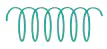
A
b)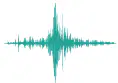
B
c)
C
d)
D
17.

A student makes a wave pattern on the floor with a rope. She moves her arm from side to side the same distance while holding the rope. She creates a pattern with the rope like the one shown on the right. What should she do to reduce the amplitude of the waves?
a)
Slow down the movement of her arm from side to side.
b)
Increase the distance she moves her arm from side to side.
c)
Speed up the movement of her arm from side to side.
d)
Decrease the distance she moves her arm from side to side.
18.
You live in a suburb of San Francisco with your family. One night, you are suddenly woken by voices shouting and a deep rumbling sound. You get out of bed wondering if you have had a bad dream. It is pitch black outside, and there are no street lights on. The rumbling is getting louder and the floor begins to move under your feet. You realize that an earthquake is happening.
What should you do?
a)
Take shelter under the kitchen/dining table.
b)
Run downstairs and outside.
c)
Climb up onto the roof.
d)
Call the police.
19.
Which of the following forces are NOT important to consider when developing a building able to withstand a severe earthquake?
a)
Torsion
b)
Compression
c)
Bending
d)
Magnetic
e)
Tension
100 %

