
Font size
 Worksheets
Unit 3.3 Domestic Economy and Policies
Total questions: 67
Worksheet time: 22mins
This group made headlines for investigating communist influence in the movie industry in 1947
House Un-American Activities Committee (HUAC)
Loyalty Review Board
McCarran Internal Security Act
Joseph McCarthy
This group investigated government employees and dismissed those who were deemed to be disloyal/communist.
Loyalty Review Board
McCarran Internal Security Act
HUAC
McCarthyism
This was the era where people were randomly being accused of being communist with little or not proof; named after the Senator from Wisconsin.
McCarthyism
McCarran Internal Security Act
HUAC
Loyalty Review Board
This was the era where people were randomly being accused of being communist with little or not proof; named after the Senator from Wisconsin.
McCarthyism
McCarran Internal Security Act
HUAC
Loyalty Review Board
This was the nickname given to the "unfriendly" witnesses who refused to testify during the HUAC's investigation of the movie industry.
Hollywood Ten
HUAC
McCarthy
Loyalty Review Board
This helped over 1,000,000 former US soldiers pay for college & career education after WWII.
McCarthyism
The United Nations
The Truman Doctrine
The GI Bill
This led to the persecution of thousands of US citizens suspected of being Communists in the 1940s and 1950s.
The Mashall Plan
The CIA
McCarthyism
The Bretton Woods Conference
This was the central US foreign policy during the Cold War, aiming to control the growth & power of the USSR
The United Nations
McCarthyism
The Marshall Plan
Containment

What caused the Baby Boom, Interstate Highways, the growth of the Middle Class, and the rise of Suburbs.
An increase in immigration
A decrease in trade
1950s postwar economic prosperity
A reduction (decrease) in peacetime spending
What is a major effect of the G.I. Bill?
It decreased college attendance rates for ordinary citizens
It forced women into military service roles
It lead to an increase in draft rates for future wars
It increased college attendance and home ownership for veterans

Which best describes Joseph McCarthy?
He helped to create the Interstate Highway Act
He created a vaccine to stop the infectious disease Polio
He accused government officials of being Communist, many times without evidence.
He helped discover that the US government had hundreds of communists working for it.

Which describes the House Un-American Activities Committee (HUAC)?
It investigated Americans who were suspected Communists or disloyal to the US, especially in Hollywood
It placed strict immigration quotas in US ports
It created new guidelines for citizenship
It replaced the FBI as the nation's top law enforcement agency

Joseph McCarthy, HUAC, and a fear of Communism harming the US best describe-
The Second Red Scare
1950s Economic Prosperity
The Cold War
The Truman Doctrine
White flight is referring to ...
movement of white families to the cities
movement of white families overseas
movement of white families to the suburbs
The movement of African Americans to the cities
What did President Harry Truman establish in early 1947 to screen all federal employees?
HUAC
Project Verona
the loyalty review program
the subcommittee on investigations
the act allowed for highways to run north to south in the US for the first time
the act allowed people to live in suburbs that changed the patterns of community development
the act forced people to live in cities
it was founded by Levitt
What were small residential communities surrounding the cities that attracted middle class white Americans who pursued the conformity of the 1950s?
White Flight
Sun Belt
Suburbia
Baby Boom
What was the name given to an unprecedented population explosion due to soldiers returning home from WWII and settling into family life? It created the largest generation in US History.
Planned Obsolescence
Baby Boom
Conformity
White Flight
What was the difference between urban and suburban life in the 1950s?
The poor, single, or minorities lived in the city while middle class white families lived in the suburbs.
Poor, single or minorities lived in the suburbs while middle class white families lived in the cities.
Only rich people lived in the cities.
Only minorities lived in the cities.
How did the 1950s directly influence changes to society in the 1960s?
The 1950s caused people to continue to become more conservative and strive for more conformity.
Society in the 1950s (suburbia, conformity, consumerism, etc) caused the birth of the "isms" of the 1960s (feminism, environmentalism, activism, etc) as a reaction.
The 1950s caused people to despise others from other social classes and an intense class war developed in the 1960s.
There was no change of society from the 1950s to the 1960s.
Which are effects of Americans buying more cars in the 1950s?
Interstate Highway Act: more highways were built
Car culture: people did everything in their cars (ex. drive in theaters & restaurants)
Small towns along older highways were abandoned.
All of the above
The passage of the GI Bill was meant to help which part of American society?
Veterans with economic help
Farmers with higher prices
Women with more equality in society
African Americans and other minorities with desegregation.
Author of "The Feminine Mystique" and leader of the women's movement; she helped found NOW
Rachel Carson
Woodward & Bernstein
Betty Friedan
Cesar Chavez
Which of the following events helped the women's movement develop?
the civil rights movement
the publication of Ms. magazine
the work of Phyllis Shafly
the passage of the ERA
Why did Americans think they needed to build underground shelters in the 1950s/60s?
To protect themselves from nuclear bombs
To protect themselves from the Soviet invasion
To protect themselves from global warming
To protect themselves from winter.
Julius and Ethel ____________________ were convicted of espionage and executed in June 1953, although many people believed that they were victims caught in a wave of anti-Communist frenzy
Rosenberg
Truman
McCarthy
Hiss
Betty Friedan wrote what book in 1963 that became the symbol for the Women's Rights Movement?
The Feminine Mystique
Das Kapital
The Trouble with Women
Walden Pond
A large increase in the birthrate, especially in the US following WWII
Baby Boom
Summit
Perjury
Arms Race
Assembly line style homes that made owning a home affordable and popularized the Suburbs.
Levittown
Split levels
Watergate
Baby Boom
A result of the white flight to the suburbs. . .
poverty became a hidden problem because those with money had moved to the suburbs and didn't see it.
the suburbs became the first areas that were really integrated.
job opportunities increased for those that lived in cities.
city residents were able to move into new homes.
What did groups like the House Un-American Activities Committee and Loyalty Review Board have in common?
Both were trying to increase voter participation in elections.
Both were attempting to monitor civil right violations and investigate civil rights violations.
Both were attempting to uncover communists and investigate allegations of communism in the government and society.
Both were investigating anti-union activities by employers and violations of the Fair Labor Standards Act.
In general, while African Americans did not share in all the postwar prosperity, what can be said about their career prospects in the post war years?
African American opportunities in white collar jobs increased
African American opportunities in blue collar jobs increased.
There was no improvement.
Job opportunities for African Americans decreased in the decades after the war.

Groups like Loyalty Review Boards, the House Committee on Un-American Activities, and the McCarthy Senate investigations demonstrated what about America in the 1950s?
It was ok to interfere with people's constitutional rights in the hunt for communists.
Despite the communist threat, everyone's rights had to be respected.
The rights of labor unions had to be strengthened in order to protect workers.
African Americans needed protection in order to have equality in the workplace.
Betty Friedan argued what?
Women had equality in society.
A woman's role as wife and mother were fulfilling to most women.
Women were content with their current position.
Women would find more satisfaction in their lives in they could have a professional career.
White Americans were in a time of prosperity after World War II. Which statement best generalizes the experience of African Americans, Mexican Americans, Puerto Ricans , and other minorities?
They too were experiencing a time of postwar prosperity.
Puerto Ricans were able to prosper while other minorities struggled.
African Americans, Puerto Ricans, Mexican Americans, and other minorities faced discrimination in their attempts to take advantage of postwar prosperity.
African Americans were able t oprosper while other minorities were stuck in cities.
Which organizations were created to find communist sympathizers and examine people they suspected of untrustful to the U.S. government? (check all that apply)
Loyalty Review Board
Great Society
McCarthyism
the House Un-American Activities Committee
What did the House of Un-American Activities Committee establish about American outlooks in the 1950s?
Citizens constitutional rights must be suspended to be able to stop the anarchist threat.
Racial and ethnic hostilities are effectively checked by following due process of law.
The rights of citizens assumed to be associated with Communist activities were jeopardized.
Internment of suspects is necessary during times of uncertainty and wartime.

What were beatniks?
The criticized conformity of American society
Contributed to Red Scare propaganda
supported the religious revival
popularized life in the suburbs
America's post war foreign policies impacted it's domestic affairs by?
The development of the first atomic bomb
Reducing weapons because of a fear of communism
A Red Scare within the United States happened because of concerns over communist expansion.
America refused to get involved in world affairs and returned to being isolationist.
What caused the large increase in the birth rate after World War II known as the Baby Boom?
High unemployment meant men were home for longer periods of time.
College being unaffordable meant that more couples married earlier and started families than in the past.
Soldiers returned home to wives and girlfriends after years at war causing the increase in the numbers of babies
Soldiers returned home from the war with foreign brides that brought their children with them.
One way in which the postwar prosperity impacted American society was through?
Increased stock speculation and underproduction by American factories
Increased prosperity led to a reduction in the birth rate after the war.
With everyone prospering, Congress saw the GI Bill was no longer necessary.
the interstate highway system, which changed the way in which communities developed was created.
" There is not enough housing for our people or transportation for our traffic... Each
year more than 100,000 high school graduates, with proved ability, do not enter college
because they cannot afford it..."
President Lyndon B. Johnson, 1964
What is President Johnson referring to in this quotation?
Not all groups, like the urban poor and minorities were prospering in the United States.
Congress changed the tax system to equally distribute wealth
Everyone was able to equally share in the wealth of America.
Everyone was able to secure a quality education no matter their social status.
Dr. Hector P. Garcia and the American GI Forum advocated and fought for what?
The repeal of the GI Bill
The ability of Mexican Americans to experience the full benefits of the GI Bill
The demand that African Americans receive less benefits than other minority groups.
The inclusion of women in the benefits of the GI Bill.
Dr. Hector P. Garcia was known for his work with what group?
The GI Bill
Knights of Columbus
American GI Forum
Mexican Americans against the war.
While the postwar period saw increased prosperity for many Americans, what groups were not prospering like others?
African Americans and other minorities and the urban poor
Returning soldiers who were largely unable to find work
Suburban women
Small Business owners and the people they were unable to keep employed.
What kind of society did President Lyndon B. Johnson envision when he created the Great Society programs?
one where all people had a high standard of living by ensuring access to justice, education, decent housing, and health care for everyone.
on that emphasized that all people are equal only in the eyes of God
one in which extremism in the defense of liberty is encouraged
one that made separate schools for black and white children truly equal
Some critics complained that the Great Society programs
gave the rich too many tax breaks
expanded the federal government too much
paid too little attention to health care
favored rural over urban citizens
What was a purpose of LBJ's Great Society?
end poverty
end drug trafficking
end lynching
fix the economy
One long-term implication of Affirmative Action is that
White males will be left out of a lot of work and educational opportunities
it will divide the nation
more and more people will be working with a diverse group of people
all of the above
This law was designed to help African-Americans to vote without being subject to discrimination and barriers to voting like literacy tests.
Voting Rights Act of 1965
The 13th Amendment -- Abolishes slavery
Civil Rights Act of 1964
The Civil War Reconstruction Act of 1865
How did President Johnson want to change society?
increase incentives for large businesses
increase incentives for small business
reduce poverty and increase equality
decrease dependence on foreign goods

Which of the following best describes President Johnson's domestic programs?
put the US into bankruptcy
were the largest spending and government involvement on social programs in US history
kept many Americans from healthcare and provided tax breaks to large business.
dropped the US from their status as the leading superpower
What prompted Congress to pass the War Powers Resolutions?
Rulings issued by the Supreme Court that banned deployment of US combat forces without a declaration of war
Fears that renewed conflict in the Middle East would require the United States to defend Israel
Decisions made by the executive branch during the Korean and Vietnam Wars
Limits on the Authority of the Chief executive imposed by an international tribunal
What was one result of the Great Society?
Poverty was eliminated in the United States.
the lives of many underprivileged Americans improved.
President Johnson's popularity plummeted.
The federal government shrank considerably.
The Great Society could be most compared to which previous government program?
The Square Deal
Laissez-Faire
The New Deal
The New Frontier

Which of the following statements best connects Johnson’s Great Society to President Franklin Roosevelt’s New Deal?
The Great Society had no connection to the New Deal
The Great Society was the largest increase in social welfare programs since the New Deal.
The Great Society was created to solve problems created by the New Deal
The Great Society and the New Deal were both ideas of the Republican Party
Which law required the president to gain congressional approval for long-term troop deployments?
24th Amendment
Tonkin Gulf Resolution
War Powers Act
Vietnam Resolution

What law did Congress pass to limit the military authority of the executive branch in order to avoid another Vietnam?
Marshall Plan
New Deal
War Powers Act
Gulf of Tonkin Resolution
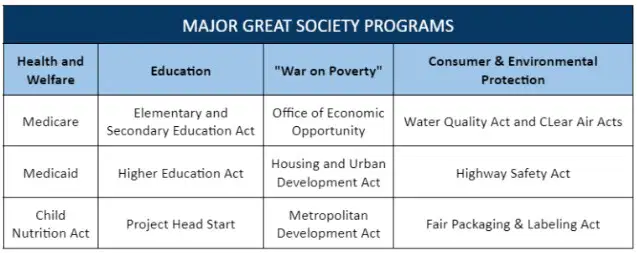
Which best describes the impact of President Johnson' Great Society?
It was the first time that taxes were used to pay for social welfare programs.
It was the first time businesses were taxed to pay for social welfare programs.
It was the largest expansion of government involvement in social welfare since the New Deal.
Ohio State is the worst team in college football.
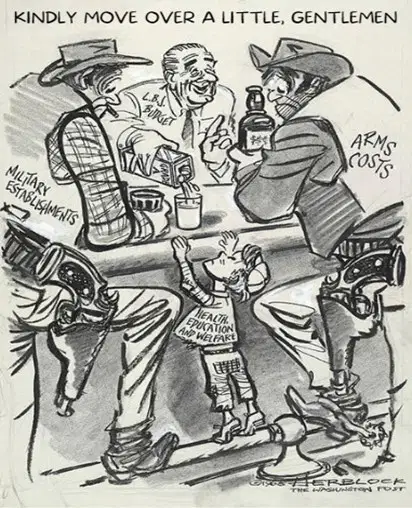
President Johnson's Great Society...
Prioritized social welfare and education programs over military expendatures

