
NEW
Font size
 Worksheets
Climate
Total questions: 10
Worksheet time: 10mins
Brazil’s rainforest is located in a region with a tropical climate. The tundra of
the North Pole is located in a region with a polar climate. Why is air in an area
with a tropical climate more humid than air in a polar climate?
Polar climates get more sunlight
Warm air holds more water vapor
Tropical climates have more rivers
Polar climates have ice instead of water
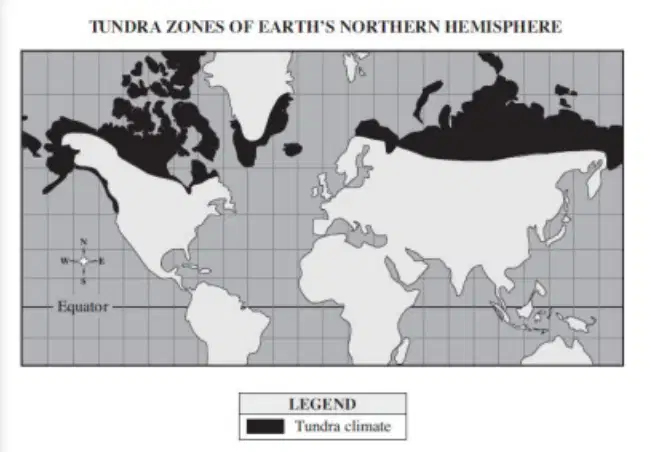
Earth has many types of climate zones. The map below shows the tundra
climate zones of the Northern Hemisphere.
Which of the following best describes this type of climate zone?
It is very hot because it is on the coastline
It is very wet because it is below sea level
It has very cold temperatures because it is far from the equator
It receives very little snowfall because it is close to the ocean
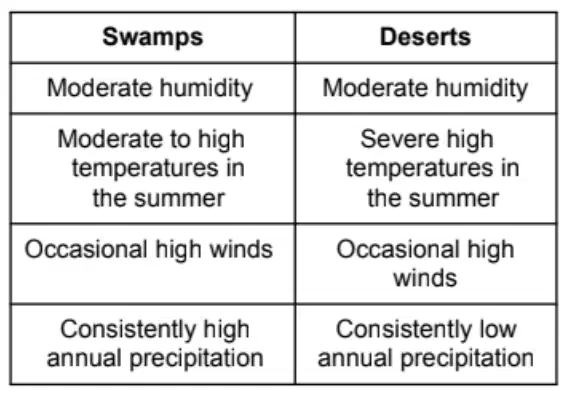
Annette created this table to compare swamps and deserts at a similar
latitude. Read the table and look for the weather characteristic that is not a
good match for both environments listed.
Which characteristic is most likely incorrect for both environments?
the level of humidity
the daily high temperatures
the frequency of high wind
the amount of annual precipitation
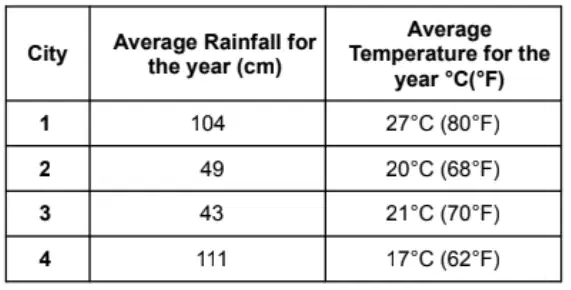
The table shows climate data for four cities located at different latitudes.
Which city most likely has a tropical climate?
city 1
city 2
city 3
city 4
Deserts in the temperate zones can be extremely hot in the afternoon and
below freezing at night. Which answer best explains why this happens?
Temperate deserts are found at high elevations, where the Sun and the
wind are much stronger. This creates more extreme temperature
changes.
Temperate deserts lack trees and grass. With no trees, the Sun shines
directly down and causes it to get hot in the day, and with no grass, the
heat escapes at night.
Temperate deserts have very little cloud cover and no humidity. This
means that more energy from the Sun reaches the desert in the day,
but that the heat can escape quickly at night.
Temperate deserts have higher rainfall than any other kind of desert.
Warm rain during the day produces warm breezes in the desert. Cooler
rains at night draw warm air away from the desert.
Which climate zone experiences the greatest range of temperatures due to its
latitude?
polar
tundra
tropical
temperate
Which answer choice correctly lists environments from most dry to least dry?
desert, tundra, grassland, rainforest
grassland, rainforest, desert, tundra
tundra, rainforest, grassland, desert
rainforest, grassland, tundra, desert
The amount of rain was measured and recorded for every Lee County School
for 30 years. Tracking precipitation over a long period provides the most
information about which characteristic of an area?
temperature of one day
type of soil
weather
climate
Many rainforests are found in the tropics. What makes a forest a rainforest?
They have a large amount of precipitation.
They always contain very large rivers or lakes.
They produce more oxygen than normal forests.
They have a large variety of animals that are not found elsewhere.
Iowa and Florida have different climates. Iowa is farther north than Florida. It is
not near any large bodies of water. Iowa's average elevation is 1,100 feet
above sea level. Florida is bordered by an ocean and the Gulf of Mexico. Its
average elevation is 100 feet above sea level. How do these factors affect
their climates?
Iowa's elevation and latitude make its climate warmer.
Iowa's lack of nearness to water and latitude make its climate mild.
Iowa's latitude and lack of nearness to water make it cooler than
Florida.
Iowa's elevation and lack of nearness to the water keep it warmer than
Florida.

