
Font size
 Worksheets
quiz
Total questions: 26
Worksheet time: 14mins
The dispersal of food coloring in a beaker of water is an example of
deposition
diffusion
active transport
endocytosis
The cell membrane allows molecules to move in and out of the cell. This helps to maintain
evolution
homeostasis
integrity
independance
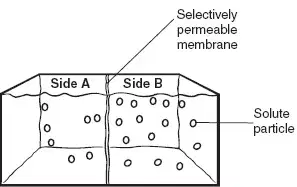
A student put together the experimental setup shown below. The selectively permeable membrane is permeable to water, but not the solute shown. Which direction will the solvent move?
to the left
to the right
will not move
more info needed
The movement of water molecules in and out of the cell through the membrane is called
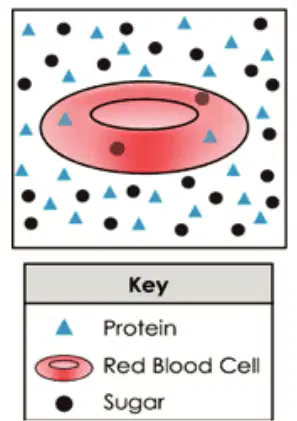
A red blood cell is placed into an aqueous (water) solution. The red blood cell has a lower concentration of protein and sugar than the aqueous solution, as shown in the diagram. In the diagram, the volume of the cell is equal to the volume outside the cell.
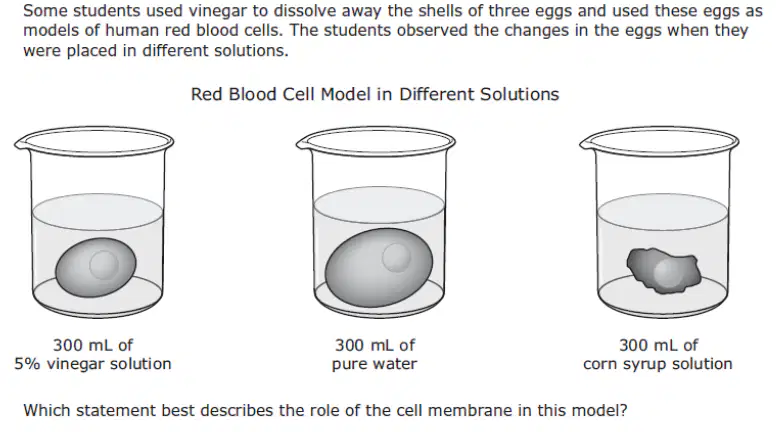
the cell membrane is a impenetrable barrier
the cell membrane removes solutes from the environment
the cell membrane allows water to leave and enter the cell
the membrane allows solutes to enter the cell which causes the cell to shrink
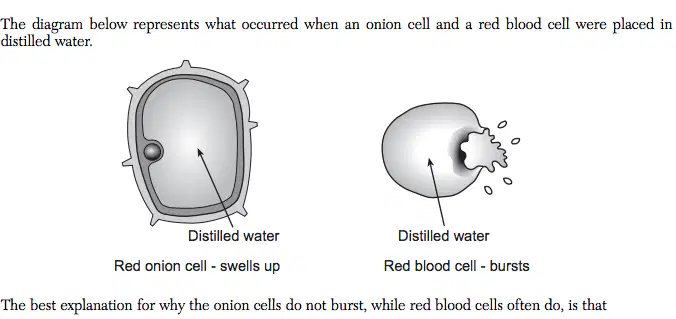
the red blood cells have only a cell membrane which protects them from bursting
the onion cells have a cell wall that protects them from bursting
the onion cells have a cell membrane that protects them from bursting
the red blood cells have a cell wall that does not protect them from bursting
A cell that is surrounded by fresh water will burst because the osmosis will because
water will move in
solutes move in
water will move out
solutes move out
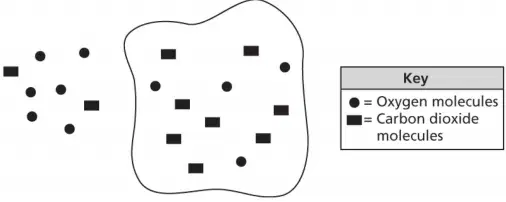
The cell membrane is permeable to both the oxygen and carbon dioxide molecules.Which statement correctly describes the movement of oxygen and carbon dioxide molecules?
both will enter
carbon will enter oxygen will leave
oxygen will enter carbon will leave
both will leave
Which type of cellular transport requires a cell to use energy?
osmosis
active transport
passive transport
diffusion
Since the sodium potassium pump is a form of active transport, it requires
oxygen
ATP
NADH
water
A type of cellular transport that requires no energy input and a carrier protein, as well as a change in the shape of its carrier is -
osmosis
Researchers conducted a study concerning cellular transport in animal cells affected by mitochondrial
disease. The disease affects an organism's ability to produce adenosine triphosphate (ATP). During their
study, which method of cellular transport still functioned in the affected animal cells?
phagocytosis
pinocytosis
simple diffusion
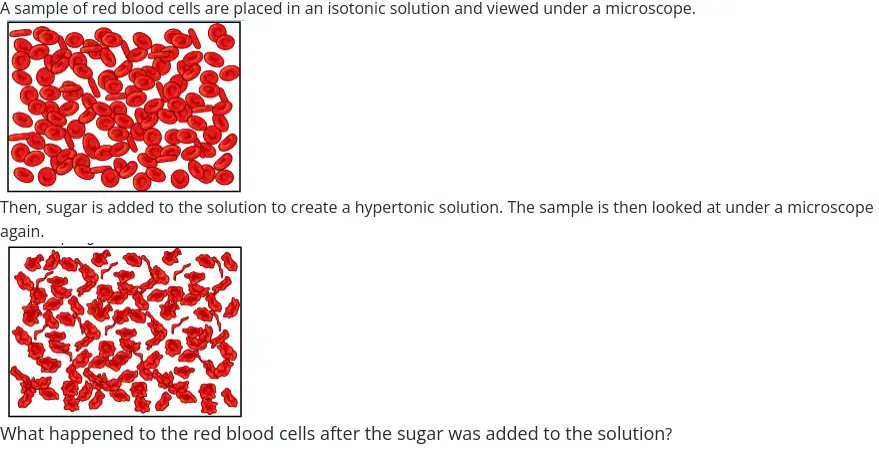
The red blood cells absorbed water through osmosis. The absorption of water helped the blood cells take in more sugar for energy.
The red blood cells released water through osmosis. The release of water helped the blood cells take in more sugar for energy.
The red blood cells released water through osmosis. The release of water helped the blood cells keep a similar concentration of solutes as the outside solution to maintain homeostasis.
The red blood cells absorbed water through osmosis. The absorption of water helped the blood cells keep a similar concentration of solutes as the outside solution to maintain homeostasis.
What change will occur in the plasma membrane of a cell during endocytosis?
It will form two phospholipid monolayers.
It will form vesicles.
It will partially dissolve.
It will partially dissolve.
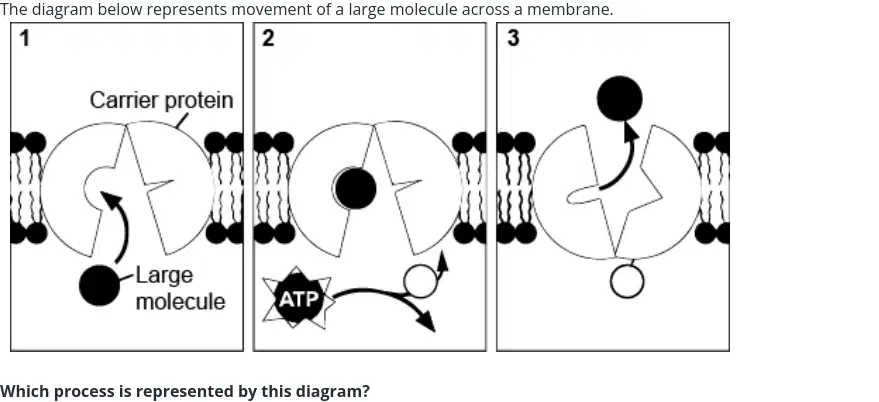
gene manipulation
active transport
diffusion
protein building
Root cells in plants absorb minerals (nitrogen, phosphorus, potassium, calcium, magnesium, and sulfur) even though the concentration of the minerals is greater inside the cell than in the surrounding soil. How do these root cells accomplish this absorption?
through osmosis
through diffusion
through passive transport
through active transport
Specialized carrier molecules in the plasma membrane are required for
any type of diffusion
facilitated diffusion and osmosis
active transport and facilitated diffusion
osmosis and active transport
Devin got his wisdom teeth removed and his mouth is swollen. His doctor tells him to rinse his mouth with a warm saltwater solution every few hours. How does the saltwater solution help heal Devin's mouth?
The salt water is a hypertonic solution, and the swollen cells in Devin's mouth will release water through osmosis.
The salt water is a hypotonic solution, and the swollen cells in Devin's mouth will take in water through osmosis.
The salt water is a hypotonic solution, and the swollen cells in Devin's mouth will release water through diffusion.
The salt water is a hypertonic solution, and the swollen cells in Devin's mouth will take in water through diffusion.
Why does active transport require energy to move molecules of a substance across a cell membrane?
Lack of the substance makes the cell weak.
The substance moves from low to high concentration, against the concentration gradient.
The cell membrane is very thick.
The substance moves from high to low concentration, with the concentration gradient.
Which of the following examples illustrates osmosis?
Water leaves the tubules of the kidney in response to the hypertonic fluid surrounding the tubules.
Digestive enzymes are excreted into the small intestine.
White blood cells consume pathogens and cell debris at the site of an infection.
Calcium is pumped inside a muscle cell after the muscle completes its contraction.
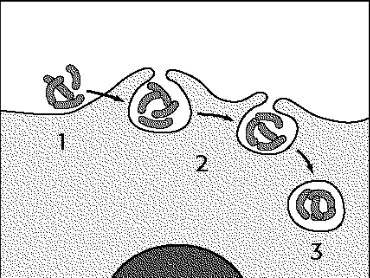
Refer to the illustration below. The process taking place is
endocytosis
exocytosis
pinocytosis
phagocytosis
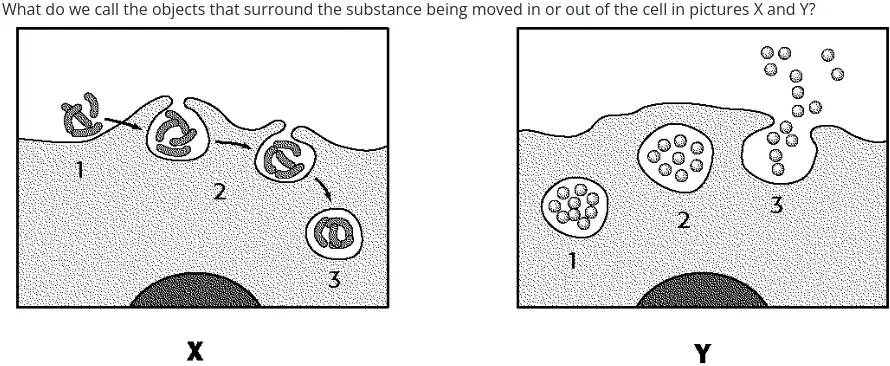
vehicles
pumps
vesicles
vessels

A. Which part of the phospholipid is considered hydrophilic?
The structure labeled 1.
The structure labeled 2.
none
all
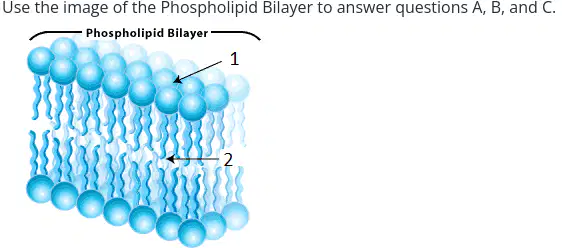
B. Which part of the phospholipid is considered hydrophobic?
The structure labeled 2.
All of the phospholipid is hydrophilic.
None of the phospholipid is hydrophobic .
The structure labeled 1.
C. What characteristics of the cells membrane make it important to the cell? Choose 3.
To separate the internal and external environment of the cell
To protect the internal environment
To regulate what enters and leaves the cell
To make ribosomes
To make proteins

