
 Worksheets
Genetics Unit Review
Total questions: 95
Worksheet time: 1hrs 24mins
Both DNA and RNA are nucleic acids.
True
False
I am usually a single stranded molecule
DNA
RNA
Both
I am generally found both inside and outside of the nucleus.
DNA
RNA
Both
I am arranged as a double helix
DNA
RNA
Both
I am made of guanine, cystosine, adenine, and uracil
DNA
RNA
Both
I am made of guanine, cytosine, adenine, and thymine
DNA
RNA
Both
I am made of nucleotides.
DNA
RNA
Both
I only stay in the nucleus and cannot leave.
DNA
RNA
Both
I contain the sugar deoxyribose.
DNA
RNA
Both
I contain the sugar ribose.
DNA
RNA
Both
I contain the instructions for making thousands of different proteins.
DNA
RNA
Both
I contain the instructions for making just one protein.
DNA
RNA
Both
What does mRNA stand for?
messenger RNA
transfer RNA
mild RNA
machine RNA
What does tRNA stand for?
tall RNA
transfer RNA
messenger RNA
transition RNA
What does rRNA stand for?
rough RNA
right RNA
ribosomal RNA
short DNA
Which type of RNA is a copy of one small section of DNA (gene)?
mRNA
tRNA
rRNA
iRNA
What type of RNA carries amino acids to the place where proteins are made?
mRNA
tRNA
rRNA
uRNA
Which RNA is the place where proteins are made?
mRNA
tRNA
rRNA
dRNA

What type of RNA is shown?
mRNA
tRNA
rRNA

What type of RNA is shown?
mRNA
tRNA
rRNA

What type of RNA is shown?
mRNA
tRNA
rRNA
ATG TGA CAG


AATCATGGA


What is the outcome of DNA transcription and translation?
Make muscles
Make protein
Make cells
Make DNA
What is the basic unit (monomer) of DNA?
Phosphate Group
Nucleotide
Amino Acid
Monosaccharide
What shape is DNA?
Alpha Helix
Double Helix
Tangled
Flat
DNA is the (a) of life .
DNA is found in the (a) . This is also where mRNA is created.
What is true of RNA? (select all that apply)
Single Strand
Contains uracil
Ribose Sugar
Deoxyribose Sugar
What is true of DNA?
Double Helix
Contains Thymine
Deoxyribose Sugar
Ribose Sugar
The m in mRNA stands for (a)
What subunits comprise a ribosome?
large and small
big and little
big and small
large and little
Which amino acid will be added to a protein chain if the codon is UAA?
Ser
Lys
Ala
STOP

What describes a change in the DNA sequence?
Transcription
Translation
DNA replication
Mutation
Apoptosis
What describes programmed cell death?
Transcription
Translation
DNA replication
Mutation
Apoptosis

What type of mutation involves substituting a DNA base with a different base?
point mutation
frameshift mutation
silent mutation
chromosomal mutation

What type of mutation involves substituting a DNA base with a different base but still forms the same protein?
point mutation
frameshift mutation
silent mutation
chromosomal mutation
What type of mutation involves adding or deleting bases from the DNA, which results in new codons (a shift in the reading of the codons)?
point mutation
frameshift mutation
silent mutation
chromosomal mutation
Original DNA = TAC GAC TTG AAT
Mutated DNA = TAC GAC TCG AAT
What type of mutation has occurred?
Chromosomal mutation
Point mutation
Frameshift mutation
No mutation occurred
Original DNA = TAC GAC TTG AAT
Mutated DNA = TAC GTA CTT GAA T
What type of mutation has occurred?
Chromosomal mutation
Point mutation
Frameshift mutation due to adding extra base
Frameshift mutation due to deletion of base
Original DNA = TAC GAC TTG AAT
Mutated DNA = TAC GAC TTG AAT
What type of mutation has occurred?
Chromosomal mutation
Point mutation
Frameshift mutation
No mutation occurred

What type of chromosomal mutation occurred?
chromosomal insertion/duplication
chromosomal deletion
chromosomal inversion
chromosomal translocation

What type of chromosomal mutation occurred?
chromosomal insertion/duplication
chromosomal deletion
chromosomal inversion
chromosomal translocation

What type of chromosomal mutation occurred?
chromosomal insertion/duplication
chromosomal deletion
chromosomal inversion
chromosomal translocation

What type of chromosomal mutation occurred?
chromosomal insertion/duplication
chromosomal deletion
chromosomal inversion
chromosomal translocation
Original DNA = TAC GAC TTG AAT
Mutated DNA = TAC ACT TGA AT
What type of mutation has occurred?
Chromosomal mutation
Point mutation
Frameshift mutation due to addition of base
Frameshift mutation due to deletion of base

What are considered "negative" mutations?
mutations in the DNA sequence that changes the resulting protein and harms the organism
mutations in the DNA sequence that changes the resulting protein and benefits the organism
mutations in the DNA sequence that produces the same protein
all mutations are considered bad and harm the organisms
What are considered "positive" mutations?
mutations in the DNA sequence that changes the resulting protein and harms the organism
mutations in the DNA sequence that changes the resulting protein and benefits the organism
mutations in the DNA sequence that produces the same protein
all mutations are considered bad and harm the organisms

What are considered neutral mutations?
mutations in the DNA sequence that changes the resulting protein and harms the organism
mutations in the DNA sequence that changes the resulting protein and benefits the organism
mutations in the DNA sequence that produces the same protein
all mutations are considered bad and harm the organisms

In humans, the haploid number of chromosomes is ____.
23
46
69
92
Which of the following is the best definition for MEIOSIS?
the process of two haploid cells uniting
the counting of chromosomes within a diploid cell
a two-step process that reduces the number of chromosomes in half such that there is only one copy of all the chromosomes
the equational division of a cell into two identical copies
True or False? Before cells undergo meiosis they pass through interphase first.
true
false
What is unique to Prophase I- is that the duplicated chromosomes pair up to form _______.
a centrosome
a tetrad
the mitotic spindle
sister chromatids

In which stage of MEIOSIS does crossing over occur? (The exchange of genetic material between chromosomes in a tetrad.)
Anaphase I
Metaphase I
Prophase I
Telophase I
In which stage of MEIOSIS does crossing over occur? (The exchange of genetic material between chromosomes in a tetrad.)
Anaphase I
Metaphase I
Prophase I
Telophase I
In Metaphase I, tetrads line up along the _______.
mitotic spindle
centrosomes
equatorial plane
contractile ring
In Anaphase I, the _________ are separated by the pulling of the spindle fibers to opposite poles of the cell.
homologous pairs of chromosomes
sister chromatids
centromeres
centrosomes
In Prophase II, the_________ reforms and the spindle fibers attach to each chromosome.
mitotic spindle
centrosomes
nucleus
cell plate
In Metaphase II, _________ line up on equatorial plane.
homologous pairs of chromosomes
single chromosomes (made up of 2 sister chromatids)
tetrads
centrosomes
In Anaphase II, the _________ separate.
Homologues
Sister Chromatids
Tetrads
Centrioles
How many cells are formed at the end of Meiosis II?
2
3
4
8
True or False. In Meiosis II, there are TWO cells that go through each phase at the same time.
true
false
The products of MEIOSIS have _______ number of chromosomes.
haploid
diploid

Which suspect left the blood stain?
Bob
Sue
John
Lisa
Which molecule represents RNA (ribonucleic acid)?
RNA stands for (a) . The sugar in RNA is (b) . RNA is (c) stranded.
Which base pairs with A in RNA? (a)
3 consecutive nitrogen bases that specify an amino acid
codon
3 bases complementary to mRNA codon located on tRNA
anticodon
type of single stranded RNA that carries genetic information from DNA to the ribosome where proteins are made
mRNA
single stranded RNA molecule that delivers amino acids to the growing polypeptide chains
tRNA
14.2 The “language” of RNA is called the (a) , and it uses three-letter “words” called (b) .
In RNA, A pairs with (a) and C pairs with (b)
Label the image
Tap on the part of DNA that is the code for your traits

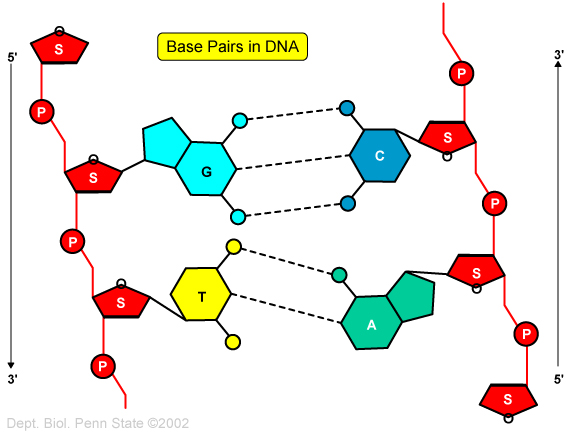
Label the parts of the DNA strand:
A. (a)
B. (b)
C. (c)
D. (d)
Move the nucleotide parts to their spot
In your groups, label the parts of the DNA structure.

