
 Worksheets
Tectonic Plates
Total questions: 34
Worksheet time: 17mins
Name
Class
Date
1.
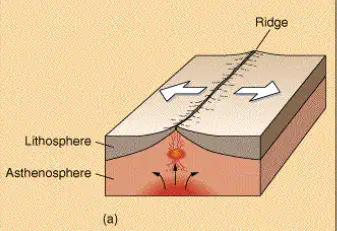
Identify the type of plate boundary in this picture.
a)
Convergent
b)
Divergent
c)
Transform
d)
Tectonic
2.
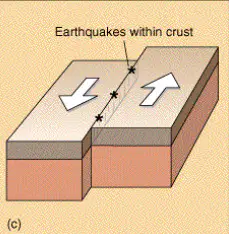
Identify the type of plate boundary in this picture.
a)
Convergent
b)
Divergent
c)
Transform
d)
Tectonic
3.
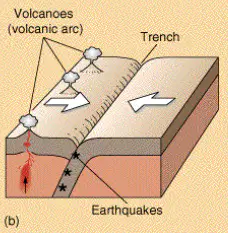
Identify the type of plate boundary in this picture.
a)
Convergent
b)
Divergent
c)
Transform
d)
Tectonic
4.
The circulation of material caused by differences in density is called convection.
a)
True
b)
False
5.
As new seafloor moves away from an ocean ridge, the seafloor cools and becomes less dense than the material beneath it.
a)
True
b)
False
6.
The weight of a subducting plate helps to pull the lithosphere into a subduction zone in a process called ridge push
a)
True
b)
False
7.
Scientists at the time rejected Wegener’s hypothesis of continental drift because he could not explain how or why Earth’s continents move.
a)
True
b)
False
8.
According the theory of plate tectonics, plates interact at plate boundaries by deflecting each other, moving away from each other, or moving horizontally past each other.
a)
True
b)
False
9.
If two continental plates converge, a subduction zone forms.
a)
True
b)
False
10.
Some early mapmakers thought that the coastline of South America matched the coastline of Africa
a)
True
b)
False
11.
Scientists have observed that the continents move apart or come together at speeds of a inches per ____.
a)
century
b)
decade
c)
day
d)
year
12.
The boundary between two plates moving together is called a ____.
a)
divergent boundary
b)
convergent boundary
c)
transform boundary
d)
lithosphere
13.
Many early mapmakers thought Earth’s continents had moved based on ____.
a)
plate boundary locations
b)
fossil evidence
c)
climatic data
d)
matching coastlines
14.
In order to complete a convection current, the rising material must eventually ____ Earth.
a)
stop inside
b)
cool
c)
sink back into
d)
warm
15.
____ is a fossil fern that helped support Wegener’s hypothesis of continental drift.
a)
Gondwanaland
b)
Kannemeyerid
c)
Mesosaurus
d)
Glossopteris
16.
A ____ can also form when two oceanic plates collide.
a)
hot spot
b)
line of volcanoes
c)
transform boundary
d)
rift valley
17.
Seafloor spreading occurs because ____.
a)
new material is being added to the asthenosphere
b)
earthquakes break apart the ocean floor
c)
sediments accumulate at the area of spreading
d)
molten material beneath Earth's crust rises to the surface
18.
A ____ is a sensitive device used to detect magnetic fields on the seafloor.
a)
seismometer
b)
geologist's compass
c)
Glomar
d)
magnetometer
19.
A lack of explanation for continental drift prevented many scientists from accepting that a single supercontinent called ____ once existed.
a)
Glomar
b)
Glossopteris
c)
Pangaea
d)
Wegener
20.
The youngest part of the ocean floor is found ____.
a)
along deep sea trenches
b)
where ocean sediments are thickest
c)
near ocean ridges
d)
where Earth’s magnetic field changes polarity
21.
The hypothesis that continents have slowly moved to their current locations is called ____.
a)
continental drift
b)
continental slope
c)
magnetic reversal
d)
convection
22.
At an oceanic-oceanic convergent plate boundary, ____.
a)
new crust is created
b)
old crust is recycled by subduction
c)
old crust is deformed or fractured
d)
plates side past one another
23.
The result of plate movement can be seen at ____.
a)
abyssal plains
b)
ocean margins
c)
plate centers
d)
plate boundaries
24.
Matching ____ on different continents are evidence for continental drift.
a)
river systems
b)
rock structures
c)
weather patterns
d)
wind systems
25.
Plates slide past one another at ____.
a)
subduction zones
b)
transform boundaries
c)
convection currents
d)
divergent boundaries
26.
The Himalayan mountain range of India was formed at a ____.
a)
convergent boundary
b)
divergent boundary
c)
hot spot
d)
transform boundary
27.
The alignment of iron minerals in rocks when they are formed reflects the fact that Earth's ____ has reversed itself several times in the past.
a)
magnetic field
b)
core
c)
asthenosphere
d)
gravity
28.
Plates move apart at ____ boundaries.
a)
convergent
b)
stable
c)
divergent
d)
transform
29.
Crust is neither destroyed nor formed along which of the following boundaries?
a)
convergent
b)
divergent
c)
transform
d)
magnetic
30.
The presence of the same ____ on several continents supports the hypothesis of continental drift.
a)
fossils
b)
rocks
c)
neither a nor b
d)
both a and b
31.
____ currents inside Earth might drive plate motion.
a)
Vertical
b)
Convection
c)
Horizontal
d)
none of the above
32.
Active volcanoes are most likely to form at ____.
a)
transform boundaries
b)
divergent boundaries
c)
the center of continents
d)
convergent oceanic–continental boundaries
33.
Continental drift was not widely accepted when it was first proposed because ____.
a)
Wegener couldn’t explain why or how the continents moved
b)
continental landmasses were too big to move slowly over Earth’s surface
c)
magnetic and sonar data proved that Wegener’s hypothesis was incorrect
d)
mantle convection currents weren’t in motion at that time
34.
The driving forces of tectonic plates are related to convection currents in Earth’s ____.
a)
crust
b)
mantle
c)
inner core
d)
outer core
100 %

