
 Worksheets
Grade 8 SRM -2
Total questions: 18
Worksheet time: 9mins
What is diffusion?
The movement of particles from an area of low concentration to an area of high concentration.
The movement of particles from an area of high concentration to an area of even higher concentration.
The movement of particles from an area of low concentration to an area of even lower concentration.
The movement of particles from an area of high concentration to an area of low concentration.
Explain the concept of selective permeability.
Selective permeability is the property of a membrane to only allow large molecules to pass through while restricting the passage of small molecules.
Selective permeability is the property of a membrane to only allow gases to pass through while restricting the passage of liquids.
Selective permeability is the property of a membrane to allow all substances to pass through without any restriction.
Selective permeability is the property of a membrane to only allow certain substances to pass through while restricting the passage of others.
Define hypertonic solution and provide an example.
An example of a hypertonic solution is distilled water.
A hypertonic solution has a lower solute concentration than the cell.
An example of a hypertonic solution is a 10% salt solution.
A hypertonic solution causes a cell to swell.
What happens to a cell in a hypotonic solution?
It remains the same size
It shrinks and becomes dehydrated
It swells and may burst
It multiplies and forms a colony
Describe an isotonic solution and its effect on cells.
An isotonic solution has a higher concentration of solutes than the cell, causing water to rush into the cell and burst.
An isotonic solution has no effect on cells and does not impact the movement of water.
An isotonic solution has the same concentration of solutes as the cell, causing no net movement of water in or out of the cell.
An isotonic solution has a lower concentration of solutes than the cell, causing water to rush out of the cell and shrink.
Differentiate between facilitated diffusion and active transport.
Facilitated diffusion is passive, while active transport is active.
Facilitated diffusion involves the use of transport proteins, while active transport does not.
Facilitated diffusion moves molecules against the concentration gradient, while active transport moves molecules with the concentration gradient.
Facilitated diffusion requires energy, while active transport does not.
How does osmosis differ from diffusion?
Osmosis involves the movement of water molecules, while diffusion involves the movement of particles.
Osmosis and diffusion are the same process.
Osmosis only occurs in plants, while diffusion only occurs in animals.
Osmosis involves the movement of particles, while diffusion involves the movement of water molecules.
Explain the process of osmosis in plant cells.
Water molecules move from an area of high concentration to an area of low concentration through a selectively permeable membrane.
Osmosis is the movement of nutrients from the soil into the plant cells.
Water molecules move from an area of low concentration to an area of high concentration through a selectively permeable membrane.
Osmosis only occurs in animal cells, not in plant cells.
What role does the cell membrane play in osmosis?
Has no effect on osmosis
Regulates the movement of water and solutes
Prevents the movement of water and solutes
Causes the cell to shrink
Discuss the importance of osmosis in living organisms.
Osmosis is only important for the movement of gases across cell membranes
Osmosis has no importance in living organisms
Osmosis is important for the movement of water and nutrients across cell membranes.
Osmosis only occurs in non-living matter
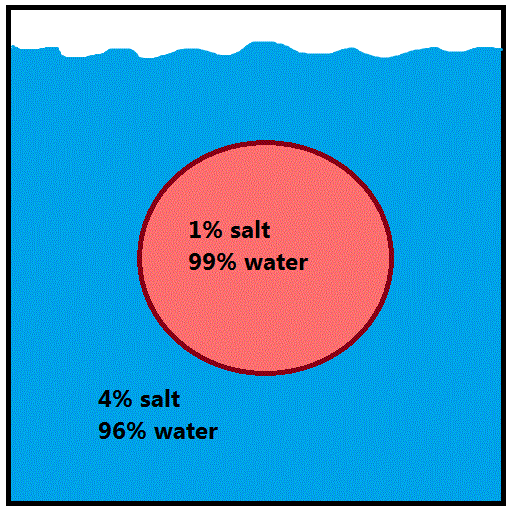

What is the movement of particles with the concentration gradient using protein "helpers"?
diffusion
facilitated diffusion
active transport
enzymatic reactions

Active transport is movement of particles through the cell membrane from a region of ...1... to a region of ...2... using energy in the form of ...3...
1: lower concentration, 2: higher concentration, 3: NADPH
1: higher concentration, 2: lower concentration, 3: NADPH
1: higher concentration, 2: lower concentration, 3: ATP
1: lower concentration, 2: higher concentration, 3: ATP
Which one is the definition of active transport?
movement of particles through the cell membrane from a region of lower concentration to a region of higher concentration using energy in the form of ATP.
passage of water molecules from a region of their higher concentration to a region of their lower concentration through a partially permeable membrane
net movement of molecule from a region of higher concentration to region of lower concentration. Molecule down a concentration gradient
net movement of molecule from a region of lower concentration to region of higher concentration. Molecule down a concentration gradient



