
 Worksheets
Human Population and Natural Events Quiz
Total questions: 16
Worksheet time: 21mins
What is the formula used to calculate population growth rate?
TotalPopulation(Births+Immigration)−(Deaths+Emigration)×100
TotalPopulation(Births−Deaths)+(Immigration−Emigration)×100
TotalPopulation(Births−Deaths)×100
TotalPopulation(Births+Deaths)×100
Which of the following is considered a natural disaster?
Oil spill
Earthquake
Factory explosion
Deforestation
Urbanization can lead to which of the following environmental impacts?
Increased biodiversity
Reduced air pollution
Increased green spaces
Increased surface runoff
What is resource depletion?
The addition of resources to an ecosystem
The sustainable use of resources
The consumption of a resource faster than it can be replenished
The discovery of new resources
Which factor does NOT directly contribute to population growth rate?
Birth rate
Death rate
Migration
Technological advancements
What is the primary cause of urbanization?
People moving from rural to urban areas for better employment opportunities
Decrease in agricultural jobs
Increase in birth rate
Decrease in urban living costs
How do natural disasters affect population distribution?
They have no significant effect
They encourage population growth in disaster-prone areas
They can lead to migration away from affected areas
They increase the birth rate in affected areas
What is the impact of urbanization on water resources?
Improved water quality due to advanced treatment facilities
Decreased demand for water resources
Increased pollution and overuse of water resources
Increased natural water recharge areas
Which of the following best describes the term "sustainable development"?
Development that meets the needs of the present without compromising the ability of future generations to meet their own needs
Rapid development of urban areas without considering environmental impacts
The use of natural resources at a rate that exceeds their replenishment
Focusing solely on economic development without regard for social equity
What role does technology play in managing resource depletion?
It has no significant impact
It exacerbates the problem by increasing consumption
It can offer solutions through the development of sustainable alternatives
It solely focuses on finding new resources
Which of the following is NOT a direct effect of population growth on the environment?
Increased carbon footprint
Reduced biodiversity
Enhanced natural resource management
Greater demand for food and water
How does deforestation contribute to climate change?
By increasing the amount of oxygen in the atmosphere
By reducing the Earth's surface albedo
By releasing stored carbon dioxide when trees are cut down
By increasing the Earth's capacity to absorb sunlight
What is the main reason for the increase in urban heat islands?
Increased vegetation in urban areas
High albedo of urban surfaces
Concentration of buildings and asphalt which absorb and retain heat
Decreased vehicle emissions in urban areas
About 3 million Brazilian free-tailed bats live near Fredericksburg, Texas, in an abandoned railroad tunnel. Eighty percent of the free-tail's diet includes agricultural pests such as the cutworm, corn borer, and webworm moths. Each can eat its weight in insects nightly, and the whole colony may devour over 25 tons of moths per night. The bats return to the tunnel between midnight and daybreak, having traveled an average 25 to 30 miles to forage.
As the population of bats increases, it is expected that the crop production in nearby areas will —
show a minimal response
remain constant
be cut in half
steadily increase
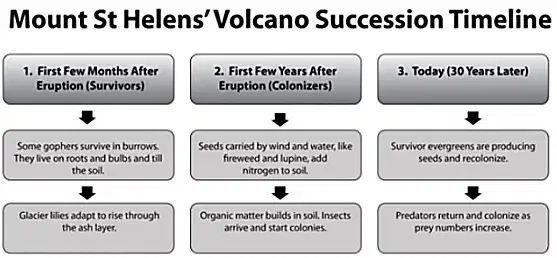
According to the diagram above, which of the following is a correct analysis of the effects of the Mount St. Helens eruption on the surrounding taiga biome?
The evergreen forest will never be able to recover.
In order for many plants and trees to recolonize, organic material and nutrients must be added to the soil.
All plants and animals must migrate into the blast zone to begin succession.
The ecosystem was stable once the glacier lilies adapted.
A landowner in Louisiana read about the decimation of the red wolf through intensive predator control programs. He now wants to reintroduce the red wolf back onto his land. He contacted the U.S. Fish and Wildlife Service to determine an appropriate starting population and then reintroduced the animals to his land. Food is plentiful and there are no natural predators. The landowner spends several years graphing the number of individuals (on the vertical axis) against the number of generations (on the horizontal axis).
By the 10th generation, the population begins to reach carrying capacity. According to the information above, which statement best defines this mathematical model used in population studies?
At a high population level, population-limiting factors strongly oppose the population’s potential to increase. It stabilizes at the carrying capacity when birth rate equals death rate.
At a high population level, no more resources are available. The population crashes and returns to its original numbers at introduction.
At a high population level, the exponential growth model is in place, which places no restrictions on population growth.
At a high population level, the growth rate becomes negative and will stay that way. Populations in decline are not able to recover.

