
NEW
Font size
 Worksheets
Unit Three Review
Total questions: 35
Worksheet time: 18mins
During the early to mid-1700s, the British policy of salutary neglect toward the American colonies contributed to
a decline in colonial manufacturing
the decline of slavery in the northern colonies
a decrease in French and Spanish influence in North America
the development of independent colonial trade practices

Which statement most accurately expresses the main idea of this illustration from the 1750s?
Colonies can only survive if they are united.
Each colony should maintain its independence.
Any colony that does not unite will be attacked.
Colonies that do not unite are not loyal.
What was a result of the French and Indian War that led directly to the American Revolution?
The British lost most of their colonies in the Americas.
French colonies expanded west of the Appalachians
England decided to make the American colonists help pay war debts.
Native American Indians were given lands west of the Appalachians.
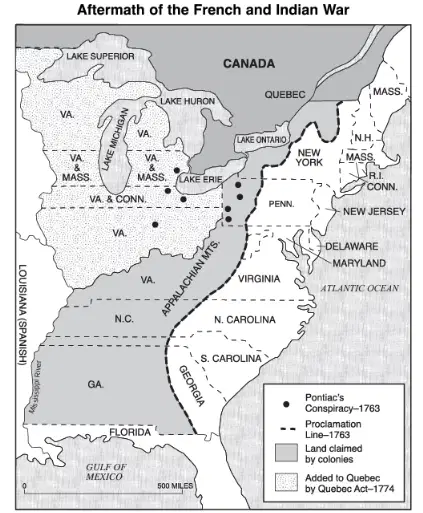
Many colonists were angered by the Proclamation of 1763 because it
took too much land from Canada
limited their freedom to move west
gave Florida to the French
encouraged raids by Native American Indians
Which event in colonial history is most closely associated with freedom of the press?
The Stamp Act
John Peter Zenger case
Salem witch trials
Boston Tea Party
“…give me liberty or give me death!” “A government of our own is our natural right…”
During the period of the American Revolution, these statements were made by members of which group?
Tories
Redcoats
Loyalists
Patriots
Samuel Adams, John Hancock, John Adams and Paul Revere were all part of this group:
Sons of Liberty
American Legion
Loyalists of Freedom
Sons of Washington
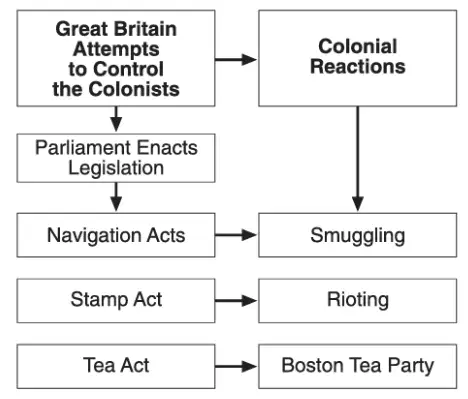
Which conclusion is best supported by the chart?
The Stamp Act led to widespread smuggling.
British policies were opposed by many colonists.
Colonists raised money by imposing new taxes.
The colonists reacted to British laws in a nonviolent way.
The “Shot Heard Around the World” happened at:
Yorktown
Concord
Saratoga
Lexington
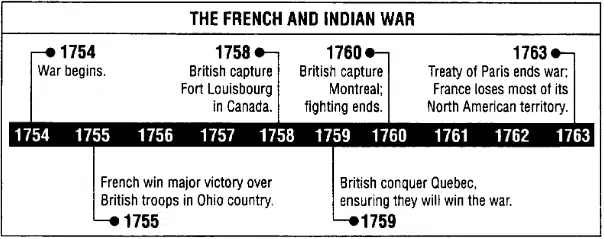
In which year did France lose most of its land claims?
1755
1763
1759
1754
The major reason the British government issued the Proclamation of 1763, which banned colonial settlement west of the Appalachian Mountains, was to
reduce casualties during the French and Indian War
maintain markets for British manufactured goods
avoid conflicts with Native American Indians
promote easy collection of new taxes
The belief that colonies exist to benefit the economy of the mother country is known as
mercantilism
free trade
nativism
triangular trade
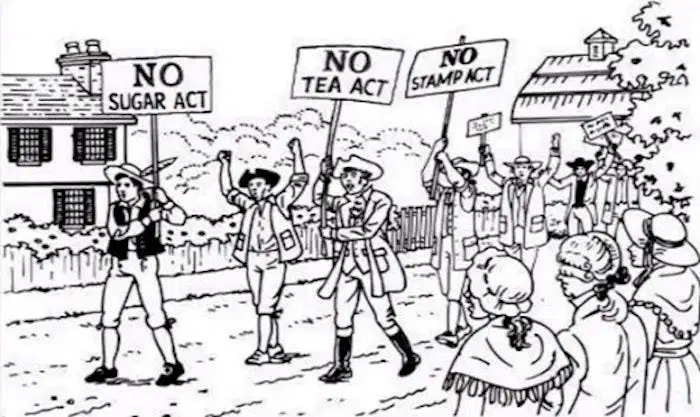
The slogan “No taxation without representation” referred to taxes enacted by
colonial legislators
town meetings
the First Continental Congress
the English Parliament
Colonial boycotts of British goods before the Revolutionary War were effective measures because they
reduced the profits of British merchants
allowed the Americans to start their own factories
lowered the prices of imported products
allowed the Americans to start their own factories
Which statement expresses an opinion about the causes of the Revolutionary War?
The Boston Massacre took place on March 5, 1770.
Colonists participated in triangular trade.
The Quartering Act was a serious violation of the colonists’ liberties.
Samuel Adams founded the Sons of Liberty.
Who wrote most of the Declaration of Independence?
Thomas Jefferson
John Adams
Patrick Henry
Benjamin Franklin
Thomas Paine was critical for the revolutionary movement when he wrote this document to unite the colonies together:
Star Wars
Common Sense
War and Peace
The Crisis

The main goal of most of the policies shown in the illustration was to
encourage Americans to trade with other European countries
enable Great Britain to raise money and control trade
encourage immigration to the colonies
allow American colonists greater self government
Which of the following is NOT a natural right according to the Declaration of Independence?
Life
Liberty
Privacy
Property
Select the correct allies that the Continental Army had in the American Revolution.
France and Spain
Italy and Spain
Great Britain and Ireland
Spain and Germany
In order to get help from France, the Continental Army had to.
Give them a lot of money
Win at the Battle of Saratoga
Lose at the Battle of Saratoga
Agree to give them supplies and weapons
Guerilla Warfare can be best described as
Soldiers fighting like gentleman
Soldiers fighting using techniques like surprise, ambushing, and disruption
Standing in a line out in the open and not moving
A combat method that involves peacefully exchanging information
After seeing the Continental Army fight and win at Saratoga, __________ decides to become allies in the following battles.
France
Spain
Great Britain
Mexico
In the Treaty of Paris (1783), Britain agreed to all of the following EXCEPT
Immediately accept America's independence
Repay their debts
Have the colonists pay them back for the money spent on the war.
Return captured property (including slaves)
Which set of events is in the correct chronological order?
Boston Tea Party → Declaration of Independence → French and Indian War
French and Indian War → Declaration of Independence → Boston Tea Party
French and Indian War → Boston Tea Party → Declaration of Independence
Declaration of Independence → French and Indian War → Boston Tea Party
Many American colonists believed that British tax laws were unfair because
taxes were higher in the colonies than in England
the British treasury had a surplus of funds
Native American Indians were exempt from British tax laws
colonists lacked representation in Parliament
Which statement is most consistent with the views of Loyalists in the 1770s?
The king is violating the rights of British citizens.
Taxation without representation is tyranny.
The colonists should be grateful to be under British rule and protection.
Citizens, under British rule, have the right to declare independence.
What was the major effect of the Stamp Act (1765) on colonial trade?
Many colonists boycotted British goods.
The British refused to sell certain products to the colonists.
The colonists no longer needed British goods.
The law led to a decline in the value of colonial currency.
What impact did the French and Indian War have on the relationship between the American colonies and England.
The relationship stayed the same
The relationship increased
There was no relationship
The relationship worsened
The Albany Plan of Union called for
a joint colonial council for defense
separation from England
a declaration of war on England
equal voting rights for all citizens
Which document is a primary source concerning the American Revolution?
a published article written by a history teacher
a videotape showing a reenactment of a battle
a social studies textbook
a journal of the events written by a Continental soldier
“ Don’t fire till you see the white’s of their eyes!”
Which of the following battles is this quotation associated with?
Treaty of Paris
Lexington & Concord
Pearl Harbor
Bunker Hill
The Treaty of Paris (1787) is most known for
Starting the French and Indian War
Starting the American Revolution
Ending the American Revolution
Starting the Seven Years War
The first traitor of the United States was
Benedict Arnold
Samuel Adams
Molly Pitcher
Francis Marion
The Battle of Saratoga was significant in the Revolutionary War because it
ended the British threat to the South
convinced the French to support the Americans
guaranteed Canadian help for the colonists
forced the British to withdraw from North America

