wayground logo

Free Printable Worksheets

NEW

Font size

S
M
L
XL
Worksheets

DNA Replication

Total questions: 48

Worksheet time: 39mins

Name
Class
Date
1.
Which of the following units are repeatedly joined together to form a strand of DNA?
a)
amino acids
b)
nucleotides
c)
fatty acids
d)
polysaccharides
2.
DNA replication results in two DNA molecules,
a)
each one with two original strands
b)
each one with two new strands
c)
each one with one new strand and one original strand
d)
one with two new strands and the other with two original strands
3.
In what phase of the cell cycle does DNA replication take place?
a)
G1
b)
S
c)
G2
d)
M
4.
Which of the following must happen first in order for DNA replication to occur?
a)
DNA polymerase binds to the leading strand
b)
DNA is unwound
c)
Hydrogen bonds form between bases
d)
chromosomes condense
5.
Okazaki fragments form on the:
a)
lagging strand
b)
leading strand
c)
base-pairs
d)
5' end
6.
During replication, what enzyme adds complimentary bases?
a)
helicase
b)
synthesase
c)
ligase
d)
polymerase
7.

Direction that DNA is replicated

a)

3' to 5'

b)

5' to 3'

8.
What strand is copied faster?
a)
Leading
b)
Lagging
9.

H is the

a)

leading strand

b)

lagging strand

c)

parent strand

d)

none of these

10.
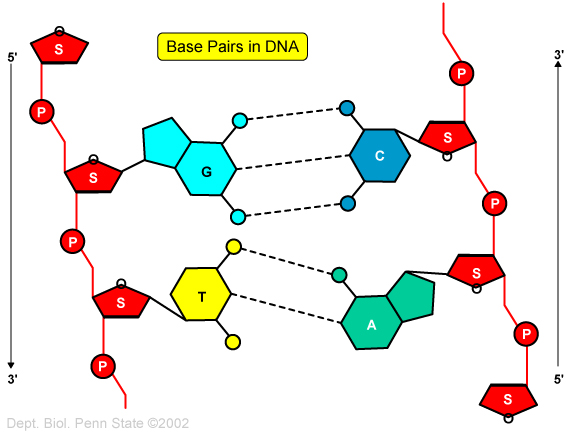
Which sequence of DNA bases would pair with this partial strand
ATG TGA CAG
a)
ATG TGA CAG
b)
TAC ACT GTC
c)
GTA AGT GAC
d)
CAT TCA CTG
11.
In a molecule of double-stranded DNA, the amount of Adenine present is always equal to the amount of
a)
cytosine
b)
guanine
c)
thymine
d)
uracil
12.
Guanine bonds with ______________.
a)
Adenine
b)
Guanine
c)
Cytosine
d)
Thymine
13.
Which 2 molecules form the sides (backbone) of the DNA ladder?
a)
deoxyribose sugar and adenine
b)
deoxyribose sugar and a hydrogen bond
c)
deoxyribose sugar and the nucleus
d)
deoxyribose sugar and phosphate
14.
Nitrogenous bases are joined by which type of bond?
a)
polar bonds
b)
ionic bonds
c)
covalent bonds
d)
hydrogen bonds
15.
Which organelle is DNA usually found in?
a)
cell membrane
b)
vacuole
c)
chloroplast
d)
nucleus
16.
What are the 4 nitrogen bases?
a)
adenine, thymine, cytoplasm, and guanine
b)
adenine, thymine cytosine, and guanine
c)
adenine, thymine, cytosine, and gylcerol
d)
adenine, thymine, cytosine, and glucose
17.
In the diagram strand I and II represent portions of DNA molecule. Strand II would normally include...
a)
AGC
b)
TCG
c)
TAC
d)
GAT
18.
Why is it crucial that living things are able to replicate their DNA?
a)
Each cell must have its own DNA
b)
Less copies of DNA are needed when a new cell is created
c)
A cell needs multiple copies of DNA
d)
Only muscle cells need DNA 
19.
The DNA is found in the nucleus of what type of organisms?
a)
Bacteria
b)
Eukaryotes
c)
Prokaryotes
d)
Viruses
20.
Which of the following best describes a DNA molecule?
a)
double helix
b)
contains ribose
c)
made of amino acids
d)
contains Uracil
21.
Why is DNA important?
a)
it is very small and very complicated
b)
it's in everything
c)
it serves as the blueprint for traits of all living things
d)
because we eat it every day for energy
22.

The picture below shows the steps of DNA replication beginning with step one and ending with step three.


​Because you are reusing the old, or parent, DNA strand DNA replication is said to be

a)

Semi- Conservative

b)

Semi-discontinuous

c)

Continuous

d)

Fully-Conserveative

23.
What are the three components of a nucleotide?
a)
sugar, hydrogen, nitrogen base
b)
sugar, oxygen, nitrogen base
c)
sugar, phosphate, nitrogen base
d)
sugar, phosphate, protein
24.
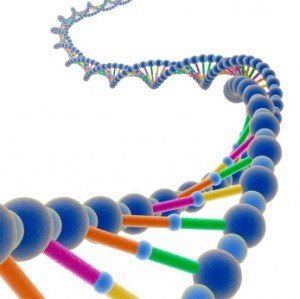
This picture is illustrating the ____ nature of DNA.
a)
anti-parallel
b)
deoxyribosic
c)
helical
d)
radioactive
25.

Amount of A=T and G=C

a)

Chargaff

b)

Franklin

c)

Watson and Crick

d)

Hershey and Chase

26.

Came up with the term 'transforming principle'

a)

Mendel

b)

Griffith

c)

Avery

d)

Hershey and Chase

27.

Was the first to say that DNA was the 'transforming principle'

a)

Mendel

b)

Griffith

c)

Avery

d)

Hershey and Chase

28.

Created models of DNA

a)

Chargaff

b)

Franklin

c)

Watson and Crick

d)

Hershey and Chase

29.

Studied bacteriophages

a)

Mendel

b)

Griffith

c)

Avery

d)

Hershey and Chase

30.

Used x-rays to take pictures of DNA

a)

Chargaff

b)

Franklin

c)

Watson and Crick

d)

Hershey and Chase

31.

Figured out the amount of A, T, G, and C that many different organisms have

a)

Chargaff

b)

Franklin

c)

Watson and Crick

d)

Hershey and Chase

32.

Created radioactive viruses to see what their genetic material was made of

a)

Mendel

b)

Griffith

c)

Avery

d)

Hershey and Chase

33.

Conducted research on bacteria that cause pneumonia

a)

Mendel

b)

Griffith

c)

Avery

d)

Hershey and Chase

34.
Which two radioactive isotopes were used to label the DNA and protein components of viruses called bacteriophages?
a)
Nitrogen and Phosphorus
b)
Phosphorus and Sulfur
c)
Nitrogen and Sulfur
35.
The work of scientists including Griffin, Avery, Hershey & Chase, and Franklin helped us to determine that _______ are responsible for carrying genetic material.
a)
Amino Acids
b)
Proteins
c)
Nucleic Acids
d)
Carbohydrates
36.
Which scientists used viruses and radioactive isotopes to definitively prove that DNA, and not protein, was the molecule of heredity?
a)
Griffith and Avery
b)
Chargaff and Franklin
c)
Watson and Crick
d)
Hershey and Chase
37.
What did Avery use to destroy proteins, lipids, and carbohydrates to show that DNA was the transforming factor?
a)
Bacteriophages
b)
X-ray diffraction
c)
Enzymes
d)
Radioactive isotopes
38.
Who discovered the process of transformation while trying to create a vaccine against bacterial pneumonia?
a)
Griffith
b)
Avery
c)
Hershey and Chase
d)
Watson and Crick
39.
What organism was Griffith using when he discovered that a harmless strain of bacteria could transform into a lethal strain of bacteria?
a)
pea plants
b)
fruit flies
c)
bacteriophages
d)
mice
40.
This scientist(s) conducted experiments that involved injecting mice with S bacteria and R bacteria.
a)
Avery
b)
Griffith
c)
Watson & Crick
d)
Hershey & Chase
41.

What is "B"?

a)

Nucleotide

b)

Deoxyribose Sugar

c)

Nitrogenous base

d)

Phosphate

42.

What is "C"?

a)

Nucleotide

b)

Deoxyribose Sugar

c)

Nitrogenous base

d)

Phosphate

43.

What is the molecule in the image?

a)

Nucleotide

b)

Deoxyribose Sugar

c)

Nitrogenous base

d)

Phosphate

44.

Adenine and Thymine are held together by ____ hydrogen bonds, while cytosine and guanine are held together by ___ hydrogen bonds.

a)

1,2

b)

3,2

c)

2,3

d)

1,2

45.
A fossilized cell is discovered, and evidence suggests it reproduced on its own and had DNA, but a membrane did not enclose its DNA. Which type of organism would this most likely be?
a)
prokaryote
b)
eukaryote
c)
plant cell
d)
animal cell
46.
The concept that DNA is made of two strands running in opposite directions is called:
a)
Antiparallel
b)
Isomerism
c)
Enantiomerism
d)
S/R Chirality
47.
DNA found at the end of each chromosome is called a:
a)
Telomere
b)
Centromere
c)
Kinetochore
d)
Histone
48.
Small segments of DNA made on the lagging strand are called:
a)
Okazaki Fragments
b)
ERVs
c)
Transposable Elements
d)
Telomeres