
 Worksheets
Gas properties and Partial Pressure
Total questions: 20
Worksheet time: 15mins
Name
Class
Date
1.
How are pressure and volume related?
a)
Directly
b)
Indirectly
c)
They aren't related
2.
Gas molecules can easily be compressed because ___________.
a)
gas molecules are soft
b)
gas molecules are far apart
c)
gas molecules follow the shape of the container
3.
Pressure is caused by ______.
a)
gravity.
b)
gas molecules colliding with each other.
c)
gas molecules colliding with surfaces of the container.
d)
gas molecules reacting with each other.
4.

Which container will have lower pressure?
a)
left
b)
right
c)
they both have the same pressure
5.
You decide to make a balloon animal. As the balloon is being twisted, it increases the pressure inside of the balloon. What happens to the volume?
a)
It increases
b)
It decreases
c)
It stays the same
6.
Which of the following would increase the (gas) pressure of a system?
a)
Increase the Temperature
b)
Decrease the volume
c)
Pump in more gas
d)
All of these
7.

How could you make the stopper pop out of the flask?
a)
Decrease pressure
b)
Decrease temperature
c)
Increase volume
d)
Increase temperature
8.

What relationship can be interpreted from the diagram?
a)
As volume decreases, pressure decreases
b)
As pressure increases, volume increases
c)
As moles increase, temperature increases
d)
As pressure increases, volume decreases
9.

What 2 variables are used in a Hot Air Balloon?
[Hint: Space and Heat]
[Hint: Space and Heat]
a)
Pressure and Volume
b)
Volume and Temperature
c)
Temperature and Pressure
d)
Pressure, Temperature and Volume
10.
Pick the best answer to explain all properties of gases....
a)
They're fluids
Can be compressed
Little space between particles
Can be compressed
Little space between particles
b)
They're solids
Can be compressed
Lots of space between particles
Can be compressed
Lots of space between particles
c)
They're fluids
Cannot be compressed
Lots of space between particles
Cannot be compressed
Lots of space between particles
d)
They're fluids
Can be compressed
Lots of space between particles
Can be compressed
Lots of space between particles
11.

What happens to the average kinetic energy of matter when it is heated?
a)
It increases
b)
It decreases
c)
It doesn't change
d)
It cannot be determined
12.
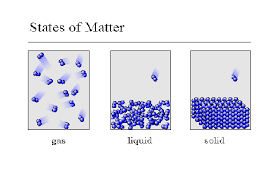
A gas
a)
has a definite shape but no definite volume
b)
has a definite volume but no definite shape
c)
has fast-moving particles
13.
What is condensation?
a)
gas to solid
b)
gas to liquid
c)
liquid to solid
d)
solid to liquid
14.

What does this picture represent?
a)
solid
b)
liquid
c)
gas
d)
plasma
15.
Dalton's Law states...
a)
that at a constant temperature the volume of a confined ideal gas varies inversely with its pressure.
b)
that the total pressure exerted by the mixture of non-reactive gases is equal to the sum of the partial pressures of individual gases
c)
how gases tend to expand when heated
d)
that the density of an ideal gas at constant pressure varies inversely with the absolute temperature of the gas.
16.

Which equation represents Dalton's Law?
a)
e=mc2
b)
PV=nRT
c)
P1/T1=P2/T2
d)
Ptotal=P1, P2, P3...
17.

Dalton's law of...
a)
Partial Pressure
b)
Thermodynamics
c)
Ideal Gas
d)
Physics
18.
Three gases, Ar, N2 and H2 are mixed in a 500L container. Ar has a pressure of 255 torr, N2 has a pressure of 228torr and H2 has pressure of 752torr. What is the total pressure in the container?
a)
483torr
b)
270torr
c)
1235torr
19.
A mixture of hydrogen, nitrogen, and water vapor has a total pressure of 864 mmHg. The partial pressure of hydrogen is 220 mmHg and that of nitrogen is 410 mmHg. What is the partial pressure of water vapor?
a)
234 mmHg
b)
1.37 mmHg
c)
2.64 mmHg
d)
1, 494 mmHg
20.
Which of the following is not true about gases?
a)
They spread out to fill their containers
b)
They have a low density.
c)
The particles move very slowly.
d)
The volume changes with whatever shape the room is.
100 %

