
 Worksheets
SOCIAL ENTREPRENEURSHIP
Total questions: 71
Worksheet time: 1hrs 9mins
Objective of an economy is to generate wealth and
welfare for the society, using the available resources.
TRUE
FALSE

When there is a _______ production externality, the free market _________ resources to the production of the good and too ______ of it is produced relative to the social optimum. This is shown by _______and _______ at the point of production, Qm, *
negative; misallocate; little; Qm > Qopt; MSC < MSB
positive; underallocate; much; Qm > Qopt; MSB > MSC
negative; overallocate; much; Qm > Qopt; MSC > MSB
positive; misallocate; much; Qm > Qopt; MSC > MSB

Which of the following is a characteristic of a merit good?
It could be provided by the free market, but not in sufficient quantities
It is always provided free to consumers
It tends to generate negative externalities, so governments restrict its consumption
Once the good has been supplied to one consumer, there is no additional cost in supplying it to others
Which of the following diagrams best represents the market for vaccines?


Which of the following diagrams best represents the market for sugary drinks?


Negative externality of production happens when
Marginal social cost is to the left of marginal private cost
Marginal social cost is to the right of marginal private cost
Marginal social benefit is to the left of marginal private benefit
Marginal social benefit is to the right of marginal private benefit
The use of advertisement to decrease negative externality of consumption affects
Marginal social cost
Marginal private cost
Marginal social benefit
Marginal private benefit
Complete market failure always exists when
there are negative externalities in production
the free market underprices demerit goods
the free market fails to provide sufficient merit goods
the market does not provide any public goods
Merit goods are likely to be underprovided in a free market economy because their
social benefits exceed their social costs
social benefits exceed their private benefits
private benefits exceed their social benefits
private costs exceed their private benefits
Where there is partial market failure
the product is both non-excludable and non-rival in consumption
the market can only be competitive with government support
a market exists but there is a misallocation of resources
there is excess demand in the market at the current market price
A good is excludable if
it is supplied by the government rather than through the free market
one person's use has no effect on the quantity available for someone else
it is supplied at a zero price
it is possible to prevent someone from enjoying its benefits
What is a distinguishing feature of a public good that is not found with private goods?
It creates negative externalities
Consumption depends on the ability to pay
Its consumption by one consumer can have an effect on othe consumers
Its consumption by one consumer does not restrict consumption by other consumers

Tax = P4-P2
Tax = P3-P2
Tax = P3-P1
Tax = P4-P2

Which of the following is true based on the graph shown?
Quantity of education in the private market is more than the socially optimal quantity
Producers of education could be taxed in order to achieve the socially optimal quantity
Consumption of education has a negative externality
Consumers of education could be subsidised in order to achieve the socially optimal quantity

The demand and supply schedules for grain are shown in the image. The government fixes the minimum price (price floor) at $18 per tonne. How much will this cost taxpayers, IF the government buys the entire economic surplus?
$72,000
$108,000
$144,000
$180,000
What is the reason why price ceilings are often imposed on essential goods and services, such as food products and rents on public housing?
To make these goods and services affordable to low-income earners
To reduce the consumption level of these goods and services
To create informal markets for these products
To create producer surplus for suppliers of these goods and services

HL: What is the change in consumer expenditure after the price ceiling?
£ 45,000
£ 135,000
£ 160,000
£ 115,000

HL: What is the change in producer revenue per week after the introduction of the price floor?
£ 200,000
£ 800,000
£ 1,000,000
£ 1,200,000
£ 2,000,000
Why does the government give subsidies?
To reduce negative externalities in a market
To increase consumption of merit goods
To increase the interest rate
To reduce travel costs
What is a subsidy?
Direct payments made by Producers to the Consumers
Direct payments made by Government to the Producers
Direct payments made by Government to the Consumers
Direct payments made by Government to the Stakeholders
Which 2 of the following are advantages of subsidies?
Reduces the price of raw materials
Reduces producer's cost of production
Increases production/output
Increases consumer's income

The government grants subsidy to producers. What are the 2 effects of this?
Price changes from P1-P
Quantity changes from Q-Q1
Quantity changes from Q1-Q
Price changes from P-P1
When PED<1,a subsidy will reduce cost of production AND prices which will result in...a 1._________ percentage change in 2.________
1.Greater, 2.Price
1.Lower, 2.Demand
1.Greater, 2.Demand
1.Lower, 2.Price
One effect of the subsidy is to increase:
Market Failure
Consumer surplus
Tax revenue
Producer surplus
This is the minimum price buyers are required to pay for a good. It's a lower limit for the price.
equilibrium
shortage
price floor
price ceiling
A price ceiling will result in a
shortage
surplus
equilibrium price
equilibrium quantity
A price ceiling will result in a
shortage
surplus
equilibrium price
equilibrium quantity
A price floor will result in a
shortage
surplus
equilibrium price
equilibrium quantity

Market failure results in a misallocation of resources. In some cases, this can be corrected by the government
restricting the manufacture of goods that generate positive externalities
Providing public goods
subsidising all loss-making firms
placing a tax on merit goods
Provide one advantage of a market economy.
Consumers are sovereign
There is no poverty.
Firms have a lot of market power.
All people are employed.
What encourages firms to produce what consumers demand?
The chance to earn a high profit
The chance to experience high unit costs of production
The desire to attract new firms into the industry
The desire to keep revenue as low as possible
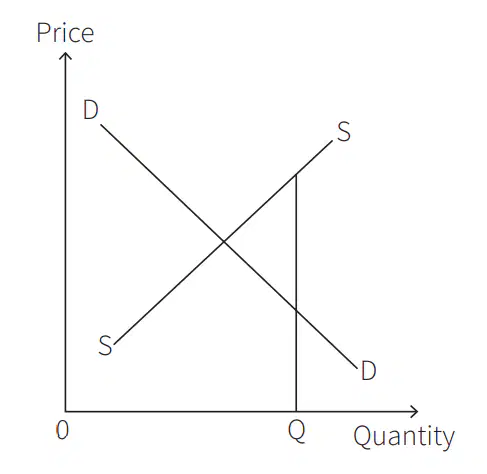
In this diagram, how is allocative efficiency experienced?
Price: fall
Demand: fall
Supply: rise
Price: fall
Demand: rise
Supply: fall
Price: rise
Demand: fall
Supply: rise
Price: rise
Demand: rise
Supply: fall
In a market system, what encourages firms to keep their costs low?
Competition
Government regulations
Subsidies
Taxation
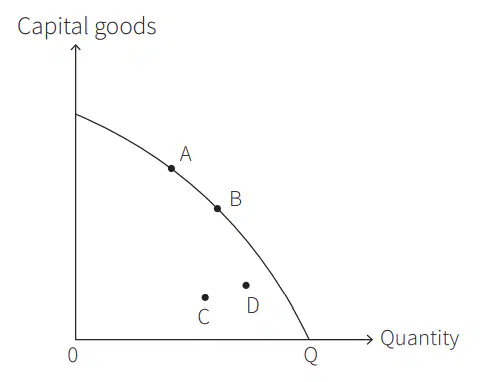
Which movement in the diagram shows an increase in productive efficiency?
A to B
B to C
C to D
A to D
What is the "private sector"? Select all that apply.
composed of individual firms
composed of government firms
providing goods and services for everyone is the main objective
earning a profit is the main objective
What is the "public sector"? Select all that applies
composed of individual firms
providing goods and services for everyone is the main objective
earning a profit is the main objective
composed of government firms
How are consumers sovereign in a market economy? Select all that apply.
they keep the price low by buying the most affordable products
they produce products that are needed by everyone
they determine what is
produced
they can increase a product's price by buying more of it
What is the role of profit in a market economy? Select all that apply.
it's an incentive that firms get when they listen to customers
it drives efficiency among firms
Consumers' demands are met
it gives firms an opportunity to expand their bsuiness
What argument can be used to say that prices in a market economy may be low?
because there may be a high level of
competition
because customers are always right
because producers will use quality materials
because customers like second-hand products
Which of the following cases is market failure experienced?
Firms producing above the lowest possible cost
Consumers determining what is produced
Price falling as a result of a decrease in demand
Price rising as a result of an increase in costs of production
Which of the following defines a merit good?
has an absence of external benefits
has higher private benefits than consumers realise
imposes costs on those who are not involved in its production directly
is both non-excludable and non-rival
Which type of goods would be over-produced if left to market forces?
Capital goods
Basic necessities
Merit goods
Demerit goods
What is a cause of market failure?
Diff erences in pay between skilled and unskilled workers
Competition between firms
Resources being both geographically and occupationally mobile
Consumers lacking information about where the lowest prices can be found
What is an external cost? Choose all that apply.
a harmful effect on third parties
a harmful effect on people not directly involved in
consuming and producing a product
workers in a chemical factory suffer from respiratory problems
people living near a chemical factory suffer from contaminated water source
What does not define a merit good?
one that the government considers is more beneficial to consumers than they
realise
underconsumed and underproduced if left to market forces
generates external benefits
the private benefits exceed the social benefits
What is a demerit good? Choose all that apply.
it causes external costs
government thinks is more harmful to consumers than
they appreciate
is underconsumed and so underproduced if left to
market forces
the social costs exceed the private costs
Why are the social benefits of education exceed its private benefits?
because education has external benefits
because what else can we say, education is education
because if a private benefit exceeds another one, then there will be 2 of them
because a private benefit is directed to the one engaged in education
What are the external benefits of education? Select all that apply.
and better quality output due to higher labour productivity
increased output
More and better
products can be consumed
increased tax revenue arising from higher
incomes
What are arguments that can be used to support the claim that the continuous tree cutting in the Amazon rainforest should stop? Select all that apply.
External costs exceed external and private benefits
Damage to wildlife habitats
Global warming
Social costs exceed social benefits
Assume that the government regulates a monopoly so that it definitely won't have to subsidize the firm. In this case, regulators would set a price equal to:
Average variable cost
Average total cost
Average fixed cost
Marginal cost
Compared to a perfectly competitive industry, a monopoly’s price and quantity will be which of the following?
P=Higher; Q=Same
P=Lower; Q=Same
P=Lower; Q=Higher
P=Higher; Q=Lower
A monopoly introduces a technological innovation that lowers the marginal cost of production. The price of the good and the quantity are most likely to change in which of the following ways?
P=Decrease; Q=Increase
P=Decrease; Q=Decrease
P=Increase; Q=Increase
P=Increase; Q=Decrease
If a monopolist wants to sell a larger quantity of its good, it must
set a higher price
maintain the current price
set a lower price
implement new technology
In a normally functioning monopoly, if the firm's total revenue is falling, it marginal revenue must be
positive
negative
zero
greater than TR
A formal organization of sellers or producers who cooperate on the production, pricing, and marketing of a product
Imperfect competition
Monopoly
Cartel
Market structure
What is the main difference between the profit-maximizing actions a perfectly competitive firm can take and those a monopoly can take?
Perfectly competitive firms maximize profits where MC=MR while monopolies do so where P=MC
they both face downward-sloping demand curves but a perfectly competitive firm's demand is inelastic
a monopoly chooses the highest possible price while a perfect competitor chooses the lowest
a competitive firm can only change output, monopoly can change output or price
Offering a senior citizen discount is an example of
Perfect price discrimination.
Illegal collusion
3rd degree price discrimination.
Product differentiation
Assume that a monopoly is producing a quantity where its marginal revenue is positive as output rises. The firm's total revenue is ____ as output rises and demand for its product is _____.
decreasing; elastic
decreasing; inelastic
increasing; elastic
increasing; inelastic
A monopoly is currently producing in the inelastic portion of its demand curve. In order to maximize profits, the firm should change the price and quantity in which of the following ways?
P=Increase; Q=Increase
P=Increase; Q=Decrease
P=Decrease; Q=Decrease
P=No Change; Q=Increase
Analysis of how decisions are made when strategic interaction between firms exists is known as
Game theory
Contestable market theory
Market power
Predatory pricing theory
A given market is considered to be monopolistic. Which of the following is a necessary characteristic of that industry?
A small number of large firms dominate the market
Many firms sell differentiated products in order to inspire brand loyalty
There are significant barriers to entry that will keep new competitors out of the market
The existing firms are mutually dependent and may often cooperate on pricing decisions
In monopolistic competition, which of the following most accurately describes the long-run equilibrium conditions for a firm?
P>ATC, MR=MC, and P>MC
P=ATC, MR=MC, and P=MC
P=ATC, MR=MC, and P>MC
P=ATC, MR>MC, and P>MC
One important difference between monopoly and monopolistic competition is that
There is a greater likelihood of the government restricting output in monopolistic competition.
There are no barriers to entry in monopolistic competition, allowing for new competitors to enter the industry in pursuit of profit
The marginal revenue and demand curves are the same for a monopoly whereas they are different for monopolistic firms
The different types of demand curves the firms face
In long run equilibrium, monopolistically competitive firms are considered inefficient in allocating society’s resources for which of the following reasons?
The firms' marginal revenue exceeds the price they charge
The price charged by these firms is greater than their marginal cost
Firms in these markets will have minimized their average total costs
Firms in these markets will be earning economic profits in the long run
An industry that is dominated by a few large firms, making each firm interdependent would be considered
Monopolistic competition
A monopoly
Perfectly competitive
An oligopoly
A monopolistically competitive firm advertises in order to:
Shift the demand curve for its product to the left
Make its product more similar to its competitors’
Reduce the industry’s barriers to entry
Make the demand for its product more price inelastic

