
 Worksheets
Unit 6: Early Modern Europe Study Guide
Total questions: 46
Worksheet time: 2hrs 18mins
Read the statement about a family member of the Medici Family and decide who is the key person is.
He founded the Medici bank in Florence.
Giovanni di Bicci de Medici
Piero
Lorenzo de Medici
Cosimo de Medici
Why would the growing influence of humanism have inspired High Renaissance artists to paint realistic subjects and backgrounds? (Choose 2)
Because humanism focused on people, their goodness, and their ability to improve the world, artists wanted to depict people as they were
Because humanism, unlike religion, was grounded in the physical world, artists’ paintings looked more like the physical world.
Because humanism stated that knowledge comes through people’s reasoning abilities, artists believed it was reasonable to paint people as they were.
Because humanism held Greek and Roman cultures in high esteem, artists wanted to create paintings that were similar in style to Greek and Roman art.
Which statements are true about William Shakespeare? (Choose 3)
He wrote many famous novels
One of his most famous works is a love story called Romeo and Juliet
He wrote plays and poems
He earned very little money during his lifetime
Many people consider him the greatest writer of English literature.
Why would Thomas Aquinas and a humanist during the Renaissance have disagreed with one another?
Aquinas believed a person needs both reason and faith for knowledge, whereas humanists said you need only reason.
Humanists believed a person needed only reason to get into heaven, whereas Aquinas believed you needed both reason and faith
Humanists believed a person needs both reason and faith for knowledge, whereas Aquinas said you need only faith.
Aquinas believed certain aspects of life require both reason and faith, whereas humanists said all aspects of life require reason and faith.

Which descriptions complete the graphic organizer? (Choose 2)
successful banking system established here
considered the birthplace of the Renaissance
had a large, thriving port
was the home of William Shakespeare

Which word or phrase best completes the graphic organizer?
Paris, France
England
Jerusalem
Florence, Italy
Why did the invention of the printing press and the growth in the number of Bibles increase literacy?
The Catholic Church used the invention of the printing press to encourage more people to read.
More people were exposed to written language, which made it possible to learn to read.
The new books in circulation led to the opening of schools where children were taught to read.
People needed to know how to read in order to become members of the Catholic Church.
Why did people split from the Catholic Church and form Protestant churches?
They supported tithing but not indulgences.
More people knew how to read and had learned about corruption in the Catholic Church.
People were not happy about some of the practices of the Catholic Church
They believed only Martin Luther could run a non-corrupt religion.
What was Henry VIII's motivation for leaving the catholic church and creating the Church of England (A protestant church)
Henry VIII wanted a female heir to inherit his throne
Henry VIII was told that he had to divorce his wife so he left the Catholic church to stay with her
Henry VIII wanted a male heir and needed to divorce his wife since she didn't give him one
Henry never left the catholic church...
“Any truly repentant Christian has a right to full remission of penalty and guilt, even without indulgence letters.” -Martin Luther
Why would this idea from 95 Theses be appealing to many people?
This idea gave hope for forgiveness of sin to people who couldn’t afford to pay indulgences.
This idea guaranteed a place in the Catholic Church to everybody, rich and poor alike
This idea proved that Catholic leaders were guilty of corruption.
This idea introduced the idea of ending all taxation.
What is predestination?
Predestination is where someone chooses what church you have to attend for you
Predestination is where God has already decided where you will end up after you die.
Predestination is where you are on vacation and your trip is already planned out
The emphasis on serving the poor and oppressed originated with the __________ .
Jesuits
Protestant People
Council of Trent
Church of England

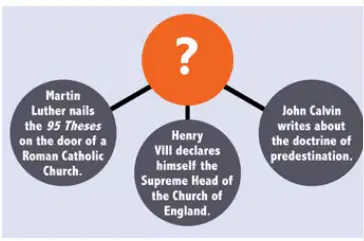
Which phrase best completes the graphic organizer?
Important participants and events in the Protestant Reformation
Important participants and events in Humanism
Important participants and events in the Renaissance
Important participants and events in the Catholic Counter Reformation
________________ declared himself as the Supreme Head of the Church of England.
Henry VIII
John Calvin
Martin Luther
Ignatius of Loyola
______________ created a Protestant Reformation movement in Germany
John Calvin
Henry VIII
Martin Luther
Ignatius of Loyola
___________ created a Protestant Reformation movement in Switzerland
John Calvin
Henry VII
Martin Luther
Ignatius of Loyola
Which phrase best completes the graphic organizer?
Important participants and events in the Renaissance
Important participants and events in the Protestant Reformation in England
C Important participants and events in the Protestant Reformation
Important participants and events in the Catholic Counter Reformation
England’s Tudor Golden Age flourished even more.
England became one of the major European powers.
Elizabeth’s skillful leadership kept England out of European wars.
England started a colony in North America.
How are all of these statements similar?
They list the historical consequences of the Protestant Reformation on England.
They list the historical consequences of England’s defeat of the Spanish Armada.
They list the historical consequences of Henry VIII’s separation from the Catholic Church.
They list the historical consequences of William Shakespeare’s writing in Tudor England.
_______________________ declared that planets move around the sun in ellipses, not circles
Nicolaus Copernicus
Johannes Kepler
Galileo Galilei
Sir Isaac Newton
_______________________ used a powerful telescope to support the heliocentric theory
Nicolaus Copernicus
Johannes Kepler
Galileo Galilei
Sir Isaac Newton
_______________________ developed the three laws of motion
Nicolaus Copernicus
Johannes Kepler
Galileo Galilei
Sir Isaac Newton
Through his experiments, Galileo sought evidence that he would use _________
for analysis
to confirm his beliefs
In one famous experiment, Galileo dropped two cannonballs of different weights to demonstrate that __________ .
they would land at about the same time
they would land at different times
Which of these theories of elliptical orbits did Johannes Kepler establish? (Choose 2)
There is an exact relationship between a planet’s distance from the sun and the amount of time it takes to revolve around the sun.
Planets closer to the sun move faster around the sun than planets far away from the sun.
Planets farther from the sun have a more pronounced elliptical orbit than planets that are closer to the sun.
As planets get closer to the sun, the speed at which they travel increases.
Failure to follow the scientific method could lead to which problematic outcomes? (Choose 2)
You could get an unexpected result.
You could get a result that confirms your biases.
You could make a new discovery.
You could get a poor, misleading result.
Which centuries witnessed a scientific revolution in Europe?
11th, 12th, and 13th
12th, 13th, and 14th
15th, 16th, and 17th
16th, 17th, and 18th
. What was the main result of the Scientific Revolution that occurred in Early Modern Europe
People developed many false assumptions about the world.
People’s understanding of the world improved.
People were persecuted for giving science more importance than religion.
People stopped using the scientific method.

Which giants might Newton have been referring to? (Choose 2)
Nicolaus Copernicus
John Calvin
Galileo Galilei
Martin Luther
Galileo’s experiments paved the way for the __________ .
Aristotelian theory
scientific method
_______________________ developed the heliocentric theory
Nicolaus Copernicus
Johannes Kepler
Galileo Galilei
Sir Isaac Newton
What was the most significant discovery that occurred as a result of Galileo’s interest in the telescope?
He learned how to grind lenses and make his own telescopes.
He eventually saw that the planets revolved around the sun.
He discovered stars that nobody else had ever seen.
He earned a living by making telescopes for Venice merchants.
From ancient Greece until the Renaissance, what did most people believe about Earth’s place in the universe?
They believed Earth was at the center of the universe.
They believed that the sun was at the center of the universe.
They believed there wasn’t a center of the universe.
They believed our solar system was the center of the universe.
Elizabeth I is famous for leading England to a victory over __________ Spanish Armada in 1588.
Henry VIII's
Ignatius of Loyola's
King Charlemagne's
King Phillip II's
Elizabeth I was a __________ who ushered in the Tudor Golden Age in England.
Protestant Queen
Catholic Queen
__________ formed the 'Society of Jesus' in Spain
John Calvin
Henry VIII
Martin Luther
Ignatius of Loyola
Addressing financial abuses in the Catholic Church was undertaken by the __________ .
Jesuits
Protestants
Council of Trent
Church of England
Martin Luther and other reformers rejected the Roman Catholic Church’s indulgences and __________ .
doctrine of predestination
taxes
reading
elmo
Michelangelo famously painted several scenes from the Bible on a chapel at the Vatican. What was the chapel’s name?
the Vatican
the Sistine Chapel
the Medici Chapel
Hagia Sophia
Leonardo da Vinci was a painter, __________ , and scientist.
inventor
poet
banker
architect
Thomas Aquinas’ most famous work was _________ .
Romeo and Juliet
Summa Theologica
The Last Supper
David
What do these historical figures have in common? y Thomas Aquinas y Leonardo da Vinci y Michelangelo y William Shakespeare
They were Renaissance painters.
They were Catholic priests during the Renaissance
They were leading innovators during the Renaissance.
They worked in Italy during the Renaissance.
Suppose you were a painter working in the year 1450, during the early Renaissance. Which qualities would your art have most likely had?
My paintings would have looked realistic.
My paintings would have included unrealistic backgrounds.
My paintings would have had Impressionist characteristics.
My paintings would have depicted religious themes.
Read the statement about a famous family member of the Medici Family and decide who the key person is.
As a cardinal in the Catholic church, he used his influence to restore the Medici family to Florence.
Giovanni (Pope Leo)
Piero
Lorenzo di Medici
Cosimo
Read the statement about one family member of the Medici Family and choose which key person it is describing.
He assumed political power but angered people and was exiled from Florence.
Lorenzo de Medici
Giovanni di Bicci de Medici
Pierro
Giovanni (Pope Leo)
Read the statement about a family member of the Medici Family and decide who is the key person is.
He established the family’s political power.
Cosimo de Medici
Giovanni (Pope Leo)
Lorenzo de Medici
Pierro
Read the statement about a famous family member of the Medici Family and decide who the key person is.
A poet and patron of artists, he was known as Lorenzo the Magnificent
Giovanni (Pope Leo)
Lorenzo de Medici
Giovanni di Bicci de Medici
Cosimo

