
 Worksheets
Earth History Final
Total questions: 20
Worksheet time: 10mins
Name
Class
Date
1.
Which of the following describe characteristic of a mineral?
a)
It occurs naturally.
b)
It is solid.
c)
It has a definite composition.
d)
It is organic
e)
It has a crystalline internal structure
2.
When you see an igneous rock that has large crystals, what does that tell you about how the rock was formed?
a)
it formed as an intrusive igneous rock
b)
it formed as an extrusive igneous rock
c)
It formed due to heat and pressure
3.
Which of the following is a sedimentary rock?
a)
limestone
b)
basalt
c)
granite
d)
none of the listed are sedimentary
e)
all are sedimentary
4.
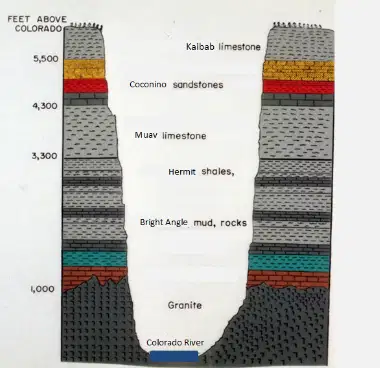
What layer would the river be at about 3 million years ago?
a)
Granite
b)
Kaibab limestone
c)
Hermit shale
5.
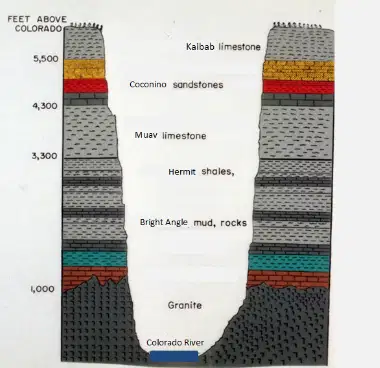
What would the Grand Canyon look like about 3 million years ago?
a)
Same as today
b)
Not as deep but much wider
c)
Not as deep and not as wide
6.
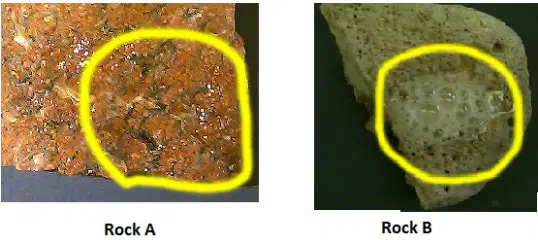
Look at the picture below. Some students are using acid to test rock samples they collected... What are the students testing for?
a)
Calcite
b)
Salt
c)
precious metal
d)
oxygen
7.
Which of the following is true about the geological time scale?
a)
It arranges geological events in order from oldest to youngest.
b)
It is a scale used by geologists to measure the diameter of rocks.
c)
It describes the history of Earth in millions of years.
d)
It shows geological time divided into era and periods.
8.
What are bigger or longer, in terms of geological time?
a)
Eras
b)
Periods
9.
Fossils that help geologists determine the age of the rock layers are called?
a)
prehistoric fossils
b)
paleozoic fossils
c)
ancient fossils
d)
index fossils
10.
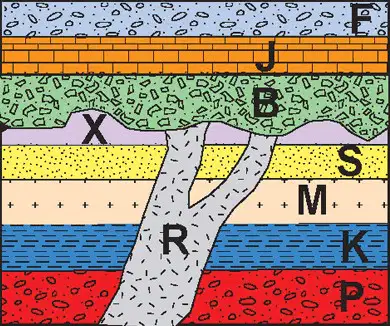
Which of the following are "YOUNGER" than X? ...Pick all that apply.
a)
F
b)
J
c)
B
d)
R
e)
S
11.
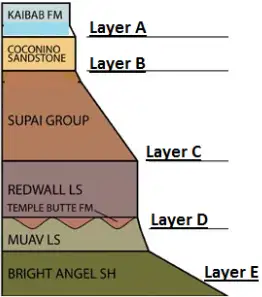
Which layers would have formed in swamps or wetlands?
a)
Layers A
b)
Layers B
c)
Layers C
d)
Layers D
e)
Layer E
12.
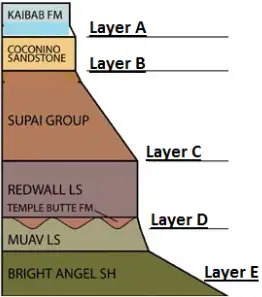
Which layers would have formed in deserts or beaches?
a)
Layer A
b)
Layer B
c)
Layer C
d)
Layer D
e)
Layer E
13.
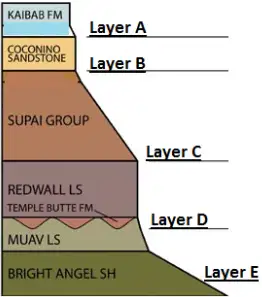
Which layers are younger then Layer C?
a)
Layers A
b)
Layers B
c)
Layers D
d)
Layers E
14.
What came first: the Colorado River, Colorado Plateau or the Grand Canyon.
a)
Colorado River
b)
Colorado Plateau
c)
Grand Canyon
15.
Oxidation is an example of?
a)
Differential erosion
b)
Physical weathering
c)
Chemical weathering
d)
Erosion
16.
What is the main difference between weathering and erosion
a)
Erosion breaks down rock, weathering moves it
b)
Weathering breaks down rock, erosion moves it
c)
Weathering can only happen by water
d)
Erosion can only occur from wind
17.
Select all of the following that are example of physical weathering?
a)
Plant roots
b)
Oxidation
c)
Running water
d)
Frost wedging
18.
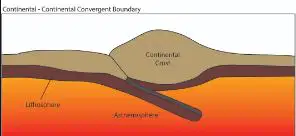
Two continental plates colliding would create what type of landform?
a)
Fold Mountains
b)
Trench
c)
Arc Volcanos
d)
Canyon
19.
Where do earthquakes and volcanoes occur ?
a)
They form at the boundary of tectonic plates
b)
They form because of the Earth's core
c)
They have very little to do with each other
d)
They form do to meteor impact sites
20.
Which of the following are pieces of evidence used to support the Theory of Plate Tectonics? (choose ALL that apply)
a)
fit of the continents
b)
matching rocks and mountains across continents
c)
matching fossils across continents
d)
magnetic striping on the seafloor showing seafloor spreading
e)
evidence of glaciers in places now too warm
100 %

