Wayground logo

Free Printable Worksheets

Font size

S
M
L
XL
Worksheets

Quiz BoNKa IB

Total questions: 128

Worksheet time: 6hrs 46mins

Name
Class
Date
1.
The number set which includes all real numbers rational and irrational is represented by which letter?
a)
ℝ
b)
ℕ
c)
ℚ
d)
ℤ
2.
The set of all rational numbers greater than zero is described using what symbol?
a)
ℚ+ 
b)
ℚ
c)
ℤ
d)
ℤ+
3.
The number set which includes all whole numbers positive, negative and zero is represented by which letter?
a)
ℝ
b)
ℕ
c)
ℚ
d)
ℤ
4.
The number set Z can be restricted to become Z+ . Which of the following numbers would no longer be included?
a)
-3, -2,
b)
3, 2
c)
-3/2,  -4/5
d)
π
5.
Which if any of the following numbers are placed in the wriong number set?
a)
-7
b)
√2
c)
none they are all correct
d)
9/5
6.
Which number set includes all recuring decimals and all finite decimals but does not include irrational numbers?
a)
ℚ
b)
ℝ
c)
ℕ
d)
ℤ
7.
Which number or numbers are in the wrong place?
a)
√3 
b)
8/2
c)
√25
d)
√3 and 8/2
8.
Which number is in the wrong place?
a)
√25
b)
none
c)
π
d)
-3.2
9.
Which column is incorrect?
a)
ℕ
b)
ℚ
c)
ℚ+
d)
ℤ+
10.
Zero has been incorrectly added to every set which set or sets should it not be in and why?
a)
ℚ+ and ℤ+ as zero is not positive
b)
ℕ as zero is not a counting number
c)
ℤ and
ℚ as it is not a rational number
d)
ℤ+ and
ℕ as it is not an integer
11.
The square root of 5 is a real number
a)
True
b)
False
12.
0 is an integer
a)
True
b)
False
13.
In which of the following sets does √-4 fall?
a)
Real, Irrational
b)
Real, Rational
c)
Real, Rational, Integers
d)
Imaginary
14.
A rational number can be written as a fraction.
a)
True
b)
False
15.
A whole number is which type of number?
a)
Rational 
b)
Irrational
16.
Which number is a rational number?
a)
2.25
b)
-8.78654684598.....
c)
Square root of 99
d)
3.14...
17.
Which number is an irrational number?
a)
-15 / 7
b)
square root of 88
c)
square root of 25
d)
0.3333....
18.
Which name does not apply to this number?
√ 36 
a)
real number
b)
integer
c)
whole number
d)
irrational number
19.
Which name does not apply to this number?
√ 24
a)
real number
b)
irrational number
c)
rational number
20.
True or False: Both rational and irrational numbers are real.
a)
True
b)
False
21.
What number set is represented?
0, 1, 2, 3......
a)
Natural
b)
Rational 
c)
Integers 
d)
Irrational
 
22.
What number set is represented?
-1.23, 0, 4, 10.3
a)
Rational
b)
Irrational 
c)
Whole
d)
Integers
23.
Numbers like -3, -2, -1, 0, 1, 2, 3 are called
a)
whole numbers
b)
integers
c)
rational numbers
d)
natural numbers
24.
A repeating decimal is what type of number?
a)
Rational 
b)
Irrational
c)
None of these
25.
An example of an integer is...
a)
9.1
b)
8/9
c)
-9
d)
-2.3
26.
a)

A

b)

B

c)

C

d)

D

27.

What are the roots of the graph y = x2 - x - 5

a)

no roots

b)

x = -1.8, x = 2.8

c)

x = -1.4, 3.4

d)

x = -5

28.
a)

x = - 0.8, y = 2.2

b)

x = -5, y = 19

c)

x = -1, y = 3

d)

x = -4, y = 15

29.
What are the solutions of 7x2 + 8x + 1 = 0? Solve using the quadratic formula.
a)
-1, 1/7
b)
1, 7
c)
-1, -7
d)
-1, -1/7
30.

Using the graphing function, what are the solutions of 2x2 - 6x + 4 = 0?

a)

5/2, 1/2

b)

2,1

c)

4,2

d)

-1,-2

31.

Using the equation function, what are the solutions of 5x2 + 3x - 1= 0?

a)

no roots

b)

0.24, -0.84

c)

-1.20, 4.20

d)

-0.24, 0.84

32.

Determine the minimum point of the parabola:

y = 5x2 - 20x + 13

a)

(5, -7)

b)

(-2, -7)

c)

(2, -7)

d)

(-7, -2)

33.

Find the minimum point of the graph y= x3- 2x2- 5x+1

a)

(1.58, -3.39)

b)

(-1.58, 3.39)

c)

(-0.79, 3.21)

d)

(2.12, -9.06)

34.

Solve using the equation function:

4x - y = 17

7x - y = 32

a)

x = 5

y = 3

b)

x = -5

y = 3

c)

x = 5

y = -3

d)

x = -5

y = -3

35.

Solve using the graphing function:

y = -6x + 5

y = 5 +2x

a)

(-3, -6)

b)

(-6, 3)

c)

(0, 5)

d)

(-3, 5)

36.

What is the equation of the line of symmetry for the parabola y = 2x2-4x-3?

a)

x = 2.58 and -0.58

b)

y = -3

c)

y = -5

d)

x = 1

37.

draw the graph y = x3 -7x - 6. Find all the roots of the equation

a)

x = 1, -7 and -6

b)

x = -1, -2 and 3

c)

y = -6

d)

x = 2, -3 and 1

38.

How many solutions are there to the simultaneous equations y = x3 -7x - 6 and y = 2x + 7?

a)

none

b)

1

c)

2

d)

3

39.
Solve for x:
8x+1= 3
a)
0.528
b)
0.893
c)
-0.472
d)
1.893
40.
log (x - 1)  - log (x - 2)  = log 5
a)
7
b)
4/9
c)
9/4
d)
1/7
41.
Solve:
log4x2 - log4(x-1) = 1
a)
4
b)
3
c)
2
d)
1
42.
9log8(x-8)=18
a)
8
b)
72
c)
64
d)
16
43.
Solve for x:
a)
6
b)
-6
c)
-6,6
d)
No solution
44.
2x+6=32
a)
x=-1
b)
x=11
c)
x=1
d)
x=-11
45.
Rewrite as a single log:
log 5 + log 7
a)
log 12
b)
log -2
c)
log 35
d)
undefined
46.
Solve for x using the convert to logs method.
8x+1= 3
a)
0.528
b)
0.893
c)
-0.472
d)
1.893
47.
Solve:
log4x2 - log4(x-1) = 1
a)
4
b)
3
c)
2
d)
1
48.
a)
3a15
b)
9a15
c)
9a8
d)
27a15
49.
a)
y4
b)
y5
c)
y6
d)
6y
50.
a)
t24
b)
t12
c)
t18
d)
t-12
51.

(2x3)(3x8)

a)

5x11

b)

6x11

c)

6x24

d)

5x24

52.
a)
1/16
b)
1/9
c)
1/3
d)
1/27
53.

As the result of experimental work, a student finds the density of a liquid to be 30 g/cm3. The known density of that liquid is 25 g/cm3. What is the percent error of this student’s work?

a)

200

b)

20

c)

2

d)

0.02

54.
Rewrite 34 = 81 in logarithmic form.
a)
log34 = 81
b)
log813 = 4
c)
log381 = 4
d)
log481 = 3
55.
Solve for x
5x = 17
a)
x = log175
b)
x = log 5 + log 17
c)
x = log517
d)
x = (log 5)/(log 17)
56.

Write as a single logarithm:

log(30)-log(6)

a)

-6log(30)

b)

log(24)

c)

log(-24)

d)

log(5)

57.
a)

-0.20

b)

0.60

c)

0.20

d)

-0.6

58.

Solve for x:

2(4x ) - 10 = 24

a)

0.489

b)

2.552

c)

0.893

d)

2.044

59.
a)

(i) and (v)

b)

(iii) and (vi)

c)

(i) and (vi)

d)

(ii) and (vi)

60.

Convert the above into index form.

a)

a6/5

b)

1/6 a5

c)

5/6 a

d)

a5/6

61.

Simplify 40

a)

1

b)

4

c)

0

d)

40

62.
a)
b)
c)
d)
63.
a)
b)
c)
d)
64.

Describe the transformation

-f(x)

a)

shift down

b)

reflect over x-axis

c)

reflect over y-axis

d)

shift right

65.

Describe the transformation

f(-x)

a)

reflect over the x-axis

b)

shift up

c)

shift down

d)

reflect over the y-axis

66.

Which transformation reflects over the x-axis?

a)

f(-x)

b)

f(x)

c)

-f(x)

d)

:(

67.

Which transformation reflects over the y-axis?

a)

f(-x)

b)

f(x)

c)

-f(x)

d)

:(

68.

Describe the transformation

f(x) + 4

a)

shift left 4

b)

shift right 4

c)

shift up 4

d)

shift down 4

69.

Describe the transformation

f(x+5)

a)

shift left 5

b)

shift right 5

c)

shift up 5

d)

shift down 5

70.

Describe the transformation

f(x) - 6

a)

shift left 6

b)

shift right 6

c)

shift up 6

d)

shift down 6

71.

Describe the transformation

f(x-7)

a)

shift left 7

b)

shift right 7

c)

shift up 7

d)

shift down 7

72.

Which describes a vertical stretch (skinnier)?

a)

2f(x)

b)

0.5f(x)

c)

(1/2)f(x)

d)

0.000001f(x)

73.

Which describes a vertical compression (wider)?

a)

-3f(x)

b)

45f(x)

c)

0.5f(x)

d)

1f(x)

74.

What are the transformations of f(x) = |x-3| + 4 from the parent function?

a)

right 3

down 4

b)

left 3

up 4

c)

right 3

up 4

d)

down 3

right 4

75.

What are the transformations of f(x)=− x+4f\left(x\right)=-\ \sqrt[]{x+4}  ?

a)

left 4

reflect over y-axis

b)

right 4

reflect over y-axis

c)

left 4

reflect over x-axis

d)

right 4

reflect over y-axis

76.

f(x)=x2f\left(x\right)=x^2  and g(x)=(x+3)2−12g\left(x\right)=\left(x+3\right)^2-12  

Describe the transformations that map f(x) onto g(x)

a)

up 3

left 12

b)

right 3

down 12

c)

left 3

up 12

d)

left 3

down 12

77.

f(x)=x3f\left(x\right)=\sqrt[3]{x}  and g(x)=x−13+2g\left(x\right)=\sqrt[3]{x-1}+2  

Describe the transformations that map f(x) onto g(x)

a)

right 1

up 2

b)

down 1

down 2

c)

left 1

up 2

d)

down 1

up 2

78.

If the function below is f(x), what is the range of f(x)?

a)

y>0y>0  

b)

y<0y<0  

c)

−∞<y<+∞-\infty<y<+\infty  

d)

y≥0y\ge0  

79.

If f(x) is the graph below, which graph represents f(x) - 3?

a)
b)
c)
d)
80.

If the function below is f(x), what is the range of f(x) - 3?

a)

−∞<y<∞-\infty<y<\infty  

b)

y≥3y\ge3  

c)

y≥−3y\ge-3  

d)

x≥3x\ge3  

81.

The graph of f(x) is below

Which graph represents f(-x) - 1

a)
b)
c)
d)
82.

The point (6,-4) is on the graph of f(x). What are the coordinates of the point for

f(-x)?

a)

(6,-4)

b)

(-4,-6)

c)

(-6,-4)

d)

(-6,4)

83.

The point (-5,10) is on the graph f(x). What are the coordinates for this point on

-f(x)?

a)

(-5,-10)

b)

(5,10)

c)

(5,-10)

d)

:(

84.

The graph of f(x) is shown here. What is the graph of 12f(−x)\frac{1}{2}f\left(-x\right)  ?

a)
b)
c)
d)
85.

The graph of f(x) is shown here. What is the graph of −2f(x)-2f\left(x\right)  ?

a)
b)
c)
d)
86.

Describe the transformation

-f(x)

a)

shift down

b)

reflect over x-axis

c)

reflect over y-axis

d)

shift right

87.

Simplify:  sec⁡θsin⁡θ\secθ\sinθ  

a)

cos θ

b)

csc θ

c)

tan θ

d)

cot θ

88.

Simplify:   cos⁡θtan⁡θ\cos\theta\tan\theta  

a)

sin θ

b)

cos θ

c)

tan θ

d)

csc θ

89.

Simplify:  (sec⁡θ−1)(sec⁡θ+1)(\secθ-1)(\secθ+1)  

a)

sin 2 θ

b)

cos 2 θ

c)

tan 2 θ

d)

sec 2 θ

90.

Simplify:  (cos⁡ θ)(sec⁡ θ−cos⁡θ)\left(\cos\ θ\right)\left(\sec\ θ-\cosθ\right)  

a)

  sin⁡2θ\sin^2θ  

b)

cos⁡2θ\cos^2θ  

c)

csc⁡2θ\csc^2\theta  

d)

sec⁡2θ\sec^2\theta  

91.

Simplify: sec⁡2xsec⁡2x−1\frac{\sec^2x}{\sec^2x-1}  

a)

sin⁡2x\sin^2x  

b)

csc⁡2x\csc^2x  

c)

cos⁡2x\cos^2x  

d)

sec⁡2x\sec^2x  

92.

Simplify:   sin⁡2x+cos⁡2x+cot⁡2x1+tan⁡2x\frac{\sin^2x+\cos^2x+\cot^2x}{1+\tan^2x}  

a)

cot⁡2x\cot^2x  

b)

tan⁡2x\tan^2x  

c)

csc⁡2x\csc^2x  

d)

sec⁡2x\sec^2x  

93.
a)
-1
b)
sin θ
c)
csc θ
d)
1
94.
a)
csc²θ
b)
sec²θ
c)
cscθ
d)
1
95.
Simplify the trig expression.
a)
tan2x
b)
-tan2x
c)
cot2x
d)
cos2x*sin2x
96.
Simplify the trig expression.
a)
secx
b)
cotx
c)
sec2x
d)
tan2x
97.
Simplify the trig expression.
a)
1
b)
-1
c)
cotx
d)
cosx
98.

Select all that are Pythagorean Identities.

a)

sin2(u) + cos2(u) = 1

b)

sin2(u) - cos2(u) = 1

c)

tan2(u) + 1 = sec2(u)

d)

cot2(u) + csc2(u) = 1

e)

cot2(u) + 1 = csc2(u)

99.

Select the coefficients of the 5th term in Pascal's Triangle

a)

1;3;3;1

b)

1;4;6;4;1

c)

1;5;10;10;5;1

d)

1;6;15;20;15;6;1

100.
Expand
(b - 2)3
a)
b3 - 2b2 + 4b - 8
b)
5b3 - 20b2 + 40b - 40
c)
b3 - 6b2 + 12b - 8
d)
4b3 - 12b2 + 16b - 8
101.

What would be the 5th term of the expansion of (n+4)4?

a)

257

b)

256

c)

n4

d)

259

102.

What would be the 2nd term of the expansion of (y+4)4?

a)

253y

b)

16y3

c)

64y

d)

96y2

103.
Which row of Pascal's Triangle would you use to expand (x+y)3?
a)
1
b)
1  1
c)
1  2  1
d)
1  3  3  1
104.

How many rows in The Pascal's triangle?

a)

7

b)

8

c)

100

d)

Infinite

105.
What is the third term in the expansion of (x + 4)5?
a)
640 x2
b)
160 x3
c)
4 x5
d)
64 x3
106.

How many terms are the in the expansion of (1+b)5

a)

5

b)

6

c)

25

d)

50

e)

3

107.

Expand (u2−2)3\left(u^2-2\right)^3  

a)

u6−6u4+12u2−8u^6-6u^4+12u^2-8  

b)

u6−16u4+12u2−8u^6-16u^4+12u^2-8  

c)

5u6−20u4+40u2−405u^6-20u^4+40u^2-40  

d)

u6−24u4+12u2−8u^6-24u^4+12u^2-8  

108.

Find the coefficient of aa in the expansion of (a−3)3\left(a-3\right)^3 .

a)

−27-27

b)

−9-9

c)

2727

d)

99

109.
Determine if the series converges or diverges
a)
Converges
b)
Diverges
110.
Determine if the series converges or diverges
a)
Converges
b)
Diverges
111.
Determine if the series converges or diverges
a)
Converges
b)
Diverges
112.
Find the next three terms in the arithmetic sequence: 25, 34, 43, 52, ...
a)
63, 72, 81
b)
79, 88, 97
c)
70, 79, 88
d)
61, 70, 79
113.
You have $10 in you bank account.  It doubles every month.  How much money will you have after 5 months?
a)
$50
b)
$35
c)
$320
d)
$250
114.
Find the 22nd term of the following sequence:
5, 8, 11, ...
a)
14
b)
68
c)
63
d)
71
115.

What is the explicit rule for the sequence:

11, 22, 44, 88...

a)

an = 2(11)n-1

b)

an = 11x2

c)

an = 11(2)n-1

116.
Which of the following is DIVERGENT?
a)
10+6+2+-2+...
b)
25+5+1+0.2+...
c)
100+50+25+5+...
d)
3(.25)n = An
117.
Find the 1st 6 terms of the sequence:
an = (n + 1)3
a)
6, 9, 14, 21, 30, 41
b)
3, 6, 9, 12, 15, 18
c)
8, 27, 64, 125, 216, 343
118.
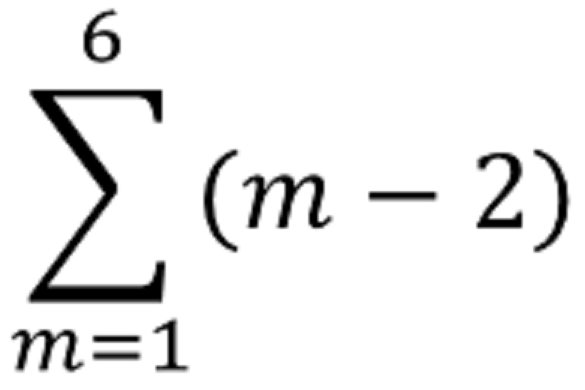
Is this summation finite or infinite?
a)
Finite, because there are only 6 terms to add up.
b)
Infinite, because there are an infinite number of terms to add up.
119.
Is this sum finite or infinite?
a)
Finite, because there are 4 terms to add up.
b)
Infinite, because there are an infinite amount of terms to add up (m goes from 1 to infinity).
120.
Calculate the final sum/total of the series.
a)
6
b)
21
c)
9
d)
2
121.
∑ is
a)
a funky looking "E"
b)
theta
c)
pi
d)
sigma
122.
Find the sum for the following series. 
a)
44
b)
-162
c)
-682
d)
324
123.
Write the nth term formula:  5 + 11 + 17 + 23 + … + 35
a)
t(n) = 5 + 6(n – 1) 
b)
t(n) = 5(6)n-1
c)
t(n) = 5 + 6n 
d)
t(n) = -1 + 6(n - 1)
124.

Evaluate the series

a)

62

b)

63

c)

-62i

d)

61

125.

What is the equation you need to use to evaluate this series?

a)

n(n+1)/2

b)

n2(n+1)2/4

c)

n(n+1)(2n+1)/6

d)

12+22+32...132

126.

Evaluate the series

a)

1134

b)

378

c)

756

d)

1890

127.

Evaluate the series

a)

142

b)

58

c)

106

d)

22

128.

Evaluate the series

a)

120

b)

50

c)

116.67

d)

220