
 Worksheets
Bella SCience
Total questions: 136
Worksheet time: 2hrs 33mins
A self sustainable community of organisms living in a particular area on earth.
ecosystem
population
abiotic factors
biotic factors
The non living components of the ecosystem.
ecosystem
population
abiotic factors
biotic factors
The living components of the ecosystem.
ecosystem
population
abiotic factors
biotic factors
Organisms interact with each other and their environment to meet their basic needs and survive.
True
False
Which of the following is an example of mutualism?
A snake eating the rat
A butterfly on a flower
A tick sucking dog's blood
Hyenas and lions both try to eat the same prey.
It is a kind of symbiotic relationship where one species of organism benefits while the other is not affected.
Mutualism
Parasitism
Commensalism
Competition
In predation the animal that kills and eat other animal is called __________.
prey
predator
commensal
parasite
Which of the following is the abiotic component of the ecosystem?
light
man
plant
animal
Lack of rainfall in the desert
Abiotic
Biotic
Dry soil during summer
Abiotic
Biotic
Animals do not reproduce
Abiotic
Biotic
Death of plants
Abiotic
Biotic
Rivers dry up
Abiotic
Biotic
The population of polar bears decreases
Abiotic
Biotic
High pH near the volcanic vent
Abiotic
Biotic
Increase in the variety of producers
Abiotic
Biotic
Low amount of light present
Abiotic
Biotic
Microorganisms in soil
Abiotic
Biotic
Which of the following is an abiotic factor produced by plants?
Seed
Carbon Dioxide
Oxygen
Fruit

What do you call the living organisms that inhabit an environment?
Community
Biotic Factors
Population
Abiotic Factors

In which place do biotic and abiotic factors interact?
Ecology
Biosphere
Community
Ecosystem

How will you classify the factors such as sunlight, oxygen, air, and rocks?
Biotic
Abiotic
Living
Alive
Which of the following represents an abiotic component of the environment?
Growing grasses on mountain
Cat nursing its young
Sprouting mongo seeds
Flowing lava

On which abiotic factors would varieties of fish and seaweeds rely for their survival?
Insects and sun
Water and corals
Water and temperature
Solid particles and temperature
Which abiotic factor below is NOT required by plants during photosynthesis?
Sunlight
Oxygen
Water
Carbon Dioxide

Which biotic factor below is NOT involved in the decomposition of matter?
Bacteria
Plants
Fungi
Detrivores
A plant needs water, radiant energy, minerals, oxygen, and carbon dioxide to live. How are these requirements needed by plants categorized?
Climate
Minerals
Biotic
Abiotic
One of the following statements describes biotic factors in an ecosystem correctly. Which one is it?
Gases and water in an area.
Non-living things in an organism's environment.
Plants, animals, fungi and bacteria in an environment.
Solid materials such as rock and soil found everywhere.
It consists of all the organisms that live in an ecosystem and composed of different population.
ecosystem
community
population
habitat

What is an ecosystem?
A community of interacting organisms and their chemical environment.
A community of non-interacting organisms and their physical environment.
A biological community of interacting organisms and their physical environment.
A biological community of interacting organisms and their chemical environment.
Which of the following is a biotic factor?


Soil mineral is an example of
Biotic factor
Abiotic factor
Both biotic and abiotic
None of the choices
They use light energy to synthesize food on their own
Consumer
Decomposer
Producer
Animals
They act on dead matter and decay them for nutrition.
Consumer
Decomposer
Producer
Plants

Which of the following statements about ecosystems is true?
Ecosystems can be any size
An ecosystem consists of only living things
An ecosystem consists of only non-living things
Different animals cannot live in the same ecosystem
Plants, animals and fungi are called ___
Consumers
Producers
Decomposers
Organisms
Which of the following should be the next item below?
Biotic: trees, squirrels, bacteria
Abiotic: light, water, ___
Worms
Ferns
Cacti
Soil

All the living and nonliving things in a town’s pond make up a/an____.
Ecosystem
Habitat
Biosphere
Community
Biotic and abiotic factors in an ecosystem ___ with each other.
Communicate
Compete
Interact
Do not interact


Remoras are fish that generally latch on to sharks and eat leftovers of food from the shark. This is an example of which type of ecological relationship?
Mutualism
Commensalism
Parasitism
Competition

Plover birds typically eat parasites trapped inside of crocodiles' mouths. The plover receives a meal, while the crocodile is rid of parasites. What type of ecological relationships does this scenario represent?
Mutualism
Predator/Prey
Competition
Commensalism

Lions typical fight to death for territory, mates, and food sources. Lions are most likely fighting due to:
Commensalism
Mutualism
Competition
Parasitism

Cordyceps are a type of a fungi that hijack insects muscular and nervous systems, eventually leading to the death of the insect. What type of relationship is this?
Commensalism
Predator/Prey
Parasitism
Competition

As a leopard is searching for prey, a lion stalks and slowly approaches it. This could be considered what type of relationship between the lion and leopard?
Competition
Predator/Prey
Mutualism
Commensalism
This is the study of the environment and the organisms living in it.
Biology
Ecology
Meteorology
Zoology
The following are the biotic components in an ecosystem, except one;
Water
Producers
Consumers
Decomposers
This type of consumer eats both plants and animals.
Autotrophs
Herbivores
Carnivores
Omnivores
Below are the sub-types of a symbiotic relationship, except one;
Competition
Mutualism
Commensalism
Parasitism
In this relationship only one specie gets benefited while the other is harmed.
Competition
Mutualism
Commensalism
Parasitism

Identify what type of ecological relationship is being shown in the picture:
Mutualism
Commensalism
Parasitism
Predation

Identify what type of ecological relationship is being shown in the picture;
Competition
Predation
Mutualism
Parasitism

Identify what type of ecological relationship is being shown in the picture;
Competitioon
Predation
Mutualism
Commensalism

Identify what type of ecological relationship is being shown in the picture;
Competition
Predation
Mutualism
Commensalism

Identify what type of ecological relationship is being shown in the picture;
Competition
Predation
Mutualism
Parasitism


A feeder fish usually follows behind sharks to pick up food scraps that they leave behind. The fish gets food and the shark is unaffected. What ecological relationshipsrepresents?
Mutualism
Commensalism
Parasitism
Decomposition


The original source of energy for a food web is...
plants
sun
producers
decomposers

Decomposers get energy from...
the sun
eating plants
eating animals
dead things and waste

Producers are ...
plants
able to do photosynthesis
also called autotrophs
all of these are true

Arrows in a food web represent...
eating
sunlight
energy
matter
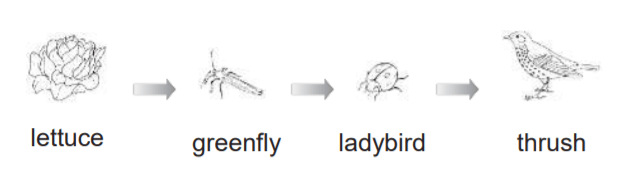
Who is the producer?
lettuce
greenfly
ladybird
thrush

What is a producer?
an organism that gets energy from eating other organisms
an organisms that uses sunlight to make its own food
an organism that gets energy from eating dead organisms, non-living material or waste

An animal that hunts other animals for food is a ___________
herbivore
predator
prey
omnivore

What is a herbivore?
an animal that gets energy from eating other animals
an organism that gets energy from eating only plants
an animal that gets energy by eating both plants and other animals

An organism that gets energy from eating other organisms is a ______________
producer
consumer
decomposer

A connection of food chains with many food energy paths in an ecosystem is a ____________
ecosystem
food web
environment

What is a carnivore?
an animal that gets energy by eating other animals
An animal that gets energy by eating only plants
an animal that gets energy by eating both plants and animals

Which of the following is NOT a consumer
grass
dog
shark
fish


relationship in which one population is inhibited and the other is not affected
(a)
relationship of two species of bacteria in which the antibiotic is introduces
(a)
occurs when to or more interacting members of community affect influence one another's evolution
(a)
relationship of hummingbirds and flower of the fushia plant
(a)
relationship that takes place when species in the community fight over limited supply
(a)
principle which state that no two competing species can occupy the same area at the same time
(a)
relationship in which animal eat plant or plant like organism
(a)
relationship in which a living organism feeds on the remains of dead plant or animal
(a)
relationship in which there is a close and permanent association exist between organism of same species
(a)
relationship of ants and aphids
(a)
relationship of deer and leaves
(a)
relationship of lions attacking buffalo
(a)
RELATIONSHIP OF CATTLE EGRETS AND CATTLE
(a)
orchids growing on the branches of the tree
(a)
fungus inhibiting the growth of bacteria
(a)
The four abiotic factors that affect all aquatic ecosystems are...
whales, tuna, tripod fish, and sharks
streams, rivers, ponds, and lakes
sunlight, temperature, oxygen, and salt content
soil, sunlight, rocks, and minerals
___________ and ___________ are the two major types of aquatic ecosystems.
Ponds and lakes
Freshwater and marine
Streams and rivers
Salt and fresh
____________________ ecosystems include streams, rivers, ponds, and lakes.
Marine
Ocean
Freshwater
Aquatic
Gills for breathing oxygen in water, fins, tails, and scales for insulation and protection are all examples of ___________________ fish have to allow them to live in water.
relationships
modifications
adaptations
changes
Sunlight is important to ALL aquatic ecosystems because it is needed for _______________________ to make food and oxygen.
consumers
producers
decomposers
scavengers
Only _____ of the water covering Earth's surface is fresh water.
3%
20%
47%
63%


This biome is much like a cold desert.
tundra
taiga
boreal forest
grassland

This biomes gets very little rainfall.
temperate forest
rainforest
grassland
desert

This biome gets very cold in the winter, but not quite as cold as the tundra.
grassland
taiga
temperate forest
rainforest

Most trees in this biome lose their leaves in the winter.
rainforest
boreal forest
taiga
temperate forest


