
 Worksheets
Wave Theory - 2
Total questions: 15
Worksheet time: 18mins
Water waves travel from deeper water to move to more shallow water. This causes them to refract. Which wave property always remains the same when refraction occurs?
Wavelength
Frequency
Amplitude
Speed
Which of the following waves are longitudinal?
Radio waves from a radio broadcaster.
Infrared waves from an oven.
Sound waves from a guitar
Water waves on a lake
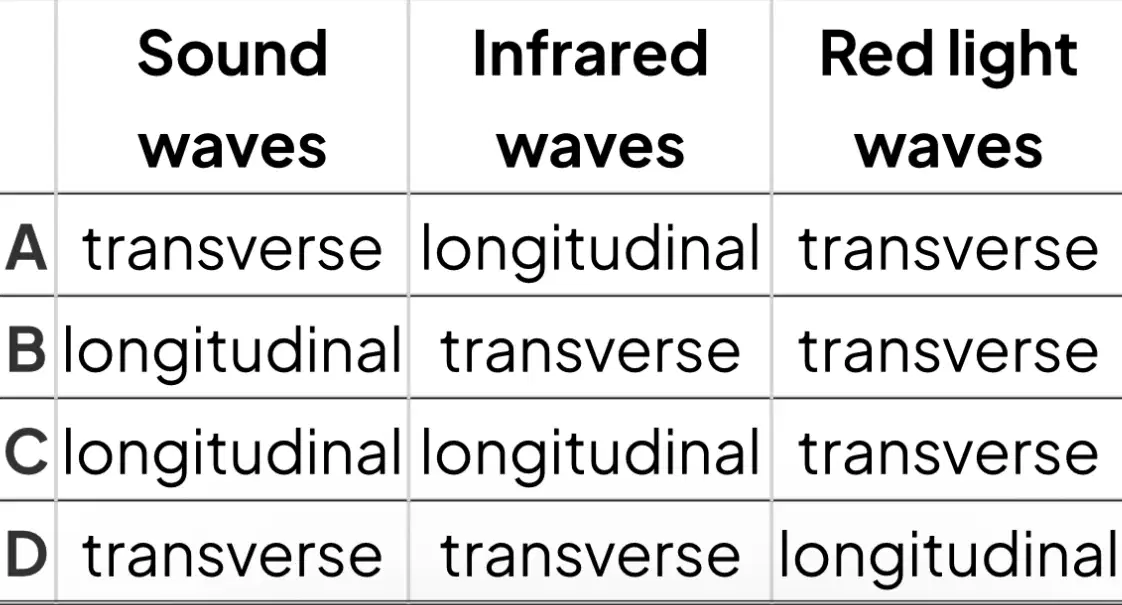
The following table shows some examples of waves. Which row correctly lists the nature of each of the wave types?
A
B
C
D
What is the definition of the word amplitude?
The number of complete waves that pass a point per second.
The distance from the peak of one wave to the peak of an adjacent wave.
The distance from the equilibrium position of a peak plus the same distance from a trough.
The maximum distance from the equilibrium position of any point on a wave.
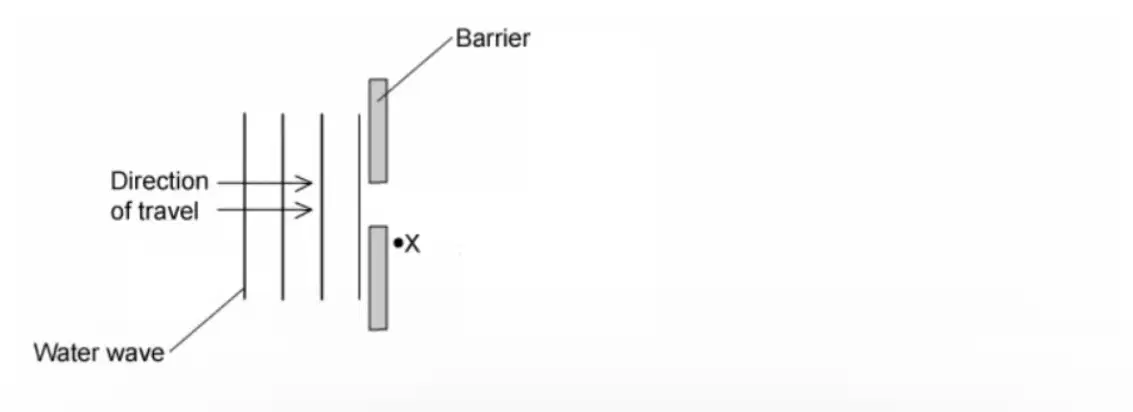
What is the name given to the effect that allows the wavefronts to reach point X, shown on the diagram?
Reflection
Refraction
Diffraction
Dispersion
Sound waves travel at a speed of 1500 m/s through a substance. Their wavelength is 5.00 cm. What is their frequency?
30 kHz
75 Hz
7.5 Hz
300 Hz
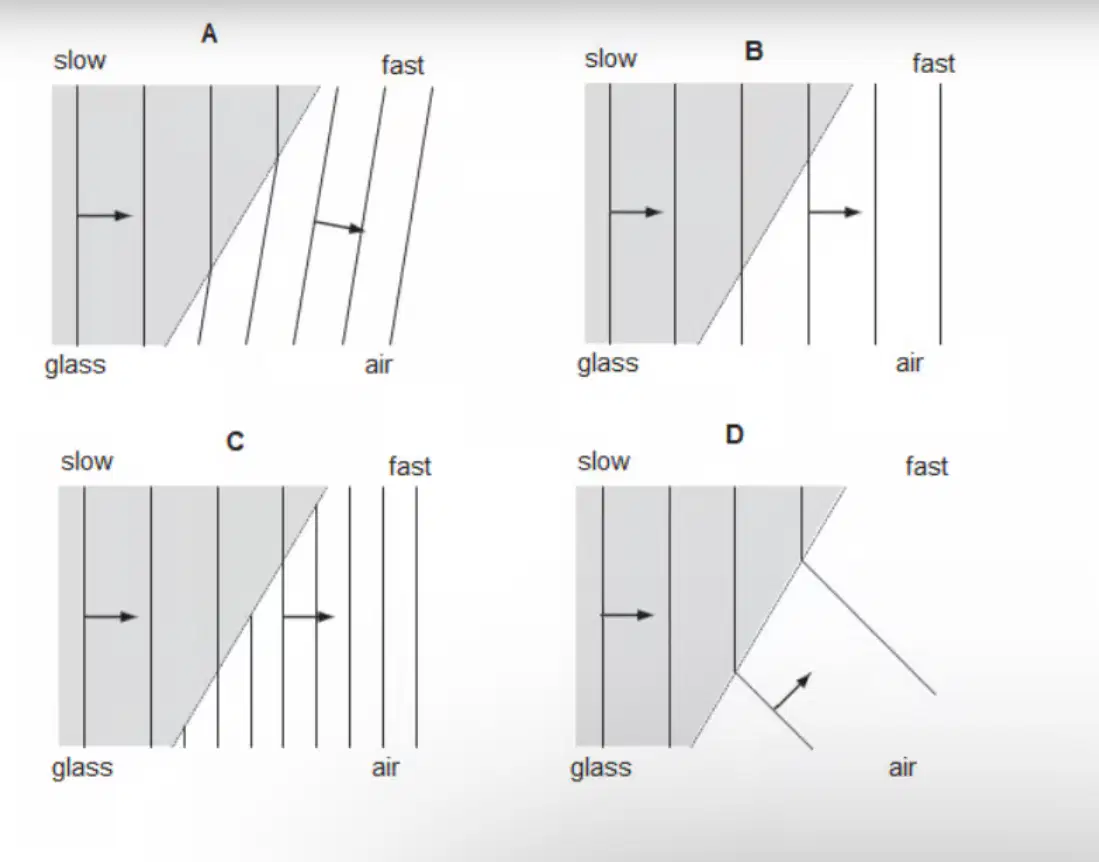
The diagrams below show the wavefront diagrams of light as it passes from glass into air. They are magnified many times.
Which diagram correctly shows what happens to the wavefronts as they pass the glass-air boundary?
A
B
C
D
Which of the following statements about sound waves is incorrect?
Sound waves are longitudinal.
Sound waves transfer energy away from the source.
Sound waves push air away from the source.
Sound waves cause objects to vibrate.
The speed of a wave is doubled. The frequency remains the same.
What happens to the wavelength of the wave?
It doubles
It halves
It remains the same
It becomes four times as large
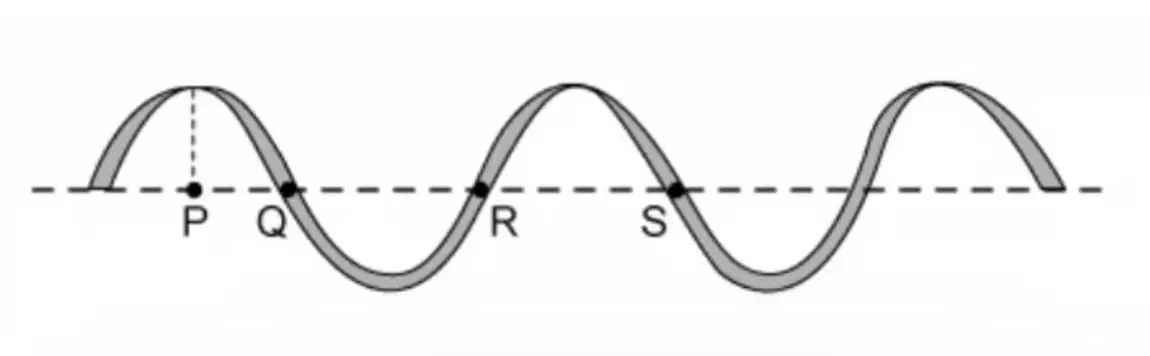
Which two points on the wave are exactly one wavelength apart?
P and S
Q and R
Q and S
P and S
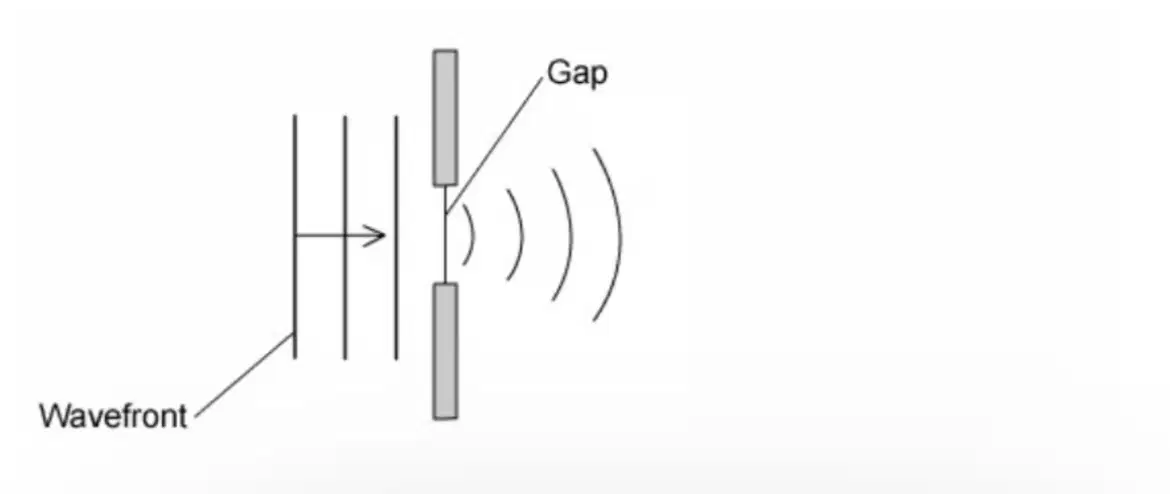
The diagram shows a plane water wave approaching a gap as viewed from above.
How could the situation be changed so that the waves on the far side of the gap do not spread out as far?
Decrease the speed of the waves (but keep their wavelength the same).
Increase the speed of the waves (but keep their wavelength the same).
Make the gap a little smaller
Make the gap a little bigger
A small child throws a stone into a very still pond.
Where the stone hits the water, waves travel outwards in a circular pattern until they reach the side of the pond.
In a very uncharacteristic move for a small child, he notices that six waves arrive in a time of 3.2 s (the child has a remarkably accurate internal clock).
waves?
To 3 significant figures, what is the frequency of the
1.5 Hz
19.2 Hz
0.533 Hz
1.88 Hz
What is the unit of wave speed?
Hertz
Metre
Second
Metres per second
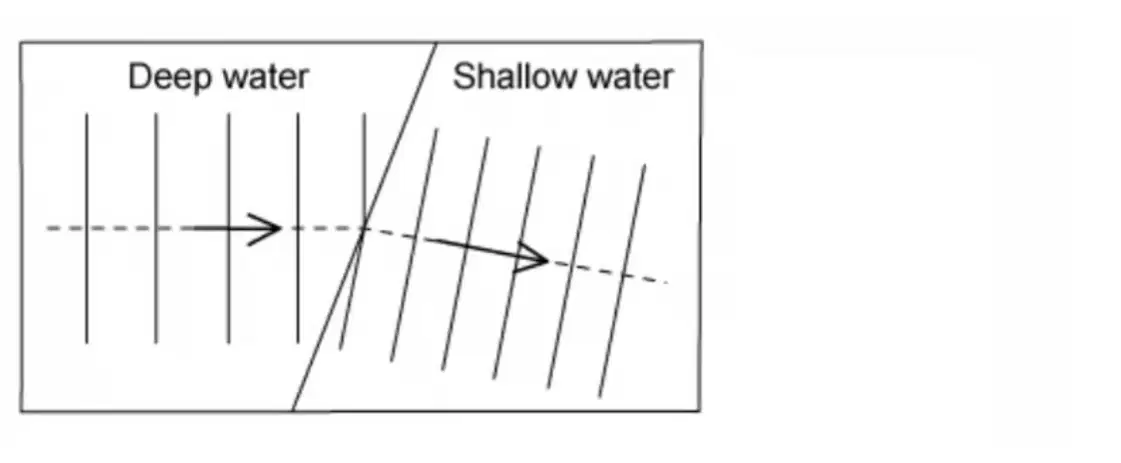
When water waves travel from deeper water into more shallow water they are refracted.
Why does the wave change direction in the manner shown?
The wave speed increases.
The wave speed decreases.
The frequency increases.
The frequency decreases.
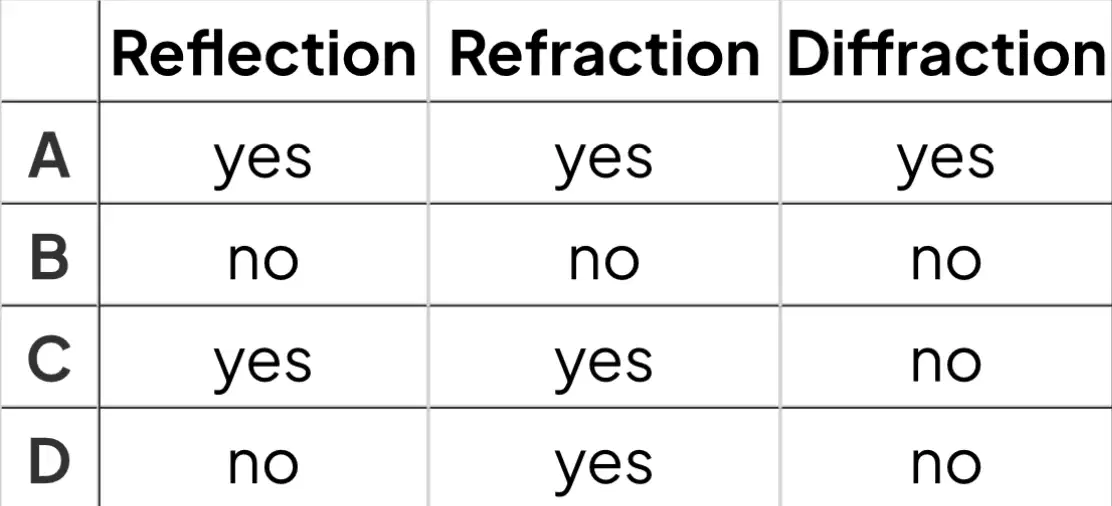
For each of these, which rows shows whether or not the wavelength of the water waves changes?
A
B
C
D

