
NEW
Font size
 Worksheets
Social-Cognitive Deficits in normal Aging Quiz
Total questions: 9
Worksheet time: 7mins
What is mentalizing?
awareness and understanding of one's own thought processes
psychological process used to understand what others are thinking or feeling
the ability to see, hear, or become aware of something through the senses
What were the three tasks that the participants were tested on?
facial recognition, moral judgment, false belief
mimicry, moral judgment, animate movement
animate movement, moral judgment, false belief
false belief, animate movement, facial recognition
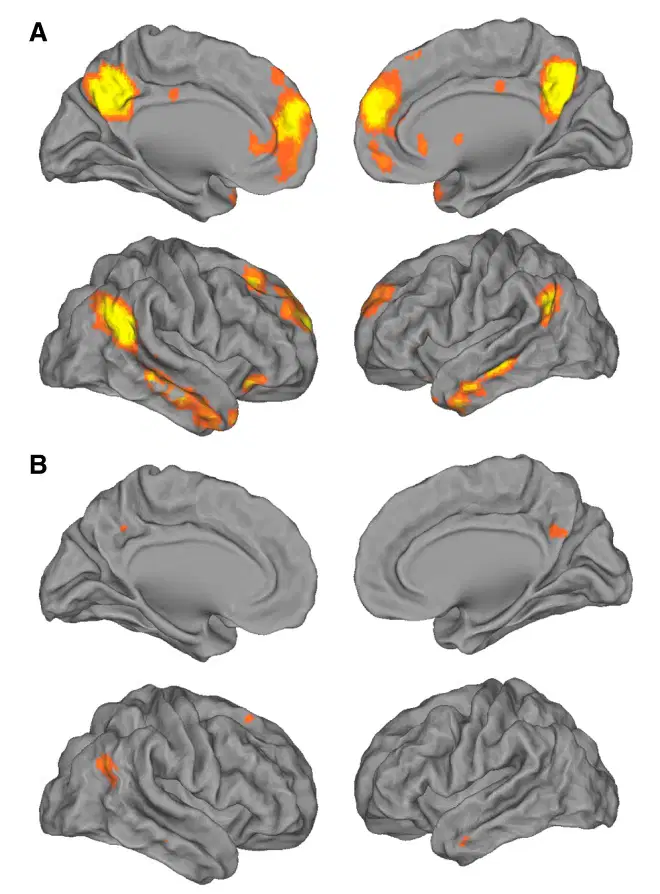
The figure below shows the brain scans of the two groups of participants for the Animate Movement Task. As seen in the picture, the A participants showed significantly greater activity than the B participants. Which were the A participants and which were the B participants?
A) older adults, B) younger adults
A) children, B) older adults
A) younger adults, B) older adults
A) children, B) younger adults
Both younger and older participants performed better on (A)____ than (B)___ questions, but older adults correctly answered fewer (C ) ___ questions correctly than did young participants
(A) false belief, (B) false photo questions, (C) false belief
(A) false photo, (B) false belief questions, (C) false photo
What part of the brain did the study find primarily responsible for differences in response during social-cognitive tasks between younger and older participants?
Dorsomedial prefrontal cortex
Ventromedial prefrontal cortex
Anterior STS
Bilateral inferior frontal gyrus
What was an additional possibility presented by existing literature on social cognition that may account for lower social cognition performance in older adults?
Older adults are more tired when completing these tasks
Older adults have greater difficulty with retaining information
Older adults are more motivated which may cause greater anxiety when completing tasks
Older adults may be less motivated to perform well
Which of the following would best show less mentalizing in older adults than younger adults in the moral judgment task?
Neutral outcome, negative intention
Negative outcome, neutral intention
Neutral outcome, neutral intention
Negative outcome, negative intention
More intriguingly, older adults in this earlier study also engaged the _____, an additional set of brain regions not typically associated with social cognition.
Primary auditory cortex (A1)
Lateral prefrontal cortex
Primary valisu cortex (V1)
Cerebellum
In the false belief task, a strong negative correlation was found between ______ and ______ among ______ participants.
Gender, performance, older
Gender, performance, younger
Age, performance, older
Age, performance, younger

