
Font size
 Worksheets
Unit 8 - Work and Power
Total questions: 23
Worksheet time: 1hrs 8mins
Work done is measured in which of the following units?
Newton
Watt
Kilogram
Joule
Power is measured in which of the following units?
Newton
Watt
Kilogram
Joule
How many watts are there in a kilowatt?
10 W
100 W
1000 W
10000 W
How many watts are there in a megawatt?
1,000 W
10,000 W
100,000 W
1,000,000 W
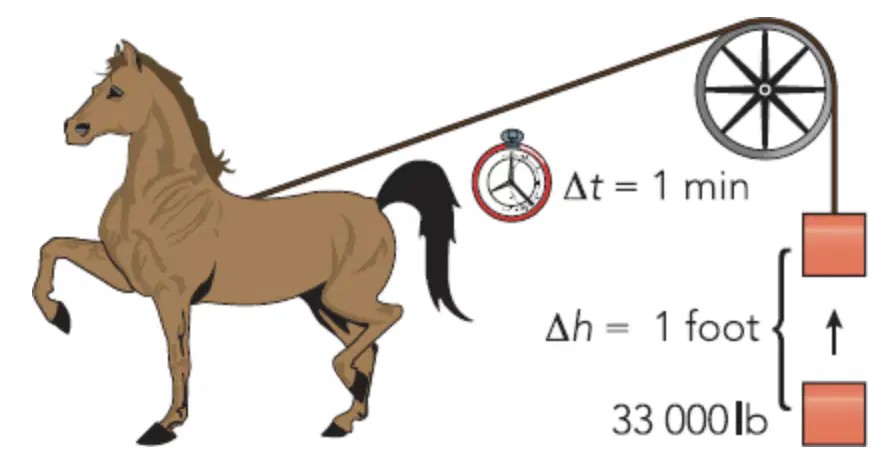
One horsepower is the power output of one horse when it lifts a mass of 33 000 lb of water through a height of one foot in one minute as shown in the image.
You need to know that 1 lb = 0.453592 kg and one foot = 0.3048 meters.
Calculate the mass of water the horse lifts in one minute.
1.497 x 10^3 kg
1.497 x 10^4 kg
1.497 x 10^5 kg
1.497 x 10^6 kg
One horsepower is the power output of one horse when it lifts a mass of 33 000 lb of water through a height of one foot in one minute as shown in the image.
You need to know that 1 lb = 0.453592 kg and one foot = 0.3048 meters.
Calculate the weight of water the horse lifts in one minute. (Assume that g = 10 N/kg)
1.497 x 10^3 N
1.497 x 10^4 N
1.497 x 10^5 N
1.497 x 10^6 N
One horsepower is the power output of one horse when it lifts a mass of 33 000 lb of water through a height of one foot in one minute as shown in the image.
You need to know that 1 lb = 0.453592 kg and one foot = 0.3048 meters.
Calculate the work the horse does in one minute.
4.56 x 10^3 J
4.56 x 10^4 J
4.56 x 10^5 J
4.56 x 10^6 J
One horsepower is the power output of one horse when it lifts a mass of 33 000 lb of water through a height of one foot in one minute as shown in the image.
You need to know that 1 lb = 0.453592 kg and one foot = 0.3048 meters.
Calculate the power output of the horse.
380 W
3800 W
760 W
7600 W
An average man needs to eat food containing about 2500 kcal of chemical potential energy per day (1 kcal = 4.18 kJ). a
What is 2500 kcal expressed in joules?
5,225,000 J
10,450,000 J
10.45 MJ
13.85 MJ
An average man needs to eat food containing about 2500 kcal of chemical potential energy per day (1 kcal = 4.18 kJ). a
Calculate the power output of the average man, even when he is doing no work.
60W
12.1 W
242 W
121 W
It is estimated that the human brain has a power requirement of 40 W. How much energy does it use in an hour?
72 kJ
144 kJ
288 kJ
300 kJ
A light bulb transfers 1000 J of energy in 10 s. What is its power?
1 W
10 W
100 W
1000 W
An electric motor transfers 100 J in 8.0 s. It then transfers the same amount of energy in 6.0 s. Has its power increased or decreased?
Increased
Decreased
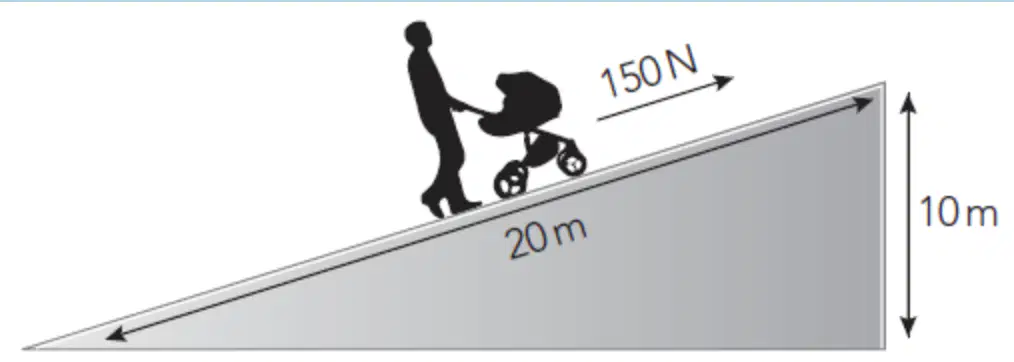
A man pushes a 25 kg pram up a slope as shown in the diagram.
He pushes with a force of 150 N along the 20 m slope. How much energy is dissipated as thermal energy?
250 J
500 J
2500 J
5000 J
When it moves an object, a smaller force does ________ work than a bigger force.
Work
Energy
More
Less
The greater the distance an object is moved by the force, the ________ work it does.
Work
Energy
More
Less
Power is the rate at which _______ is transferred.
Work
Energy
More
Less
Power is the rate at which _______ is done.
Work
Energy
More
Less
The Empire State Building in New York is the venue for an annual running competition. Competitors race up 86 floors (1576 stairs) or 320 metres to finish close to the top. The record fastest time is 9 minutes 33 seconds by Paul Crake in 2003. His mass was 62.5 kg.
Calculate Paul Crake's weight.
62.5 N
625 N
6250 N
10000 N
The Empire State Building in New York is the venue for an annual running competition. Competitors race up 86 floors (1576 stairs) or 320 metres to finish close to the top. The record fastest time is 9 minutes 33 seconds by Paul Crake in 2003. His mass was 62.5 kg.
Calculate the work done by Paul Crake.
2 x 10^4 J
2 x 10^5 J
2 x 10^6 J
2 x 10^7 J
The Empire State Building in New York is the venue for an annual running competition. Competitors race up 86 floors (1576 stairs) or 320 metres to finish close to the top. The record fastest time is 9 minutes 33 seconds by Paul Crake in 2003. His mass was 62.5 kg.
Calculate Paul Crake's average power output during his record-breaking run.
3.49 W
34.9 W
349 W
3490 W
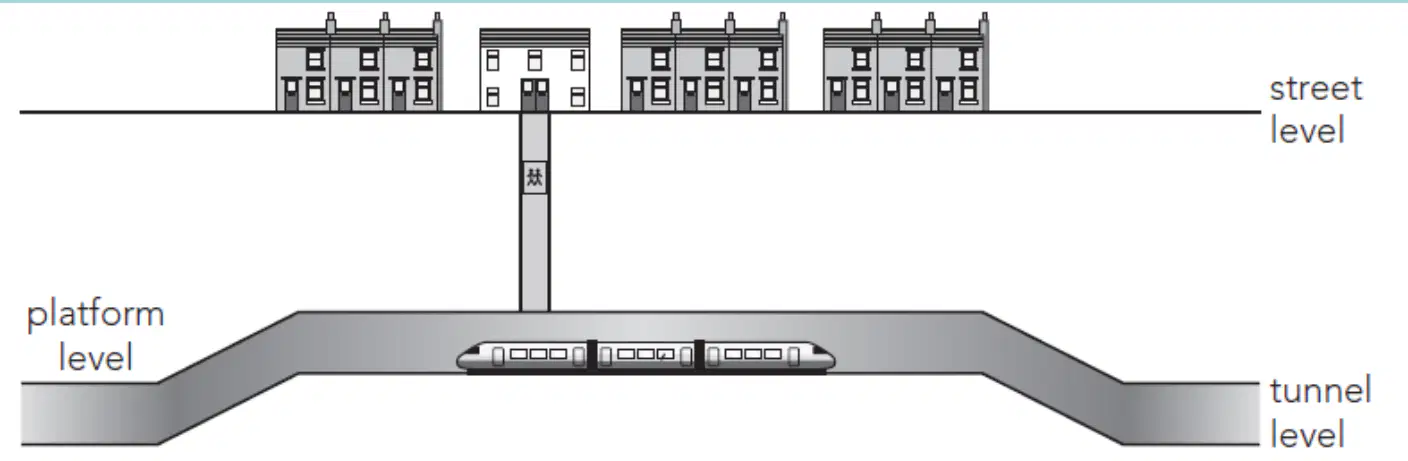
The diagram shows a section through a subway station. The track at the station platform is designed to be higher up than the track in the tunnels. The driver uses brakes to stop the train at the platform and a motor to make the train set off. What is the advantage of having the platform higher up than the track in the tunnels? Explain your answer in terms of the work done by the brakes and the motor.
A subway train has a mass of 270 000 kg (including passengers) and a maximum kinetic energy of
81.7 MJ.
1.23 m/s
12.3 m/s
2.46 m/s
24.6 m/s

