
 Worksheets
Water/landforms, glaciers, fossils, geologic time scale
Total questions: 25
Worksheet time: 13mins
Which of the following is NOT a major reservoir of the hydrosphere?
Rivers
Glaciers
Atmosphere
Volcanoes
Weathering, mass movement, and erosion are all considered internal processes of the Earth.
True
False
Define mass movement:
Mass movement refers to the flow of water through the hydrosphere, influencing landscapes by erosion and deposition.
Mass movement is the transfer of energy within the atmosphere, leading to changes in weather patterns.
Mass movement refers to the movement of large masses of land or rock down a slope, shaping landscapes through processes like landslides and mudflows.
Mass movement is the rotation of Earth on its axis, affecting the distribution of water on the planet's surface.
Define a watershed (water basin):
A watershed is a large body of water, such as a lake or ocean, that collects and stores precipitation.
A watershed is an area of land that drains all the streams and rainfall to a common outlet, such as a river or lake.
A watershed is a channel carved by flowing water over time, shaping the surrounding landscape.
A watershed is a type of weather pattern characterized by heavy rainfall and thunderstorms.
What type of mass movement is characterized by the sudden movement of a large mass of rock or soil down a slope?
Creep
Mudflow
Slump
Landslide
Which of the following strategies can help mitigate the impact of floods?
Restoring natural marshland, which acts as a sponge
Deforestation which decreases the root structures in the soil
Increasing groundwater extraction
Urbanization in flood-prone areas
Why are index fossils useful to geologists?
They provide clues about past climates and environments
They contain rare minerals
They can be used to date rock layers accurately
They are valuable artifacts for museums
Which geologic era came first?
Cenozoic
Paleozoic
Mesozoic
Precambrian
How do fossils help scientists understand Earth's history?
They provide evidence of past life forms and environments
They reveal future geological events
They show the effects of pollution on ecosystems
They predict earthquakes and tsunamis
How do glaciers form?
From volcanic eruptions
Through the melting of ice caps
By the accumulation of snow over time
From underground rivers freezing
An imaginary line separating one water basin (watershed) from another is called a:
Divide
Trench
Berm
River
The lowest point to which a stream can erode:
Sea level
Base level
Watershed
Basin

What is this a picture of?
River headwater
River transfer zone
Water basin
River delta
All of the following describes a narrow stream valley, except:
V-shaped
Downcutting toward base level
Meanders
Rapids and waterfalls
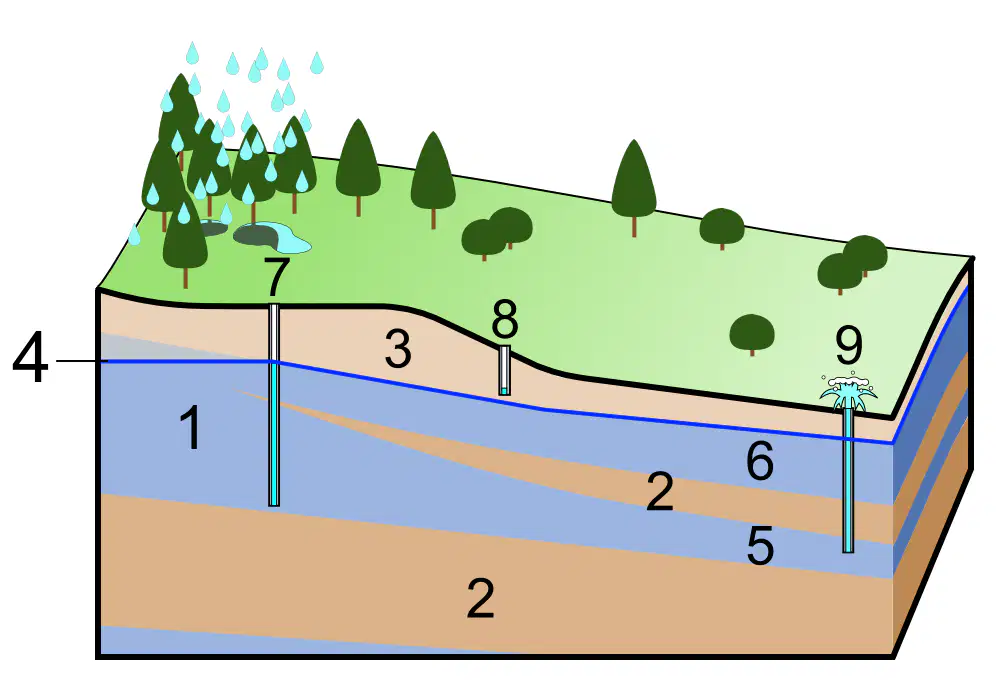
Which number represents the aquifer (zone of saturation)?
1
2
3
4
Groundwater is able to slowly form caverns and caves over time due to:
being slightly alkaline
having a high salinity
having a high level of sulfates
being slightly acidic
Two major ice sheets on Earth are over:
Iceland and Greenland
Iceland and Antarctica
Greenland and Antarctica
Antarctica and New Zealand
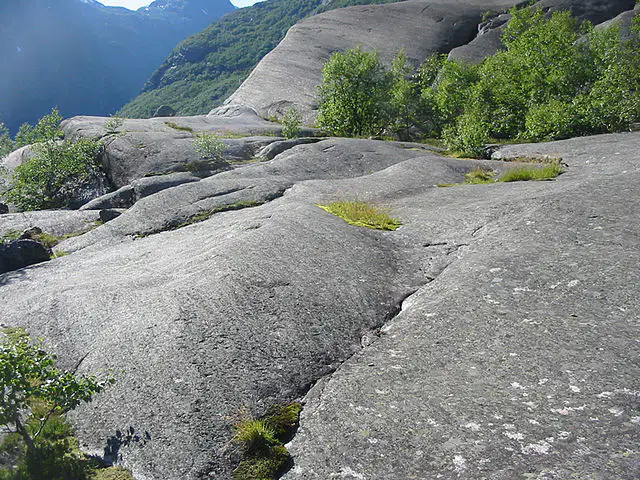
This smooth surface was created by:
glacial plucking
glacial deposits
glacial till
glacial abrasion
Which of the following is NOT and indirect effect of glaciers:
Erosion
Forced migration of animals
Changes in sea level
Climatic changes

Based on the Law of Superposition, which fossil or artifact is the oldest
Skull
Plate
Ceramic pot
Serrated arrowhead

Which is the youngest geologic feature?
B
C
E
F
It is possible for fossils to be found in igneous rock.
True
False
Rarely
Conditions favoring the preservation of fossils include:
Rapid burial
Organism had hard body parts
Organism was made of soft tissue
Both A & B

This fossil is an example of:
Petrification
Mold and cast preservation
Amber preservation
Coprolites
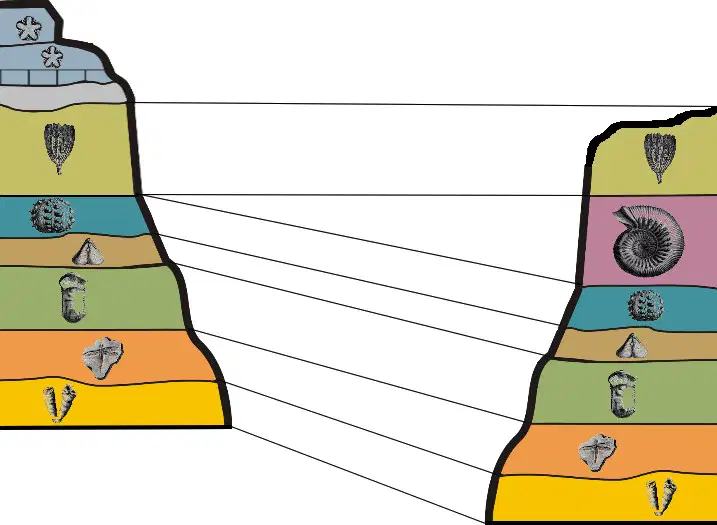
Based on correlation, what can we assume about the fossils found in the blue layers?
They are similar ages
They originated from the same geographical location
They are older than the green layer
They are not related to one another

