Worksheets
3.3 Unit Review
Total questions: 36
Worksheet time: 32mins


The United States is known as a melting pot because many different types of people compose society. People from all parts of the world have moved to the United States in search of religious freedom, to escape poverty or violence, or as a refugee after being displaced due to environmental factors. Which of these is a likely outcome of movement by people?
Gene flow occurs between populations.
Allele frequencies suddenly change dramatically.
Relative genotypic frequencies reach a constant state.
Intermediate phenotypes increase in the species.
Genetic drift is driven by chance, not natural selection
true
false
A forest fire ignites and kills many members of a population of rattlesnakes. This is an example of:
gene flow
genetic drift
mutation
According to natural selection, organisms more suited to their environment are better able to
Sleep
Survive
Perish
Migrate
Genetic diversity is decreased through this process.
Gene Flow
Genetic Drift

Select the best answer based on the image.
Gene Flow
Genetic Drift

Which of the following is an example of the founder effect?
Humans choose two dogs they like the characteristics of and breed them together.
Affected individuals with blue skin can trace their ancestry back to one of the first settlers in the region.
The environment of a fox population changes and over time foxes who are white survive and pass on their genes to their offspring.
Cheetah populations reach their lowest levels with reduced diversity and as they rebound are so genetically similar they appear to be inbred.

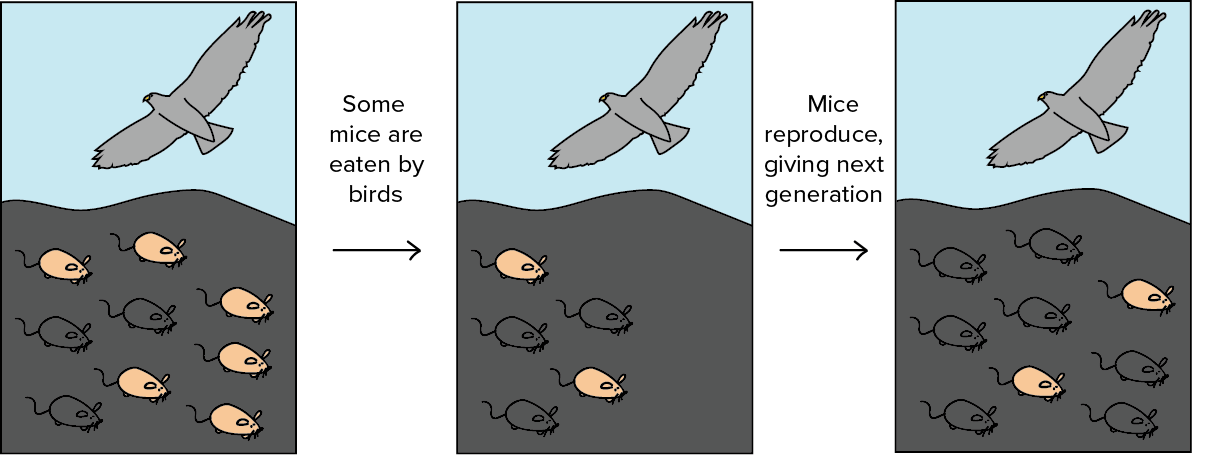
Due to pollution, a pond becomes darker over time. Which trait variation became more common?
light fish
dark fish
Why are advantageous traits more likely to be passed onto offspring?
Because they are more likely to survive and reproduce.
Because they come from dominant alleles.
Because they come from recessive alleles.
Because the organism knew it needed that trait, survives, and passes it on.
What advantage did the development of bipedalism most likely confer to early hominids?
It allowed them to evolve a complex social structure
It allowed them to move and hold objects at the same time
It allowed them to evolve an opposable thumb
It allowed them to see with binocular vision

Scientists have found evidence that about 2.4 million years ago a gene regulating jaw muscles mutated and may have led to the more graceful human jaw we see today. The diagram below shows the skulls of 3 hominid species. Which statement below most closely explains the link between jaw size and hominid evolution?
The jaws of hominids evolved to be smaller and less protruding over time as did the skull.
The jaws of hominids evolved to be larger and more protruding over time.
There appears to be no change in the jaws of hominids over time.
The jaws of hominids changed over time due to a change in brain size
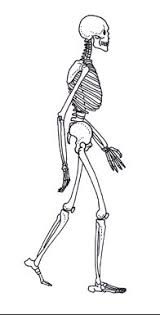
The ability to walk upright on two legs is called:
bipedalism
quadropedalism
bicyclepedalism
tripedalism
Did Redi disprove spontaneous generation?
Yes
No
Pasteur's experiment led to the theory of
Cells
Biogenesis
Heterotrophs
Spontaneous Generation
The Miller-Urey experiment of 1953 was designed to test the hypothesis that lightning supplied the energy needed to turn atmospheric gases into organic molecules such as amino acids. Which of the following describes why the Miller-Urey theory is widely accepted today?
Amino acids spontaneously form from molecules in the atmosphere today.
Organic molecules are present today in extremely high concentrations.
The process of synthesizing organic molecules from a mixture of gases has been successfully modeled in the laboratory.
No other alternative hypotheses have been introduced.
Which of the following can be learned by using the fossil record?
When organisms changed or evolved
when organisms appeared on Earth
when organisms became extinct
All the above
Which of these is the best definition of biogeography?
The study of how and why plants and animals live where they do.
The study of how and why plants affect each other and the environment.
The study of how and why plants evolve to compensate for changes in habitats.
None of these are definitions of biogeography.