
 Worksheets
BIO 112 Practical Review
Total questions: 62
Worksheet time: 48mins

The cells of organisms in these two domains are prokaryotic:
Archaea and protista
Archaea and bacteria
Plantae and animalia
Bacteria and fungi
Which of the following is NOT a characteristic of organisms in Kingdom Fungi
They are eukaryotes
They are mostly multicellular organisms
It includes mushrooms and molds
They are autotrophic
A eukaryotic organism that is multicellular and has cell walls made of cellulose would most likely be placed in:
Domain Bacteria
Kingdom Plantae
Kingdom Animalia
Domain Archaea
Organisms from this group can live in some of the most extreme environments.
Domain Eukarya
Domain Bacteria
Kingdom Protista
Domain Archaea
Domain Bacteria have cell walls made of:
cellulose
chitin
peptidoglycan
They do not have cell walls
Which of the following is not a type of protist?
Animal-like
Plant-like
Bacteria-like
Fungus-like

Which leaf is shown in the drawing?
Magnolia
Redbud
Sweetgum
None of the above
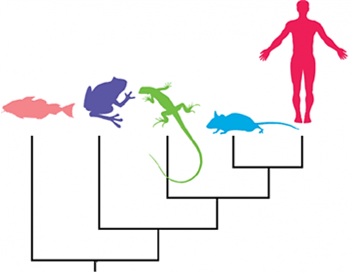
What is the human most closely related to?
Fish
mouse
Salamander
Human

Where is the alligator and T. rex's common ancestor?
Point A
Point B
Point C
Point D
Evolved from the same ancestor, but have different functions
Homologous structures
Analogous structures
Vestigial structures
All of the above
An anatomical feature that no longer seams to have a purpose in the current form of an organism
Homologous structure
Analogous structure
Vestigial structure
None of the above
According to natural selection, organisms more suited to their environment are better able to
Sleep
Survive
Perish
Migrate

Scientists have found evidence that about 2.4 million years ago a gene regulating jaw muscles mutated and may have led to the more graceful human jaw we see today. The diagram below shows the skulls of 3 hominid species. Which statement below most closely explains the link between jaw size and hominid evolution?
The jaws of hominids evolved to be smaller and less protruding over time as did the skull.
The jaws of hominids evolved to be larger and more protruding over time.
There appears to be no change in the jaws of hominids over time.
The jaws of hominids changed over time due to a change in brain size

What type of evidence is shown with the diagram above?
Molecular
Anatomical
Embryology
Fossil
p + q = 1. If p represents the dominant allele frequency, what would q represent?
the homozygous dominant genotype frequency
the recessive allele frequency
the total amount of alleles in the population
a measure of fitness in the population
The gene pool for a population of 10 individuals contains 4 recessive alleles and 16 dominant alleles (20 alleles total). What is the value for p (dominant allele frequency)?
(a)

Which values can be plugged into the equation? p + q = 1
0.6 and 0.16
0.6 and 0.4
0.4 and 0.16
0.48 and 0.36
Which statement is true about viruses?
Viruses can eat and metabolize food.
Viruses can reproduce only using a host cell.
Viruses can reproduce on their own at any time.
A bacterium reproduces asexually by dividing to form two new bacterial cells. What is the name of the process by which bacteria reproduce?
meiosis
budding
binary fission
Match the following bacteria shapes to the correct term
Coccus
Sphere or Round
Bacillus
Rod or Stick
Spirillum
Spiral
What is the job of the cell wall in bacteria?
To provide protection
To make protiens
To hold organelles in place
To hold water and nutrients

What does a virus ALWAYS surrounding the viral genome?
capsid
a fur coat
membrane envelope
cell membrane

The scientific name for the "spikes" on a virus
Capsid
Membrane Envelope
Viral Genome (RNA/DNA)
Glycoproteins

What do antibodies attach to on the pathogen?
Anti inflammatory
Antigens
Antiseptic
Antibodies
Which layer of the bacteria is dyed/stained purple?
Cell membrane
cell wall
capsule
slime layer
Grace, Ava, and Sophia are having a debate about the purpose of Gram staining. Can you help them settle the debate?
To differentiate between Gram positive and Gram negative bacteria
To identify the presence of peptidoglycan in bacterial cell walls
To stain bacteria red or violet
To determine the thickness of the peptidoglycan layer
Stained pink
Gram positive bacteria
Gram negative bacteria
Stains purple
Gram positive bacteria
Gram negative bacteria

Look at the image. This bacteria colony's form is _____.
circular
irregular
filamentus
rhizoid

Look at the image. This bacteria colony's elevation is _____.
umbonate
flat
crateriform
convex

Based on the figure, which antibiotic inhibited/stopped the growth of the bacteria the most?

zone of conjugation
Used to prevent the spread of a virus
vaccines
antibiotics
Aspirin

What type of protist is this?
euglena
volvox
paramecium
amoeba

What type of protist is this?
euglena
volvox
paramecium
amoeba

What type of protist is this?
euglena
volvox
paramecium
amoeba

What type of protist is this?
euglena
volvox
paramecium
amoeba
Euglena and Volvox move using _____.
pseudopods
cilia
flagella
Paramecium move using _____.
pseudopods
cilia
flagella
Amoebas move using _____.
pseudopods
cilia
flagella
Is kelp a type of algae?
Yes
No
green pigment
fucoxanthin
chlorophyll
carotenoids
phycoblins
Protozoa are a type of protist that is anima-like. Choose 2 examples that are Protozoans.

Paramecium

Diatoms

Kelp

Amoeba

Cellular Slime Molds are an example of
Animal-like protist
plant-like protist
fungi-like protist
fungi


This bread mold belongs to what phylum? (a)

Name the Phylum?
Ascomycota
Glomeromycota
Chytridiomycota
Basidiomycota
Which are the Ascomycota!


Who are the unicellular fungi?
Microsporidia
Yeasts
Chytridiomycota
Zygomycota
Which fungi form arbuscular mycorrhizae?
Zygomycota
Glomeromycota
Ascomycota
Basidiomycota
Producing spores in asci and having ectomycorrhizae are traits of
Ascomycota
Basidiotmycota
Zygomycota

Select the Correct Lichen Form
Crustose
Fruticose
Foliose
Moss

Select the Correct Form of Lichen for the Lichen in the Center of the Image
Crustose
Foliose
Fruticose
Moss

Select the Correct Lichen Form for the Center Lichen
Crustose
Foliose
Fruiticose
Moss

