
Font size
 Worksheets
Earth System Amplify 5th Grade Q3
Total questions: 29
Worksheet time: 29mins
The teacher pours water into a glass beaker. He heats the beaker and the liquid begins to boil. Soon it appears as if there is no liquid left in the beaker.
Amber claims that the water disappeared. Stacy claims that the water did not disappear.
Which student’s claim is accurate?
Amber; the water disappeared because we can no longer see it.
Amber; the water disappeared because the beaker weighs less.
Stacy; the water didn’t disappear, it just changed forms.
Stacy; the water didn’t disappear, the beaker absorbed it.
A student weighs a whole piece of paper on a balance. The paper weighs 4 grams. The student tears the paper into two pieces and weighs all pieces again. Then she tears it into 4 pieces, 8 pieces, and 16 pieces. She weighs all pieces each time she tears the paper. The student makes a graph to show the weight of the paper after each tear. Which graph shows the weight of the pieces of paper?


A student wants to show how the hydrosphere and the atmosphere interact. Which model could the student make to show this interaction?
a model of a cloud forming in the sky
a model of a volcano releasing gas into the air
separate drawings of the ocean and of the sky
a life-cycle diagram of a frog in a pond
Factories often release harmful substances into the atmosphere. These substances pollute the air. An engineer wants to reduce all of the air pollution coming from a factory.
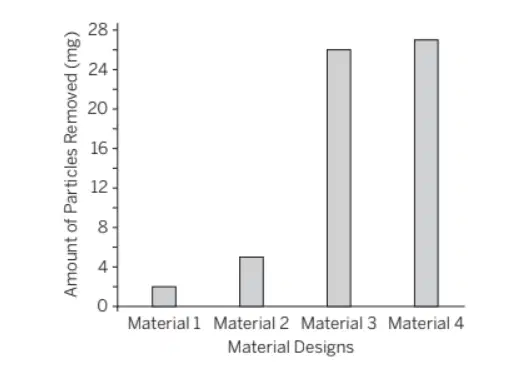
First, he focuses on pollution from one harmful substance, ash. He places different materials over a model of a chimney to stop particles of ash from getting into the air. He measures the amount of pollution that each material catches and makes a graph of the results.
What should be the engineer’s next step?
Make and sell Material 1 to nearby factories.
Retest the materials with a different type of factory pollution.
Test Materials 1 and 2 on a real factory chimney.
Find and fix any problems with Material 4.
Hurricanes are powerful storms that bring strong wind and heavy rain. They can create large, powerful waves that may cause erosion.
People living in a beachside town want to protect their beach from a hurricane that is headed their way. The hurricane arrives in one week. They have collected $500 for project supplies.
Which of the following is a problem for their project?
We need to design a solution to beach erosion with only $500 and complete the design in one week.
We need to fix erosion before the hurricane gets here.
We will use the $500 to get a big truck to pile sand along the beach to protect it from the waves.
We need to study the effects of erosion on beaches in other towns.
A teacher wants to model for young children that matter is not destroyed when it changes.
Which of the following models would best show this to the children?
taking a cup of water, pouring it onto sand, and watching the sand absorb it
weighing a piece of clay and then changing the shape of it and weighing it again
burning a piece of paper so that it will change into ash and smoke
boiling an ice cube so that it changes into gas

The graph above shows how much of Earth’s water is fresh water, salt water, and other kinds of water.
Which claim is supported by the data in the graph?
Most of Earth’s water is in lakes, rivers, and streams.
Most of Earth’s fresh water is in glaciers or underground.
Most of Earth’s water is in the ocean.
Earth’s water is split evenly between fresh water and salt water.
Colton lives next to a river. He noticed that several fish are dying in the river. He researched this problem, and a scientist told him that dirt and other debris from building houses was washing into the river.
Colton wants to design a container that can catch the dirt and debris before it gets to the river. Which of the following is an example of criteria he might use in developing this design?
The container can only cost $10 to make.
The container must collect a large amount of debris before it gets to the water.
The container design should be tested many times.
The container can only be made from available plastic in Colton’s house.
Louis poured 2 cups of water in an ice tray two weeks ago and placed it in the freezer. He took the ice cube tray out of the freezer yesterday and accidentally left it on the table for a few hours. This made all of the ice melt and it did not have time to evaporate..
Louis measured the amount of water that came from the melted ice. Which of the following measurements of the melted ice is most accurate, given what you know about matter changing?
2 Cups
5 Cups
15 Cups
7 Cups
Coral reefs are home to many different organisms, including fish. However, they are often damaged by human activity.
A group of scientists wants to regrow coral in a reef damaged by chemical pollution. First, the scientists made a model of a possible solution. Next, they tested the model and collected data. They notice that their design keeps the water clean but is harmful to the fish.
What should they do next?
Tell scientists everywhere to start making and using their design.
Look into how their design affects the biosphere, and make improvements.
Look into how their design affects the hydrosphere, and make improvements.
Redesign the product from scratch, and test it again.
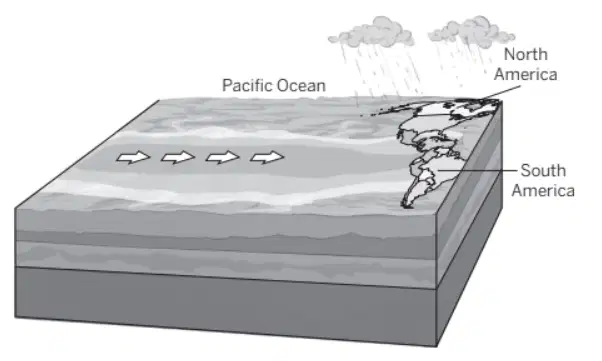
A class is studying the effects of weather on Earth’s systems. One weather event that they are studying is called “El Niño.”
El Niño occurs every few years when the water in the Pacific Ocean gets warmer than usual. This leads to increased rainfall in Southern California.
During El Niño, the warmer ocean waters of the hydrosphere evaporate faster, leading to more moisture in the atmosphere. This leads to weather occurrences that affect both the geosphere and the biosphere.
Students have been asked to explain how El Niño affects the following systems in the United States: geosphere, hydrosphere, atmosphere, and biosphere.
Reorder the following
___Clouds carry small water particles over land.
___Clouds forced even higher by mountains produce rain.
___Warmer water results in more water evaporating into the air.
___As the water vapor rises in the air, it cools and condenses to form clouds.
Warmer water results in more water evaporating
as the water vapor rises in the air, it cools and condenses to form clouds
Clouds carry small water particles over land.
Clouds forced even higher by mountains produce rain.
Humans and many other living things require fresh water to survive. There is more rain in many areas during an El Niño year, but not all of this water adds to Earth’s fresh water supply. Select all of the statements below that describe paths that water can take that add to our supply of fresh water
Water flows through streams and rivers into a local lake or pond.
Water falls as snow and becomes part of a glacier on a mountaintop.
River water flows downstream through streams and rivers into the ocean.
Water absorbed by the ground becomes groundwater that supplies wells.
Water falls directly back into the ocean and is circulated by ocean currents.
Who uses science knowledge to design something in order to solve a problem?
entertainer
editor
engineer
economist
Does the Earth have more land or water?
water
land

According to this graph, most (96.5%) of the water on Earth is what type of water?
freshwater
saltwater
Where is the least amount of freshwater found on the surface of the Earth?
lakes
rivers
wetlands
L4: In the Earth system, people and living things are part of the (a)
L4: The Earth system that consists of all the liquid and frozen water is the (a)
L6: The Earth system that is made up of all the air that surrounds Earth is called the (a)
L6: When a gas turns into a liquid, this is called __________.
gas
condensation
precipitation
perspiration
L7- A group of atoms joined together in a particular way is called a...
substance
molecule
atmosphere
resource
L7- water molecules are (a) in water vapor. water molecules are (b) in liquid water.
L7- Rain drops can form when enough water vapor gets ______ and condenses into liquid water.
cold
warm
fast
vapor
L8- Evaporation is when a (a) turns into a (b) .
water cycle
change of water from one state to another as it travels from Earth's surface to atmosphere and back
surface water
water on top of Earth's surface
evaporation
process of changing from liquid to gas, usually caused by energy from the sun
transpiration
process of water vapor leaving a plant and entering the atmosphere
respiration
the process in which animals release water vapor
condensation
process of changing from gas to liquid, such as water vapor changing to water
precipitation
water falling to the surface of the Earth in the form of rain, hail, sleet, or snow
groundwater
water below Earth's surface
Almost all of Earth's water is salt water in the (a) . The limited amount of freshwater is mostly in (b) and groundwater .
The amount of available freshwater (c) when people use more than the amount that flows into their area.
Water vapor in the air comes from liquid water that has evaporated. (a) causes water vapor to rise into the atmosphere.
Drops of water can form when enough water vapor gets cold and condenses into liquid water. Water vapor condenses as it moves higher, to where the atmosphere is (b) (c) creates clouds in the atmosphere.
Raindrops can form when enough water vapor gets cold and condenses into liquid water. (This causes (d) .
Rain Shadow Effect Key Concepts:
When wind blows toward a mountain, the mountain can direct the wind upward. This moves water vapor higher in the (a) This causes most of the rain to fall on only one side of the mountain.

