
 Worksheets
McGraw Hill Topic 7 China
Total questions: 30
Worksheet time: 21mins

people should lead by example, following a high set of morals
family members should be respectful, obedient (children), and loyal
more focused on nature
most important ideas: virtue, kindness, and learning
people should not try to gain wealth or power
How did the Han government differ from the Qin government?
The Han lowered taxes and appointed Confucian scholars as advisors.
The Han used legalism to control the people.
The Han used warlords to control the warring states.
The Han burned books and censored anything that went against the government.

What was the Silk Road?
a mountain pass through the Hindu Kush
a path for ideas from Japan
a network of trade routes that crossed Asia.
a road through the silk-weaving province of China
The Qin Empire ended after Shi Huangdi died due to revolts over heavy taxes, forced labor, and cruel policies.
True
False
The Qin Dynasty is considered the Golden Age of Chinese Civilization.
True
False
Emperor Wudi ruled during which of these dynasties?
Han
Qin
Shang
Zhou
What famous trade route was established during the Han Dynasty?
The Silk Road
The Middle Passage
The Matthew Road
The Indian Spice Route
The Han Dynasty was marked by _____________ governments based on the ideas of __________________.
harsh, Legalism
harsh, Confucianism
stable, Legalism
stable, Confucianism
Shi Huangdi ruled using which philosophy?
Buddhism
Confucianism
Legalism
Daoism
What was largest public construction project put in place by Shi Huangdi?
The Great Pyramid
The Shaolin Temple
The Taj Mahal
The Great Wall of China
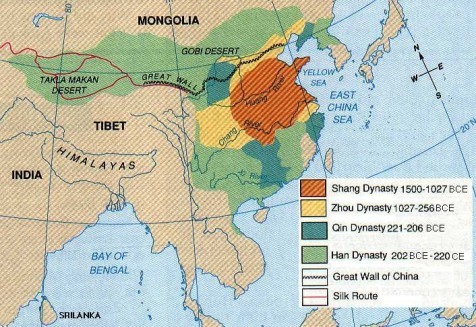

Fill in the Blank:
The (a) Dynasty was one of the 4 main Chinese Dynasties we learned about.
(onewordallcapsnospaces)
The social structure of ancient China is best described as..
made up of 4 social classes (aristocrats, farmers, artisans, and merchants).
a caste system (Bhramin, Kshatryia, Viasya, Sudra, Untouchables).
made up of 4 social classes (the upper class, the middle class, the lower class, and the slave class).
a social pyramid (Pharoah, Nobles/Priests, Soldiers, Scribes, Merchants, Artisans, Farmers, Slaves and Servants).
Why were merchants not respected
People believed that merchants were selfish and not for the good of society
People believed that merchants were not caring
People believed that merchants bad at selling
This philosophy/religion was based on the idea that people were naturally selfish & could not be trusted.
Daoism
Confucianism
Legalism
Buddhism
Qin Dynasty

