wayground logo

Free Printable Worksheets

Font size

S
M
L
XL
Worksheets

ICS - Shutter Stock Test - 2/23/24

Total questions: 110

Worksheet time: 3hrs 34mins

Name
Class
Date
1.
OS X Cheetah
a)
The thirteenth major release of macOS, Apple Inc.'s desktop and server operating system for Macintosh computers and is the successor to OS X Mountain Lion.
b)
The first major release and version of macOS, Apple's desktop and server operating system and is the successor to Mac OS 9.
c)
The fifth major release of macOS, Apple's desktop and server operating system for Mac computers and is the successor to Mac OS X Panther.
d)
Software that is undergoing testing and has not yet been officially released. The beta phase follows the alpha phase, but precedes the final version.
e)
Something that slowly drains the available memory, reducing the amount of free memory the system can use. Most are caused by a program that unintentionally uses up increasing amounts of memory while it is running.
2.
OS X Tiger
a)
The thirteenth major release of macOS, Apple Inc.'s desktop and server operating system for Macintosh computers and is the successor to OS X Mountain Lion.
b)
A small program or scripts that can negatively affect the health of your computer. These malicious little programs can create files, move files, erase files, consume your computer's memory, and cause your computer not to function correctly.
c)
A form of software virtualization that lets programs and processes run in their own isolated virtual environment.
d)
The fifth major release of macOS, Apple's desktop and server operating system for Mac computers and is the successor to Mac OS X Panther.
e)
Software that is still in the early testing phase. It is functional enough to be used, but is unpolished and often lacks many of the features that will be included in the final version.
3.
OS X Mavericks
a)
The tenth major release of macOS, Apple Inc.'s desktop and server operating system for Macintosh computers and is the successor to OS X El Capitan.
b)
An error in a software program. It may cause a program to unexpectedly quit or behave in an unintended manner.
c)
Software that is specifically designed to detect viruses and protect a computer and files from harm.
d)
An error that results when an instruction does not follow the syntax rules or grammar of the programming language.
e)
The nineteenth and current major release of macOS, Apple Inc.'s operating system for Macintosh computers, and is the successor to macOS Monterey.
4.
macOS Sierra
a)
A small program or scripts that can negatively affect the health of your computer. These malicious little programs can create files, move files, erase files, consume your computer's memory, and cause your computer not to function correctly.
b)
The fifth major release of macOS, Apple's desktop and server operating system for Mac computers and is the successor to Mac OS X Panther.
c)
The thirteenth major release of macOS, Apple Inc.'s desktop and server operating system for Macintosh computers and is the successor to OS X Mountain Lion.
d)
Software that is still in the early testing phase. It is functional enough to be used, but is unpolished and often lacks many of the features that will be included in the final version.
e)
Programs that help software developers find and eliminate bugs while they are writing programs. They tell the programmers what types of errors it finds and often marks the exact lines of code where the bugs are found. They also allow programmers to run a program step by step so that they can determine exactly when and why a program crashes.
5.
macOS Big Sur
a)
The seventeenth release of macOS, Apple Inc.'s operating system for Macintosh computers, and is the successor to macOS Catalina.
b)
The tenth major release of macOS, Apple Inc.'s desktop and server operating system for Macintosh computers and is the successor to OS X El Capitan.
c)
Software that is still in the early testing phase. It is functional enough to be used, but is unpolished and often lacks many of the features that will be included in the final version.
d)
Something that slowly drains the available memory, reducing the amount of free memory the system can use. Most are caused by a program that unintentionally uses up increasing amounts of memory while it is running.
e)
An error in a software program. It may cause a program to unexpectedly quit or behave in an unintended manner.
6.
macOS Sonoma
a)
The thirteenth major release of macOS, Apple Inc.'s desktop and server operating system for Macintosh computers and is the successor to OS X Mountain Lion.
b)
The nineteenth and current major release of macOS, Apple Inc.'s operating system for Macintosh computers, and is the successor to macOS Monterey.
c)
A small program or scripts that can negatively affect the health of your computer. These malicious little programs can create files, move files, erase files, consume your computer's memory, and cause your computer not to function correctly.
d)
Software that is specifically designed to detect viruses and protect a computer and files from harm.
e)
The tenth major release of macOS, Apple Inc.'s desktop and server operating system for Macintosh computers and is the successor to OS X El Capitan.
7.
Bug
a)
A form of software virtualization that lets programs and processes run in their own isolated virtual environment.
b)
An error in a software program. It may cause a program to unexpectedly quit or behave in an unintended manner.
c)
The nineteenth and current major release of macOS, Apple Inc.'s operating system for Macintosh computers, and is the successor to macOS Monterey.
d)
A small program or scripts that can negatively affect the health of your computer. These malicious little programs can create files, move files, erase files, consume your computer's memory, and cause your computer not to function correctly.
e)
Programs that help software developers find and eliminate bugs while they are writing programs. They tell the programmers what types of errors it finds and often marks the exact lines of code where the bugs are found. They also allow programmers to run a program step by step so that they can determine exactly when and why a program crashes.
8.
Debugger
a)
Programs that help software developers find and eliminate bugs while they are writing programs. They tell the programmers what types of errors it finds and often marks the exact lines of code where the bugs are found. They also allow programmers to run a program step by step so that they can determine exactly when and why a program crashes.
b)
Software that is still in the early testing phase. It is functional enough to be used, but is unpolished and often lacks many of the features that will be included in the final version.
c)
The nineteenth and current major release of macOS, Apple Inc.'s operating system for Macintosh computers, and is the successor to macOS Monterey.
d)
An error that results when an instruction does not follow the syntax rules or grammar of the programming language.
e)
A form of software virtualization that lets programs and processes run in their own isolated virtual environment.
9.
Beta Software
a)
Software that is undergoing testing and has not yet been officially released. The beta phase follows the alpha phase, but precedes the final version.
b)
An error that results when an instruction does not follow the syntax rules or grammar of the programming language.
c)
The thirteenth major release of macOS, Apple Inc.'s desktop and server operating system for Macintosh computers and is the successor to OS X Mountain Lion.
d)
The fifth major release of macOS, Apple's desktop and server operating system for Mac computers and is the successor to Mac OS X Panther.
e)
Programs that help software developers find and eliminate bugs while they are writing programs. They tell the programmers what types of errors it finds and often marks the exact lines of code where the bugs are found. They also allow programmers to run a program step by step so that they can determine exactly when and why a program crashes.
10.
Alpha Software
a)
A small program or scripts that can negatively affect the health of your computer. These malicious little programs can create files, move files, erase files, consume your computer's memory, and cause your computer not to function correctly.
b)
A mistake in a program's source code that results in incorrect or unexpected behavior.
c)
The fifth major release of macOS, Apple's desktop and server operating system for Mac computers and is the successor to Mac OS X Panther.
d)
An error in a software program. It may cause a program to unexpectedly quit or behave in an unintended manner.
e)
Software that is still in the early testing phase. It is functional enough to be used, but is unpolished and often lacks many of the features that will be included in the final version.
11.
Memory Leak
a)
The thirteenth major release of macOS, Apple Inc.'s desktop and server operating system for Macintosh computers and is the successor to OS X Mountain Lion.
b)
Something that slowly drains the available memory, reducing the amount of free memory the system can use. Most are caused by a program that unintentionally uses up increasing amounts of memory while it is running.
c)
Software that is undergoing testing and has not yet been officially released. The beta phase follows the alpha phase, but precedes the final version.
d)
The first major release and version of macOS, Apple's desktop and server operating system and is the successor to Mac OS 9.
e)
An error that results when an instruction does not follow the syntax rules or grammar of the programming language.
12.
Sandboxing
a)
An error that results when an instruction does not follow the syntax rules or grammar of the programming language.
b)
A small program or scripts that can negatively affect the health of your computer. These malicious little programs can create files, move files, erase files, consume your computer's memory, and cause your computer not to function correctly.
c)
A form of software virtualization that lets programs and processes run in their own isolated virtual environment.
d)
Something that slowly drains the available memory, reducing the amount of free memory the system can use. Most are caused by a program that unintentionally uses up increasing amounts of memory while it is running.
e)
Software that is specifically designed to detect viruses and protect a computer and files from harm.
13.
Syntax Error
a)
A small program or scripts that can negatively affect the health of your computer. These malicious little programs can create files, move files, erase files, consume your computer's memory, and cause your computer not to function correctly.
b)
An error in a software program. It may cause a program to unexpectedly quit or behave in an unintended manner.
c)
An error that results when an instruction does not follow the syntax rules or grammar of the programming language.
d)
Something that slowly drains the available memory, reducing the amount of free memory the system can use. Most are caused by a program that unintentionally uses up increasing amounts of memory while it is running.
e)
Software that is specifically designed to detect viruses and protect a computer and files from harm.
14.
Logic Error
a)
An error in a software program. It may cause a program to unexpectedly quit or behave in an unintended manner.
b)
Software that is still in the early testing phase. It is functional enough to be used, but is unpolished and often lacks many of the features that will be included in the final version.
c)
The tenth major release of macOS, Apple Inc.'s desktop and server operating system for Macintosh computers and is the successor to OS X El Capitan.
d)
A small program or scripts that can negatively affect the health of your computer. These malicious little programs can create files, move files, erase files, consume your computer's memory, and cause your computer not to function correctly.
e)
A mistake in a program's source code that results in incorrect or unexpected behavior.
15.
Virus
a)
A small program or scripts that can negatively affect the health of your computer. These malicious little programs can create files, move files, erase files, consume your computer's memory, and cause your computer not to function correctly.
b)
A mistake in a program's source code that results in incorrect or unexpected behavior.
c)
The fifth major release of macOS, Apple's desktop and server operating system for Mac computers and is the successor to Mac OS X Panther.
d)
A form of software virtualization that lets programs and processes run in their own isolated virtual environment.
e)
The nineteenth and current major release of macOS, Apple Inc.'s operating system for Macintosh computers, and is the successor to macOS Monterey.
16.
Antivirus
a)
Software that is specifically designed to detect viruses and protect a computer and files from harm.
b)
The fifth major release of macOS, Apple's desktop and server operating system for Mac computers and is the successor to Mac OS X Panther.
c)
A form of software virtualization that lets programs and processes run in their own isolated virtual environment.
d)
An error that results when an instruction does not follow the syntax rules or grammar of the programming language.
e)
The seventeenth release of macOS, Apple Inc.'s operating system for Macintosh computers, and is the successor to macOS Catalina.
17.
Windows 1.0
a)
Version of Windows noted for the Metro interface. This interface displays a collection of tiles rather than a traditional desktop environment.
b)
It is a proprietary I/O interface designed by Apple for its mobile devices, such as the iPhone, iPad, and iPod. The name is correlated with Thunderbolt, another I/O port Apple began using around the same time. The main difference is that Lightning is proprietary and is only used in Apple products.
c)
The graphical personal computer operating environment developed by Microsoft. The first mass-produced personal computer with a graphical user interface (GUI) that enabled users to see user friendly icons on screen. It was released on November 20, 1985, as the first version of the Microsoft Windows line.
d)
Non-volatile memory express is a form of memory that uses the M.2 form factor. It is the fastest SSD available today.
e)
It succeeded Windows 10 and is available for free for any Windows 10 devices that meet the new system requirements. It features major changes to the Windows shell influenced by the canceled Windows 10X, including a redesigned Start menu, the replacement of its "live tiles" with a separate "Widgets" panel on the taskbar, the ability to create tiled sets of windows that can be minimized and restored from the taskbar as a group, and new gaming technologies.
18.
Windows 3.0
a)
Version of Windows noted for the Metro interface. This interface displays a collection of tiles rather than a traditional desktop environment.
b)
An email bomb or "mail bomb" is a malicious act in which a large number of email messages are sent to a single email address in a short period of time. The purpose of an email bomb is typically to overflow a user's inbox. In some cases, it will also make the mail server unresponsive.
c)
It is a proprietary I/O interface designed by Apple for its mobile devices, such as the iPhone, iPad, and iPod. The name is correlated with Thunderbolt, another I/O port Apple began using around the same time. The main difference is that Lightning is proprietary and is only used in Apple products.
d)
The third major release of Microsoft Windows, launched in 1990. Like its predecessors, it is not an operating system, but rather a graphical operating environment that runs on top of DOS. It features a new graphical user interface (GUI) where applications are represented as clickable icons, as opposed to the list of file names seen in its predecessors.
e)
An Input/Output interface developed by Apple Computer.There are two versions of the FireWire interface - FireWire 400 (IEEE 1394a) and FireWire 800 (IEEE 1394b). FireWire 400 uses a 6-pin connector and supports data transfer rates of up to 400 Mbps. FireWire 800 uses a 9-pin connector and can transfer data at up to 800 Mbps.
19.
Windows XP
a)
A high-speed Input/Output interface that was developed by Intel and was introduced by Apple in 2011. It is based on the PCI Express and DisplayPort technologies and supports both data devices and displays.
b)
Solid State Drive. The type of hard drive that has no moving part, so they are more efficient, run with no noise, emit little heat, and require little power
c)
It is a proprietary I/O interface designed by Apple for its mobile devices, such as the iPhone, iPad, and iPod. The name is correlated with Thunderbolt, another I/O port Apple began using around the same time. The main difference is that Lightning is proprietary and is only used in Apple products.
d)
It succeeded Windows 10 and is available for free for any Windows 10 devices that meet the new system requirements. It features major changes to the Windows shell influenced by the canceled Windows 10X, including a redesigned Start menu, the replacement of its "live tiles" with a separate "Widgets" panel on the taskbar, the ability to create tiled sets of windows that can be minimized and restored from the taskbar as a group, and new gaming technologies.
e)
The operating system produced by Microsoft, it was designed to replace both Windows Me and Windows 2000. It was released to manufacturing on August 24, 2001, and broadly released for retail sale on October 25, 2001.
20.
Windows 8
a)
Version of Windows noted for the Metro interface. This interface displays a collection of tiles rather than a traditional desktop environment.
b)
The operating system produced by Microsoft, it was designed to replace both Windows Me and Windows 2000. It was released to manufacturing on August 24, 2001, and broadly released for retail sale on October 25, 2001.
c)
The third major release of Microsoft Windows, launched in 1990. Like its predecessors, it is not an operating system, but rather a graphical operating environment that runs on top of DOS. It features a new graphical user interface (GUI) where applications are represented as clickable icons, as opposed to the list of file names seen in its predecessors.
d)
An inbox is the main folder that your incoming mail gets stored in. Whether you check your mail through a webmail interface or use a program like Outlook or Mac OS X Mail, each downloaded message gets stored in your inbox.
e)
Non-volatile memory express is a form of memory that uses the M.2 form factor. It is the fastest SSD available today.
21.
Windows 11
a)
An Input/Output interface developed by Apple Computer.There are two versions of the FireWire interface - FireWire 400 (IEEE 1394a) and FireWire 800 (IEEE 1394b). FireWire 400 uses a 6-pin connector and supports data transfer rates of up to 400 Mbps. FireWire 800 uses a 9-pin connector and can transfer data at up to 800 Mbps.
b)
An inbox is the main folder that your incoming mail gets stored in. Whether you check your mail through a webmail interface or use a program like Outlook or Mac OS X Mail, each downloaded message gets stored in your inbox.
c)
Non-volatile memory express is a form of memory that uses the M.2 form factor. It is the fastest SSD available today.
d)
It succeeded Windows 10 and is available for free for any Windows 10 devices that meet the new system requirements. It features major changes to the Windows shell influenced by the canceled Windows 10X, including a redesigned Start menu, the replacement of its "live tiles" with a separate "Widgets" panel on the taskbar, the ability to create tiled sets of windows that can be minimized and restored from the taskbar as a group, and new gaming technologies.
e)
It is a proprietary I/O interface designed by Apple for its mobile devices, such as the iPhone, iPad, and iPod. The name is correlated with Thunderbolt, another I/O port Apple began using around the same time. The main difference is that Lightning is proprietary and is only used in Apple products.
22.
HDD
a)
The graphical personal computer operating environment developed by Microsoft. The first mass-produced personal computer with a graphical user interface (GUI) that enabled users to see user friendly icons on screen. It was released on November 20, 1985, as the first version of the Microsoft Windows line.
b)
Hard disk drive. A disk drive that has one or more platters and a spindle. In contrast, USB flash drives use flash memory.
c)
The operating system produced by Microsoft, it was designed to replace both Windows Me and Windows 2000. It was released to manufacturing on August 24, 2001, and broadly released for retail sale on October 25, 2001.
d)
The third major release of Microsoft Windows, launched in 1990. Like its predecessors, it is not an operating system, but rather a graphical operating environment that runs on top of DOS. It features a new graphical user interface (GUI) where applications are represented as clickable icons, as opposed to the list of file names seen in its predecessors.
e)
A high-speed Input/Output interface that was developed by Intel and was introduced by Apple in 2011. It is based on the PCI Express and DisplayPort technologies and supports both data devices and displays.
23.
SSD
a)
Solid State Hybrid Drive. Uses the technology from both a hard drive and a solid state drive.
b)
Stands for "Post Office Protocol." POP3, sometimes referred to as just "POP," is a simple, standardized method of delivering e-mail messages. POP3 requires users to download messages to their hard drive before reading them.
c)
An inbox is the main folder that your incoming mail gets stored in. Whether you check your mail through a webmail interface or use a program like Outlook or Mac OS X Mail, each downloaded message gets stored in your inbox.
d)
Solid State Drive. The type of hard drive that has no moving part, so they are more efficient, run with no noise, emit little heat, and require little power
e)
An email bomb or "mail bomb" is a malicious act in which a large number of email messages are sent to a single email address in a short period of time. The purpose of an email bomb is typically to overflow a user's inbox. In some cases, it will also make the mail server unresponsive.
24.
SSHD
a)
Non-volatile memory express is a form of memory that uses the M.2 form factor. It is the fastest SSD available today.
b)
Version of Windows noted for the Metro interface. This interface displays a collection of tiles rather than a traditional desktop environment.
c)
It succeeded Windows 10 and is available for free for any Windows 10 devices that meet the new system requirements. It features major changes to the Windows shell influenced by the canceled Windows 10X, including a redesigned Start menu, the replacement of its "live tiles" with a separate "Widgets" panel on the taskbar, the ability to create tiled sets of windows that can be minimized and restored from the taskbar as a group, and new gaming technologies.
d)
Solid State Hybrid Drive. Uses the technology from both a hard drive and a solid state drive.
e)
An email bomb or "mail bomb" is a malicious act in which a large number of email messages are sent to a single email address in a short period of time. The purpose of an email bomb is typically to overflow a user's inbox. In some cases, it will also make the mail server unresponsive.
25.
NVMe
a)
Non-volatile memory express is a form of memory that uses the M.2 form factor. It is the fastest SSD available today.
b)
Serial Advanced Technology Attachment . Interface for connecting storage devices like hard disks.
c)
Stands for "Simple Mail Transfer Protocol." This is the protocol used for sending e-mail over the Internet. Your e-mail client (such as Outlook, Eudora, or Mac OS X Mail) uses SMTP to send a message to the mail server, and the mail server uses SMTP to relay that message to the correct receiving mail server.
d)
Stands for "Universal Serial Bus." USB is the most common type of computer port used in today's computers. It can be used to connect keyboards, mice, game controllers, printers, scanners, digital cameras, and removable media drives.
e)
Stands for "Internet Message Access Protocol" and is pronounced "eye-map." It is a method of accessing e-mail messages on a server without having to download them to your local hard drive. The advantage of using an IMAP mail server is that users can check their mail from multiple computers and always see the same messages.
26.
SATA
a)
The third major release of Microsoft Windows, launched in 1990. Like its predecessors, it is not an operating system, but rather a graphical operating environment that runs on top of DOS. It features a new graphical user interface (GUI) where applications are represented as clickable icons, as opposed to the list of file names seen in its predecessors.
b)
Non-volatile memory express is a form of memory that uses the M.2 form factor. It is the fastest SSD available today.
c)
Serial Advanced Technology Attachment . Interface for connecting storage devices like hard disks.
d)
Stands for "Simple Mail Transfer Protocol." This is the protocol used for sending e-mail over the Internet. Your e-mail client (such as Outlook, Eudora, or Mac OS X Mail) uses SMTP to send a message to the mail server, and the mail server uses SMTP to relay that message to the correct receiving mail server.
e)
Version of Windows noted for the Metro interface. This interface displays a collection of tiles rather than a traditional desktop environment.
27.
Email Bomb
a)
Stands for "Internet Message Access Protocol" and is pronounced "eye-map." It is a method of accessing e-mail messages on a server without having to download them to your local hard drive. The advantage of using an IMAP mail server is that users can check their mail from multiple computers and always see the same messages.
b)
Stands for "Universal Serial Bus." USB is the most common type of computer port used in today's computers. It can be used to connect keyboards, mice, game controllers, printers, scanners, digital cameras, and removable media drives.
c)
Version of Windows noted for the Metro interface. This interface displays a collection of tiles rather than a traditional desktop environment.
d)
An inbox is the main folder that your incoming mail gets stored in. Whether you check your mail through a webmail interface or use a program like Outlook or Mac OS X Mail, each downloaded message gets stored in your inbox.
e)
An email bomb or "mail bomb" is a malicious act in which a large number of email messages are sent to a single email address in a short period of time. The purpose of an email bomb is typically to overflow a user's inbox. In some cases, it will also make the mail server unresponsive.
28.
Inbox
a)
Stands for "Simple Mail Transfer Protocol." This is the protocol used for sending e-mail over the Internet. Your e-mail client (such as Outlook, Eudora, or Mac OS X Mail) uses SMTP to send a message to the mail server, and the mail server uses SMTP to relay that message to the correct receiving mail server.
b)
An inbox is the main folder that your incoming mail gets stored in. Whether you check your mail through a webmail interface or use a program like Outlook or Mac OS X Mail, each downloaded message gets stored in your inbox.
c)
Version of Windows noted for the Metro interface. This interface displays a collection of tiles rather than a traditional desktop environment.
d)
Solid State Hybrid Drive. Uses the technology from both a hard drive and a solid state drive.
e)
Serial Advanced Technology Attachment . Interface for connecting storage devices like hard disks.
29.
SMTP
a)
An Input/Output interface developed by Apple Computer.There are two versions of the FireWire interface - FireWire 400 (IEEE 1394a) and FireWire 800 (IEEE 1394b). FireWire 400 uses a 6-pin connector and supports data transfer rates of up to 400 Mbps. FireWire 800 uses a 9-pin connector and can transfer data at up to 800 Mbps.
b)
It is a proprietary I/O interface designed by Apple for its mobile devices, such as the iPhone, iPad, and iPod. The name is correlated with Thunderbolt, another I/O port Apple began using around the same time. The main difference is that Lightning is proprietary and is only used in Apple products.
c)
Stands for "Simple Mail Transfer Protocol." This is the protocol used for sending e-mail over the Internet. Your e-mail client (such as Outlook, Eudora, or Mac OS X Mail) uses SMTP to send a message to the mail server, and the mail server uses SMTP to relay that message to the correct receiving mail server.
d)
A high-speed Input/Output interface that was developed by Intel and was introduced by Apple in 2011. It is based on the PCI Express and DisplayPort technologies and supports both data devices and displays.
e)
The newest, and most versatile, type of USB connector. Stands for "Universal Serial Bus Type-C." It supports USB 3.1, which means a USB-C connection can transfer data up to 10 Gbps and send or receive up to 20 volts or 100 watts of power.
30.
IMAP
a)
Stands for "Internet Message Access Protocol" and is pronounced "eye-map." It is a method of accessing e-mail messages on a server without having to download them to your local hard drive. The advantage of using an IMAP mail server is that users can check their mail from multiple computers and always see the same messages.
b)
The third major release of Microsoft Windows, launched in 1990. Like its predecessors, it is not an operating system, but rather a graphical operating environment that runs on top of DOS. It features a new graphical user interface (GUI) where applications are represented as clickable icons, as opposed to the list of file names seen in its predecessors.
c)
The newest, and most versatile, type of USB connector. Stands for "Universal Serial Bus Type-C." It supports USB 3.1, which means a USB-C connection can transfer data up to 10 Gbps and send or receive up to 20 volts or 100 watts of power.
d)
Version of Windows noted for the Metro interface. This interface displays a collection of tiles rather than a traditional desktop environment.
e)
It is a proprietary I/O interface designed by Apple for its mobile devices, such as the iPhone, iPad, and iPod. The name is correlated with Thunderbolt, another I/O port Apple began using around the same time. The main difference is that Lightning is proprietary and is only used in Apple products.
31.
POP3
a)
Stands for "Post Office Protocol." POP3, sometimes referred to as just "POP," is a simple, standardized method of delivering e-mail messages. POP3 requires users to download messages to their hard drive before reading them.
b)
The graphical personal computer operating environment developed by Microsoft. The first mass-produced personal computer with a graphical user interface (GUI) that enabled users to see user friendly icons on screen. It was released on November 20, 1985, as the first version of the Microsoft Windows line.
c)
Hard disk drive. A disk drive that has one or more platters and a spindle. In contrast, USB flash drives use flash memory.
d)
Solid State Hybrid Drive. Uses the technology from both a hard drive and a solid state drive.
e)
An email bomb or "mail bomb" is a malicious act in which a large number of email messages are sent to a single email address in a short period of time. The purpose of an email bomb is typically to overflow a user's inbox. In some cases, it will also make the mail server unresponsive.
32.
USB
a)
Serial Advanced Technology Attachment . Interface for connecting storage devices like hard disks.
b)
Hard disk drive. A disk drive that has one or more platters and a spindle. In contrast, USB flash drives use flash memory.
c)
Non-volatile memory express is a form of memory that uses the M.2 form factor. It is the fastest SSD available today.
d)
Stands for "Universal Serial Bus." USB is the most common type of computer port used in today's computers. It can be used to connect keyboards, mice, game controllers, printers, scanners, digital cameras, and removable media drives.
e)
Version of Windows noted for the Metro interface. This interface displays a collection of tiles rather than a traditional desktop environment.
33.
USB-C
a)
The graphical personal computer operating environment developed by Microsoft. The first mass-produced personal computer with a graphical user interface (GUI) that enabled users to see user friendly icons on screen. It was released on November 20, 1985, as the first version of the Microsoft Windows line.
b)
It is a proprietary I/O interface designed by Apple for its mobile devices, such as the iPhone, iPad, and iPod. The name is correlated with Thunderbolt, another I/O port Apple began using around the same time. The main difference is that Lightning is proprietary and is only used in Apple products.
c)
The newest, and most versatile, type of USB connector. Stands for "Universal Serial Bus Type-C." It supports USB 3.1, which means a USB-C connection can transfer data up to 10 Gbps and send or receive up to 20 volts or 100 watts of power.
d)
An Input/Output interface developed by Apple Computer.There are two versions of the FireWire interface - FireWire 400 (IEEE 1394a) and FireWire 800 (IEEE 1394b). FireWire 400 uses a 6-pin connector and supports data transfer rates of up to 400 Mbps. FireWire 800 uses a 9-pin connector and can transfer data at up to 800 Mbps.
e)
Stands for "Simple Mail Transfer Protocol." This is the protocol used for sending e-mail over the Internet. Your e-mail client (such as Outlook, Eudora, or Mac OS X Mail) uses SMTP to send a message to the mail server, and the mail server uses SMTP to relay that message to the correct receiving mail server.
34.
Firewire
a)
An Input/Output interface developed by Apple Computer.There are two versions of the FireWire interface - FireWire 400 (IEEE 1394a) and FireWire 800 (IEEE 1394b). FireWire 400 uses a 6-pin connector and supports data transfer rates of up to 400 Mbps. FireWire 800 uses a 9-pin connector and can transfer data at up to 800 Mbps.
b)
Serial Advanced Technology Attachment . Interface for connecting storage devices like hard disks.
c)
Hard disk drive. A disk drive that has one or more platters and a spindle. In contrast, USB flash drives use flash memory.
d)
Solid State Hybrid Drive. Uses the technology from both a hard drive and a solid state drive.
e)
The operating system produced by Microsoft, it was designed to replace both Windows Me and Windows 2000. It was released to manufacturing on August 24, 2001, and broadly released for retail sale on October 25, 2001.
35.
Lightning
a)
It is a proprietary I/O interface designed by Apple for its mobile devices, such as the iPhone, iPad, and iPod. The name is correlated with Thunderbolt, another I/O port Apple began using around the same time. The main difference is that Lightning is proprietary and is only used in Apple products.
b)
Stands for "Universal Serial Bus." USB is the most common type of computer port used in today's computers. It can be used to connect keyboards, mice, game controllers, printers, scanners, digital cameras, and removable media drives.
c)
The newest, and most versatile, type of USB connector. Stands for "Universal Serial Bus Type-C." It supports USB 3.1, which means a USB-C connection can transfer data up to 10 Gbps and send or receive up to 20 volts or 100 watts of power.
d)
An email bomb or "mail bomb" is a malicious act in which a large number of email messages are sent to a single email address in a short period of time. The purpose of an email bomb is typically to overflow a user's inbox. In some cases, it will also make the mail server unresponsive.
e)
A high-speed Input/Output interface that was developed by Intel and was introduced by Apple in 2011. It is based on the PCI Express and DisplayPort technologies and supports both data devices and displays.
36.
Thunderbolt
a)
Version of Windows noted for the Metro interface. This interface displays a collection of tiles rather than a traditional desktop environment.
b)
The newest, and most versatile, type of USB connector. Stands for "Universal Serial Bus Type-C." It supports USB 3.1, which means a USB-C connection can transfer data up to 10 Gbps and send or receive up to 20 volts or 100 watts of power.
c)
A high-speed Input/Output interface that was developed by Intel and was introduced by Apple in 2011. It is based on the PCI Express and DisplayPort technologies and supports both data devices and displays.
d)
Serial Advanced Technology Attachment . Interface for connecting storage devices like hard disks.
e)
Stands for "Post Office Protocol." POP3, sometimes referred to as just "POP," is a simple, standardized method of delivering e-mail messages. POP3 requires users to download messages to their hard drive before reading them.
37.

Our bicycle store client is collecting data for analysis. For each example, choose if it is discrete data or continuous data.

The number of employees in each department.

a)

Discrete

b)

Continuous

38.

Our bicycle store client is collecting data for analysis. For each example, choose if it is discrete data or continuous data.

The number of customers who bought bicycles this month.

a)

Discrete

b)

Continuous

39.

Why are cryptocurrencies considered volatile?

a)

They are not widely accepted as a form of payment

b)

Their value is heavily influenced by speculation

c)

They are prone to hacking and security breaches

d)

They have high transaction fees

40.

What is the environmental concern associated with cryptocurrencies?

a)

Excessive energy consumption for mining

b)

Lack of renewable energy sources

c)

Inefficient use of computing power

d)

Negative impact on traditional banking systems

41.

This is called the "brains of the computer" because it receives and executes instructions.

a)

Motherboard

b)

RAM

c)

CPU

d)

Power Supply

42.

This part supplies circuits with the power needed to run. In laptops this can also take the form of a built in battery.

a)

Power Supply

b)

RAM

c)

Fan and Heat Sink

d)

Hard Drive

43.
What is the word (command) used to display numbers and text on the screen?
a)
print
b)
input
c)
output
d)
command
44.

How would I tell Tracy to move forward 100 pixels?

a)

forward 100

b)

move(100)

c)

Tracy, move forward 100 pixels

d)

forward(100)

e)

forward(-100)

45.

If Tracy is facing right, which of the following commands can be used to turn her to face up?

A. left(90)
B. turn(up)
C. right(270)
D. setpos(90)

a)

A only

b)

A and C

c)

A, B, and C

d)

A, B, C, and D

e)

A and B

46.

Why do we use while loops?

a)

To repeat code a specific number of times

b)

To use if-else statements in a loop

c)

To repeat code when the number of times to repeat is unknown

d)

To determine if a condition is true

47.
The correct way to write a variable in Python?
a)
my_variable = 10
b)
my variable = 10
c)
my_variable is 10
d)
my_variable: 10
48.

Which symbol is floor division?

a)

//

b)

/

c)

*

d)

)

49.

Which symbol is used for exponents?

a)

**

b)

-

c)

_

d)

//

50.
Look at this code, what shape will it make?
a)
Square
b)
Triangle
c)
Rectangle
d)
Hexagon 
51.

What, if anything, is wrong with the following?

input("Type your password: ")

a)

There is no variable

b)

Input commands don't need ( )

c)

Input commands don't need " "

d)

Nothing is wrong

52.

Addition


7+1=

(a)  

53.

Addition


5+8=

(a)  

54.

How long is the paper clip?

a)

3 cm

b)

4cm

c)

5cm

d)

4in

e)

3in

55.
20 - 5 x 2
a)
30
b)
10
c)
50
56.
4 + 2 x 7
a)
42
b)
14
c)
18
d)
56
57.

5 x (6-3) =

a)

19

b)

27

c)

15

d)

23

58.
Write 5% as a decimal.
a)
5
b)
0.5
c)
0.05
d)
0.005
59.

What is 13% of 200?

a)

11

b)

13

c)

23

d)

26

60.

What is 28% of 200?

a)

48

b)

52

c)

54

d)

56

61.

What is 58% of 300?

a)

174

b)

172

c)

168

62.

What is 43% of 300?

a)

127

b)

129

c)

131

63.

What is 9% of 500?

a)

27

b)

36

c)

45

d)

54

64.

What is 12% of 500?

a)

42

b)

48

c)

54

d)

60

65.

What is 58% of 250?

a)

140

b)

145

66.

What is 22% of 250?

a)

45

b)

50

c)

55

d)

60

67.

What is 15% of 300?

a)

75

b)

90

c)

45

d)

30

e)

60

68.

What is 13% of 600?

a)

78

b)

90

c)

102

69.

Mr. Canton is buying a new suit from Macy's. It says the tie costs $100.00 but there is a sign above it that says 25% off. How much will the tie cost?

a)

$75

b)

$25

c)

$125

d)

$100

e)

$50

70.

A sports store near Big Bear Lake
is having a 20% off sale on all water skis. 
What will the sale price be for water ski’s that regularly sell for $200?

a)

$220.00

b)

$190.00

c)

$180.00

d)

$160.00

e)

$170.00

71.

Convert "OQQC" cipher-text back into plain text using the key: -10

a)

EGG

b)

MILK

c)

EGGS

d)

HAMS

72.

What is encryption?

a)

Building tombs

b)

Protecting data by scrambling it

c)

Unscrambling data to read it

d)

Exploring church basements

73.

A(n) ______ algorithm transforms cipher text to plain text.

a)

Encryption

b)

Decryption

74.

What types of sugars are used to make the hard candy?

a)

Powdered sugar and honey

b)

Corn syrup and standard table sugar

c)

Brown sugar and molasses

d)

Fructose and glucose

75.

Guten Morgen

a)

Hello

b)

Good Morning

c)

Good Bye

d)

See you

76.

When creating users for an instance of Microsoft SQL server, the type of user can be? (Choose two.)

a)

A domain user account

b)

A local user account

c)

No account is needed

d)

The root user account

77.

The steps to backup a database in Microsoft SQL include? (Choose three.)

a)

Connect to the database in object explorer

b)

Export the database to mySQL format

c)

Expand the databases and select the database to back up

d)

Right click, choose Tasks, then Back Up

78.

Which one of these is NOT a command that Karel knows?

a)

Turn Left

b)

Turn Right

c)

Turn Right

d)

Put Down a Ball

79.

Our bicycle store client is collecting data for analysis. For each example, choose if it is discrete data or continuous data.

The speed of a rider in a bike race.

a)

Discrete

b)

Continuous

80.

What is the reading?

a)

.305

b)

.295

c)

.330

d)

.405

81.

What is in cell A6?

a)

Monday

b)

Tuesday

c)

Wednesday

d)

Thursday

82.

Match the symbols:

a)

/

1.

division

b)

*

2.

multiplication

c)

+

3.

addition

d)

_

4.

subtraction

83.

What label is in cell B1

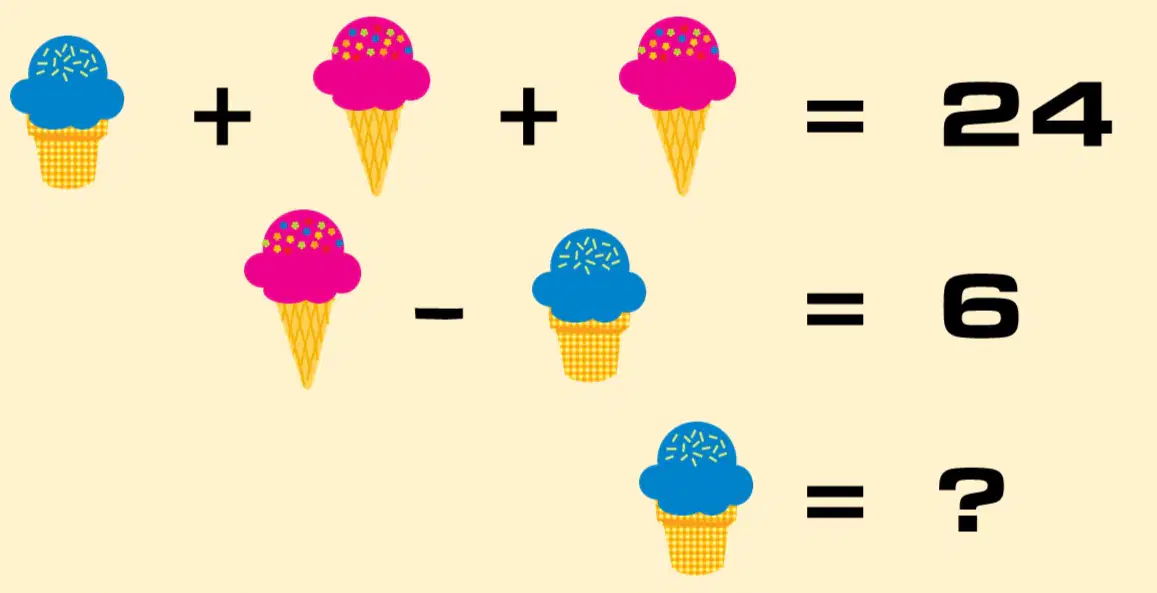
84.

What is blue ice cream cone?

(a)  

85.
a)
35
b)
135
c)
45
d)
50
86.
a)
68
b)
78
c)
88
d)
98
87.

Without using a protractor, find the measure of X.

a)

45 degrees

b)

28 degrees

c)

32 degrees

d)

118 degrees

88.
How does this image show a control in motion?
a)
Stop Motion
b)
Motion Blur
c)
Panning
d)
No Idea
89.

Who is this guy?

a)

Mr. Capps

b)

Mr. Yancey

c)

Mr. Bunyea

d)

Dr. de Hart

e)

Mr. Canton

90.

825 - 498

a)

473

b)

327

c)

477

d)

487

91.

56,234 + 1,000

a)

66,234

b)

57,234

c)

56,235

d)

56,334

92.

9+1=

(a)  

93.

Count on to find the total value.

a)

b)

c)

d)

94.

Count on to find the total value.

a)

b)

15¢

c)

25¢

d)

35¢

95.

Count on to find the total value.

a)

71¢

b)

80¢

c)

d)

50¢

e)

75¢

96.
a)
dime
b)
nickel
c)
penny
d)
quarter
97.

What is the value?

a)

b)

50¢

c)

10¢

d)

25¢

e)

55¢

98.
a)
10 cents
b)
5 cents
c)
1 cent
d)
25 cents
99.
What is the total amount?
a)
$0.50
b)
$1.00
c)
$0.10
d)
$0.30
100.

Which coin is a dime?

a)
b)
c)
d)
101.

5-3=

a)

5

b)

3

c)

2

d)

8

102.

14 - 2 =

a)

10

b)

16

c)

8

d)

12

103.

18 - 9 =

a)

10

b)

9

c)

8

d)

7

104.

12 - 6 =

a)

6

b)

12

c)

0

d)

8

105.
2 x 9 ÷ 3
a)
5
b)
7
c)
8
d)
6
106.

13 - 2 x 4 =

a)

4

b)

24

c)

5

d)

44

107.

30 - 7 x 4

a)
2
b)
92
c)
7
d)
84
108.
2 x 9 ÷ 3
a)
5
b)
7
c)
8
d)
6
109.

78+82=?

a)

639

b)

160

c)

32

d)

45

110.

1000+1999=?

a)

838

b)

4638

c)

2937

d)

2999