
Font size
 Worksheets
Unit 3 Chapter 2 Review
Total questions: 13
Worksheet time: 8mins
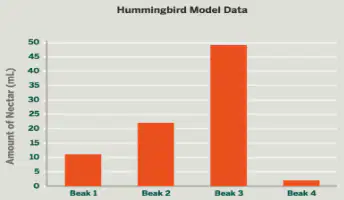
The students at Graystone Elementary did an investigation with droppers to observe if beak variations affected hummingbirds meeting their needs in their environment. The chart below shows the data that they collected.
Using Source 1, what inference can be made about the beaks?
Beak 3 represents hummingbirds that are more likely to survive in their environment.
Beak 3 represents hummingbirds that are less likely to survive in their environment.
Beak 4 represent hummingbirds that are more likely to survive in their environments.
Beak 2 and Beak 3 represent hummingbirds that are less likely to survive in their environments.
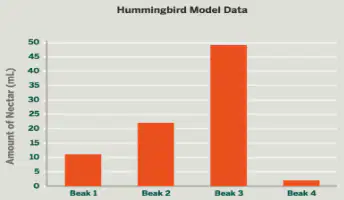
Using Source 1, what inference can be made about beak variations?
Some beak variations make it harder for hummingbirds to meet their needs.
All beak variations make it harder for hummingbirds to meet their needs.
Beak variations do not affect hummingbirds meeting their needs.
Beak variations affect other birds meeting their needs.
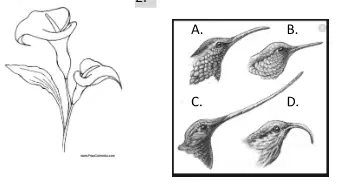
Which two hummingbirds would most likely survive in an environment with these types of flowers? Select 2.
Hummingbird A
Hummingbird B
Hummingbird C
Hummingbird D
All of the hummingbirds

Study the beak variations shown below. Which beak would be best for splitting open hard fruits and nuts?
Beak A
Beak B
Beak C
Both B and C
How does the adaptation of camouflage help protect animals from predators?
Animals are able to sleep during the cold winter months and not have cold winter months.
Animals are able to blend into their surroundings and not be seen by predators.
Animals are able to scare away their predators.
Animals are able to travel to a warmer habitat.
SOURCE 2
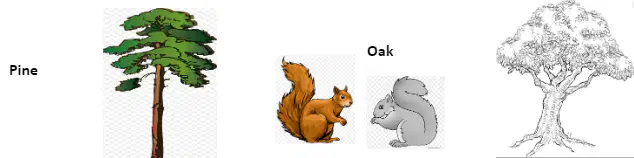
A forest habitat is made up of pine trees and oak trees. The pine trees have brown bark, while the oak trees have gray bark. Many different squirrels live in these trees. Some of the squirrels have brown fur while others have gray fur. Hawks also live in the forest. The hawks hunt the squirrels for food. There is a change in the habitat, and only oak trees are left in the forest. Make a claim about which color squirrel will most likely survive in this new environment. Support your prediction with evidence and reasoning.
The brown squirrel will most likely survive.
The grey squirrel will most likely survive.
The brown squirrel will most likely survive because only pine trees are left and they can camouflage best with the pine tree to avoid predators.
The grey squirrel will most likely survive because only oak trees are left and they can camouflage best with the oak trees to avoid predators.
Neither squirrel will survive because they can not avoid their predators.
A forest habitat is made up of pine trees and oak trees. The pine trees have brown bark, while the oak trees have gray bark. Many different squirrels live in these trees. Some of the squirrels have brown fur while others have gray fur. Hawks also live in the forest. The hawks hunt the squirrels for food. There is a change in the habitat, and only oak trees are left in the forest. Adaptive traits help animals survive in their environment. Which of the following is an adaptive trait of the squirrel in the new environment?
The grey squirrel’s tail length
The brown squirrel’s fur color
The grey squirrel’s fur color
The brown squirrel’s mouth structure
Oak trees give shade to people and animals. Squirrels nest in them. Deer, chipmunks and squirrels eat the acorns from the oak tree. Which inference can be made about oak trees?
Oak trees meet many needs for organisms in their environment.
Oak trees are useful so we should plant them in other countries.
If oak trees die, there will be no more deer or chipmunks.
Any other tree could replace oak trees.
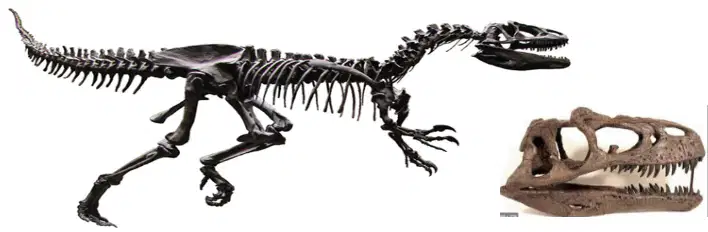
The fossil in the illustration above is from a dinosaur called an Allosaurus. Study the dinosaur’s structures. Describe one thing you know about the dinosaur or the environment it came from. Provide evidence to support your response.
The Allosaurus lived on land because it has two feet to walk on.
The Allosaurus ate plants because it has flat square teeth.
The Allosaurus ate meat because it has sharp pointy teeth.
The Allosaurus lived in a wetland environment because it has a tail to swim.
Polar bears hunt seals from sea ice in the Arctic. Warming Arctic temperatures have reduced the amount of ice, making it hard for polar bears to find food. How has the reduced amount of sea ice most likely affected polar bears?
They swim less often.
Their fur is changing color.
They must eat a lot more food.
Their population size is decreasing.
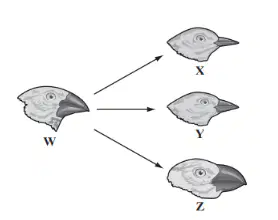
The diagram shows four types of finches labeled W, X, Y, and Z.
The type of finch labeled W adapted different traits over a long period of time that resulted in the three different types of finches labeled X, Y, and Z. What is the most likely reason the finches labeled X, Y, and Z adapted different traits from the finch labeled W?
to look like other birds
to change their environments
to copy behaviors of other similar birds
to help them survive in their environments
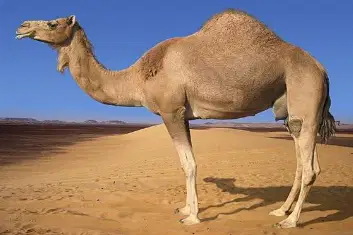
Sam read about camels in science class. The image shows a camel living in a desert. Sam wanted to learn more about camels. He read that:
A camel is a large animal with a long neck and one or two humps on its back. Their humps are actually used to store fat, which they can live off for weeks, sometimes months! When food is scarce, camels will break down the fats in their humps to use as a source of nutrition.
Even though they might not seem it, camels can be fast runners. They can run as fast as 40 miles per hour!
Camels have large, flat feet to help them walk on sand. The soles of their feet have a large surface area to stop them from sinking into the sand.
Camels have short, light colored hair.
PART A: Which two traits below would best be described as adaptive traits? Select the two correct answers.
the camel’s eye color
the camel’s hump
the camel’s tail
the camel’s small ears
the camel’s light brown hair color
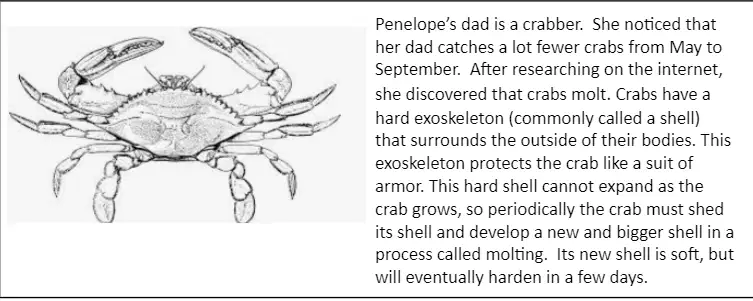
What inference can you make about why Penelope’s dad catches less soft shell crabs from May to September?
Soft shell crabs are having a difficult time avoiding predators.
Soft shell crabs are not having a difficult time avoiding predators.
Soft shell crabs are less likely to survive because of the extremely cold temperature during this time of the year.
Soft shell crabs are more likely to survive during this time of the year.

