Wayground logo

Free Printable Worksheets

Font size

S
M
L
XL
Worksheets

Unit Seven Review (4.G.1 - 4.G.4)

Total questions: 70

Worksheet time: 3590secs
Name
Class
Date
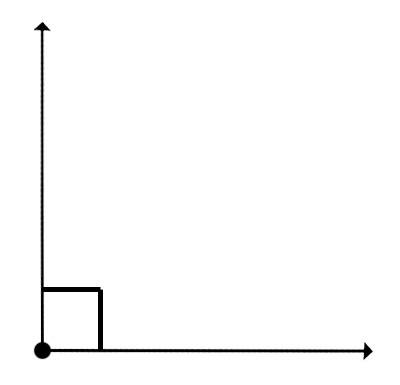
1.

This picture represents what type of angle?

a)

Obtuse Angle

b)

Right Angle

c)

Acute Angle

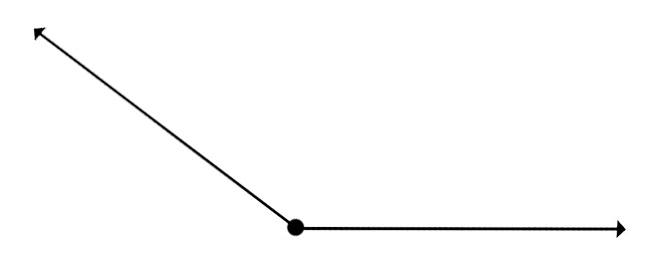
2.

This picture represents what type of angle?

a)

Right Angle

b)

Obtuse Angle

c)

Acute Angle

3.

This picture represents what type of angle?

a)

Right Angle

b)

Acute Angle

c)

Obtuse Angle

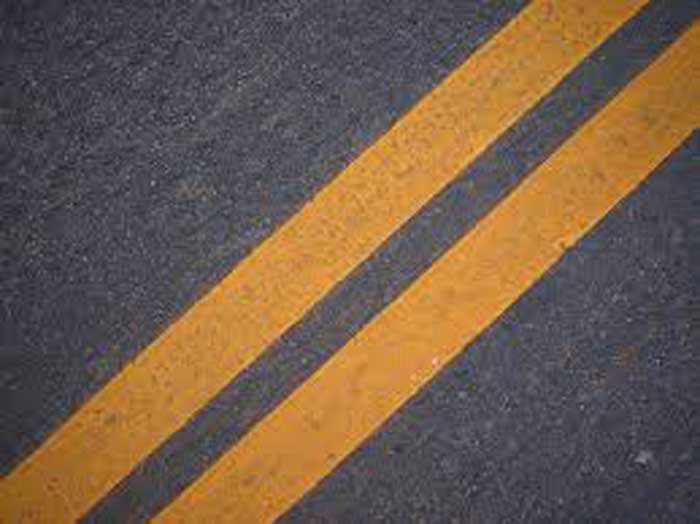
4.
What does this image show?
a)
parallel lines
b)
perpendicular lines
c)
intersecting lines
d)
line segments
5.
What type of line does the picture represent? 
a)
Parallel
b)
Intersecting
c)
Perpendicular
6.
What type of line does the picture represent? 
a)
Parallel
b)
Intersecting
c)
Perpendicular
7.

Jessi and Jenny live on a street that intersects with Calle Encina. In which street do they live?

a)

Calle Pino

b)

Calle Roble

c)

Calle Palmera

8.

Identify the type of angle shown....

a)

Acute

b)

Obtuse

c)

Reflex

d)

Right Angle

9.

Identify the type of angle shown....

a)

Acute

b)

Obtuse

c)

Reflex

d)

Right Angle

10.

What is the definition of an acute angle?

a)

Lines that intersect to form right angles.

b)

An angle that is open more than a right angle but less than a straight angle. This angle measures between 90 and 180 degrees.

c)

An angle that forms a square corner and has a measure of 90 degrees.

d)

An angle that is open less than a right angle and has a measure less than 90 degrees.

11.

What is the definition of an obtuse angle?

a)

An angle that is open more than a right angle but less than a straight angle. This angle measures between 90 and 180 degrees.

b)

An angle that forms a square corner and has a measure of 90 degrees.

c)

An angle that is open less than a right angle and has a measure less than 90 degrees.

d)

Lines that intersect to form right angles.
12.
What type of line does this picture show?
a)
parallel
b)
perpendicular
c)
intersecting
d)
line segment
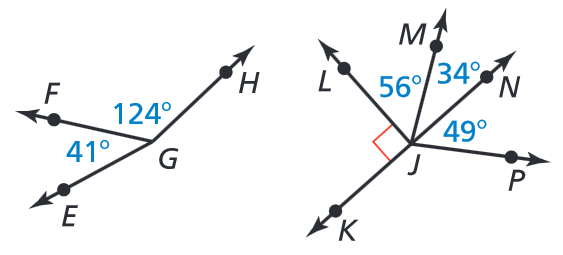
13.

Which of the following angles is  90°90\degree  ?

a)

∠FGH\angle FGH  

b)

∠KJL\angle KJL  

c)

∠PJK\angle PJK  

d)

∠EGH\angle EGH  

14.

What type of angle is ∠COA\angle COA ?

a)

acute

b)

right

c)

obtuse

d)

straight

15.

Line AB is parallel with which of the following?

a)

Line PQ

b)

Line KL

c)

Line MN

d)

Line EF

16.

Line PQ is perpendicular with which of the following?

a)

Line CD

b)

Line KL

c)

Line MN

17.

Line CD is intersecting with which of the following?

a)

Line AB

b)

Line EF

c)

Line MN

18.

This is a

a)

point

b)

ray

c)

line

d)

line segment

19.

This is a

a)

point

b)

ray

c)

line

d)

line segment

20.

This is a

a)

point

b)

ray

c)

line

d)

line segment

21.

This is a

a)

point

b)

ray

c)

line

d)

line segment

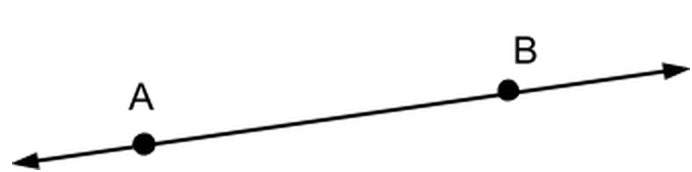
22.

What is a name for this line?

a)
b)
c)
d)
23.

Name the figure using geometric notation.

a)

↔FG\leftrightarrow FG

b)

FG‾\overline{FG}

c)

FG→\overrightarrow{FG}

24.

Name the figure using geometric notation.

a)

JK‾\overline{JK}

b)

↔JK\leftrightarrow JK

c)

KJ→\overrightarrow{KJ}

25.
8. Which quadrilateral below is a kite?
a)
quadrilateral W
b)
quadrilateral X
c)
quadrilateral Y
d)
quadrilateral Z
26.
9. Which quadrilateral below has only one pair of parallel sides?
a)
quadrilateral W
b)
quadrilateral X
c)
quadrilateral Y
d)
quadrilateral Z
27.
10.
a)
A
b)
B
c)
C
d)
D
28.
11. I am a quadrilateral that has exactly one set of parallel sides. What is my name?
a)
parallelogram
b)
kite
c)
trapezoid
d)
square
29.
12. I am a quadrilateral that has no parallel sides, but I do have two pairs of equal-length sides that are beside or adjacent to each other. What is my name?
a)
rhombus
b)
parallelogram
c)
rectangle
d)
kite
30.
13. I am a quadrilateral that has exactly two pairs of parallel sides. What is my name?
a)
parallelogram
b)
trapezoid
c)
kite
d)
none of the above
31.
14. I am a quadrilateral that has two pairs of parallel sides and four right angles. What is my name?
a)
square
b)
rhombus
c)
parallelogram
d)
rectangle
32.
15. I am a quadrilateral that has two pairs of parallel sides and all of my sides are equal in length. What is my name?
a)
trapezoid
b)
rhombus
c)
parallelogram
d)
rectangle
33.
16. I am a quadrilateral that has two pairs of parallel sides, all of my sides are equal in length, and I have four right angles. What is my name?
a)
square
b)
trapezoid
c)
rhombus
d)
rectangle
34.
18. Select any that apply! Is a quadrilateral. Has 4 angles that are 90 degrees.
a)
parallelogram
b)
square
c)
rhombus
d)
kite
e)
rectangle
35.
19. Select any that apply! Is a quadrilateral. Has 4 sides of equal length.
a)
kite
b)
square
c)
parallelogram
d)
rectangle
e)
rhombus
36.
21. Select any that apply! Is a quadrilateral. Has two pairs of parallel sides.
a)
rectangle
b)
parallelogram
c)
rhombus
d)
square
e)
trapezoid
37.
23. Select any that apply! Choose the quadrilaterals below that have at least one set of parallel lines.
a)

A

b)

C

c)

E

d)

H

e)

38.
24. Select any that apply! Choose the quadrilaterals below that have at least one set of perpendicular lines.
a)
B
b)
C
c)
G
d)
A
e)
D
39.
25. Select any that apply! Which shapes below are not quadrilaterals?
a)
D
b)
F
c)
A
d)
B
e)
C
40.
1.
a)
A
b)
B
c)
C
d)
D
41.
2.
a)
A
b)
B
c)
C
d)
D
42.
3.
a)
A
b)
B
c)
C
d)
D
43.
6.
a)
A
b)
B
c)
C
d)
D
44.
9. True or False?
a)
True
b)
False
45.
11. True or False?
a)
True
b)
False
46.
10. True or False?
a)
True
b)
False
47.
13. True or False?
a)
True
b)
False
48.
17. True or False?
a)
True
b)
False
49.

21. A rectangle will always be which of the following shapes?

a)

quadrilateral

b)
parallelogram
c)

rhombus

d)
square
e)
kite
50.

20. A trapezoid will always be which of the following shapes?

a)

parallelogram

b)
quadrilateral
c)
rectangle
d)
square
e)
kite
51.

22. A square will always be which of the following shapes?

a)
rectangle
b)

trapezoid

c)
parallelogram
d)
quadrilateral
e)
rhombus
52.

23. A parallelogram will always be which of the following shapes?

a)

rhombus

b)
quadrilateral
c)
rectangle
d)
square
e)
kite
53.

24. A kite will always be which of the following shapes?

a)

parallelogram

b)

rhombus

c)
rectangle
d)

quadrilateral

e)
trapezoid
54.

25. A rhombus will always be which of the following shapes?

a)

parallelogram

b)

kite

c)

square

d)
rectangle
e)

quadrilateral

55.

What type of triangle is shown?

a)

Isosceles

b)

Right

c)

Equilateral

d)

Scalene

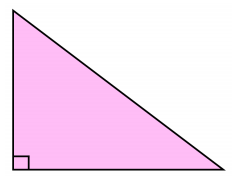
56.

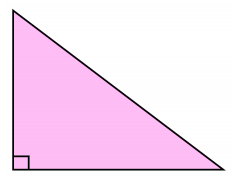
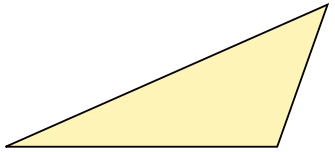
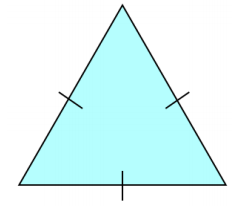
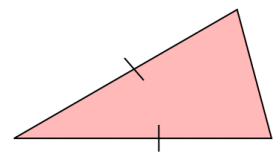
Acute triangles are triangles with only acute angles inside.


Select ALL the acute triangles below.


(There are 2 correct answers)
a)
b)
c)
d)
57.

What kind of triangle is this?

a)

Right

b)

Obtuse

c)

Acute

58.

Classify the triangle based on the angle measures:

a)

Acute

b)

Obtuse

c)

Right

59.

Classify the triangle based on the angle measure:

a)

Acute

b)

Obtuse

c)

Right

60.

What type of triangle is this?

a)

Right, Isosceles Triangle

b)

Acute, Equilateral Triangle

c)

Right, Scalene Triangle

d)

Obtuse, Isosceles Triangle

61.

Which image shows a line of symmetry?

a)

1

b)

2

c)

3

d)

4

62.

Which picture of the butterfly shows a line of symmetry?

a)

1

b)

2

c)

3

d)

4

63.
Is this a line of symmetry?
a)
Yes
b)
No
64.
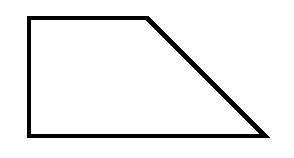
How many lines of symmetry does this trapezoid have?
a)
0
b)
1
c)
2
d)
3
65.
How many lines of symmetry does this shape have?
a)
0
b)
1
c)
2
d)
4
66.
How many lines of symmetry does this shape have?
a)
1
b)
2
c)
3
d)
4
67.
How many lines of symmetry does the picture have? 
a)
0 lines of symmetry
b)
1 line of symmetry
c)
2 lines of symmetry
d)
4 lines of symmetry
68.

Symmetrical?

a)

Is symmetrical

b)

not symmetrical

69.
How many lines of symmetry does this shape have?
a)
1
b)
2
c)
4
d)
8
70.
a)
A
b)
B
c)
C
d)
D