
NEW
Font size
 Worksheets
Electromagnetic Quiz Bee
Total questions: 20
Worksheet time: 20mins
Silver is BEST describe as a material having what?
Low resistivity, low conductivity
Low resistivity, high conductivity
High resistivity, low conductivity
High resistivity, high conductivity
A copper wire is cut such that it is now half its original length. What happens to its resistivity?
It is halved.
It is doubled.
It is quadrupled.
It remains the same.
What happens to the magnetic field intensity when you double your distance from a current-carrying wire?
It is halved.
It is doubled.
It is quartered.
It remains the same.
Alternating current is observed in the following objects EXCEPT what?
Dry cells
Generators
Transformers
AC can be observed in all devices above.
Who first showed that magnetism can cause electricity?
Ampere
Faraday
Maxwell
Oersted
What is the SI unit of the magnetic field intensity?
Ohms
Tesla
Amperes
Newtons
Which of the following, when increased, increases the magnetic field strength created by a wire?
Length of the wire
Current on the wire
Resistance of the wire
Temperature of the wire
Two light bulbs are connected in parallel. Which values between the two are equal?
Voltage only
Current only
Both voltage and current
Neither voltage nor current
What are the types of current on the primary and secondary coils of a transformer, respectively?
AC and DC
DC and AC
AC on both coils.
DC on both coils.
Which of the following is measured in Newtons?
Voltage
Electromotive force
Potential difference
None of the above
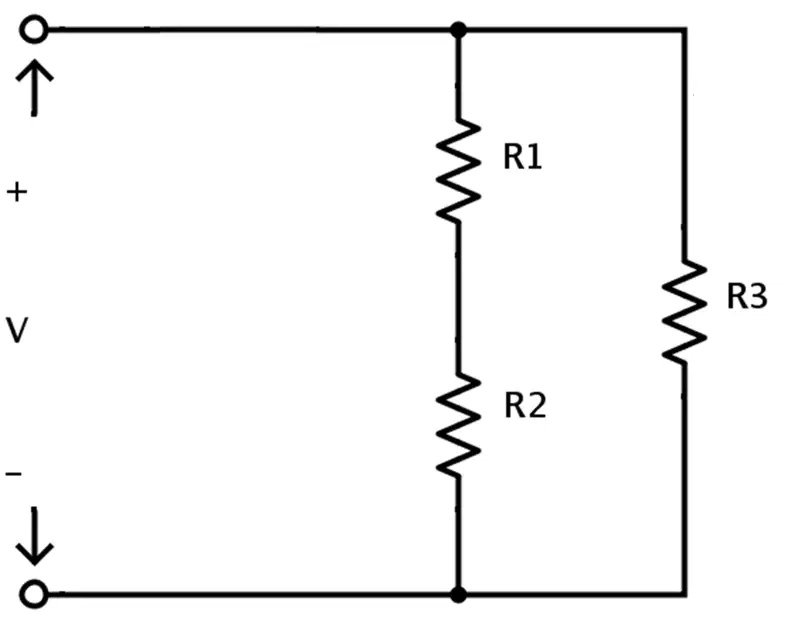
Which equation correctly relates the voltages across each resistor?
V1 = V2 = V3
V1 + V2 = V3
V1 = V2 + V3
Cannot be determined
Current depends on what values?
I. Amount of charge
II. How fast charges are moving
I only
II only
Both I and II
Neither I nor II
How should a voltmeter and an ammeter be connected to a load to properly measure needed values?
Both in series to the load
Both in parallel to the load
In series and in parallel, respectively, to the load
In parallel and in series, respectively, to the load
What is measured to determine the induced emf in a loop of wire?
Magnetic flux
Magnetic field
Change in magnetic flux
Change in magnetic field
When is the terminal voltage of a battery equal to its emf?
When the battery is not being used
When the battery is connected in a circuit
When the resistance on the circuit is great
It is impossible for the terminal voltage to be equal to the emf.
Which of the following is TRUE?
I. Electricity causes magnetism.
II. Magnetism causes electricity.
I only
II only
Both I and II
Neither I nor II
Which of the following CANNOT create a magnetic field?
Proton
Neutron
Electron
They can create a magnetic field as long as they are in motion.
Three identical bulbs are connected in parallel to a 9-V dry cell. If the current on it is 3 A, what is the voltage across and current on each bulb?
3 V and 1 A
9 V and 1 A
3 V and 3 A
9 V and 3 A
Which of the following, when increased, decreases the magnetic field strength inside a solenoid?
Length of the solenoid
Current on the solenoid
Number of loops of the solenoid
Size of the loops of the solenoid
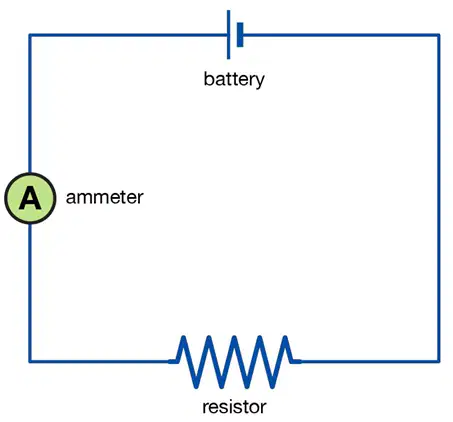
In the circuit below, which BEST describes the conventional current on the resistor?
Positive charges going to the left
Positive charges going to the right
Negative charges going to the left
Negative charges going to the right

