
 Worksheets
8th Grade Quarter 3 Study Guide
Total questions: 110
Worksheet time: 9hrs 10mins
Name
Class
Date
1.
True or False: An analog signal is one that changes continuously
a)
True
b)
False
2.
True or False: Radio waves are an example of a digital signal.
a)
True
b)
False
3.
True or False: Digital signals are more affected by noise than analog signals.
a)
True
b)
False
4.
True or False: The more pixels a digital image consists of, the clearer the image.
a)
True
b)
False
5.
Computers use a series of __________ numbers to encode information.
a)
even
b)
odd
c)
binary
d)
random
6.
Which is the best model of an analog signal?
a)
a smooth wave
b)
a light switch going on and of
c)
a series of 1's and 0's
d)
a series of pulses
7.
Which best compares the reliability of analog signals and digital signals?
a)
Only analog signals are reliable.
b)
Digital signals are more reliable than analog signals
c)
Analog signals are more reliable than digital signals.
d)
Both types of signals are equally reliable.
8.
For which type(s) of signals does noise alter the original information?
a)
analog only
b)
digital only
c)
both analog and digital
d)
neither analog and digital
9.
Which best describes binary numbers?
a)
a continuously changing wave
b)
a set of two discrete values
c)
a large array of values
d)
a set of four or five numbers
10.
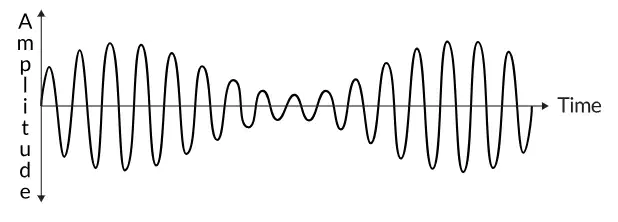
Oliver knows there are different types of waveforms, both analog and digital. He analyzes the wave below to determine which type of information is stored in the wave. Is this most likely an analog or digital signal?
a)
digital because the amplitude is only ever a certain set of values
b)
digital because the amplitude contains all values within a range
c)
analog because the amplitude is only ever a certain set of values
d)
analog because the amplitude contains all values within a range
11.
Rochelle works in a movie theater. She notices that the movie theater stores all of its movies using digital devices instead of analog film reels. Why might the theater have started storing movies using digital signals?
a)
Analog signals can change over time and can be harder to transmit.
b)
Digital signals carry more information than analog signals.
c)
Analog signals are not able to store visual information as well as digital signals.
12.
Marvin is choosing a new radio for his car. One radio can only pick up analog signals and the other can pick up digital signals. Harvey wants to make sure that the radio won’t be easily affected by interference.
Would an analog or digital signal have a less noisy signal, and how do you know?
a)
Analog because the radio waves will be less affected by interference than the digital signal’s radio waves.
b)
Analog because noise can be removed from analog signals.
c)
Digital because the radio waves will be less affected by interference than the analog signal’s radio waves.
d)
Digital because noise can be removed from digital signals.
13.
Vinyl records store music as an analog signal. CDs store music as a digital signal. Over time, the sound of music played from a vinyl record changes. But the music from a CD sounds the same each time. Why does the CD sound more consistent than the vinyl record?
a)
Interference can’t affect a digital signal.
b)
The information in a digital signal is less likely to be affected by interference.
c)
Digital signals contain more information than analog signals.
14.
Adriel was listening to music streaming from a cell phone. The sound was clear with no interference until he entered a garage and went down to the 4th level for parking. Then, the music stopped playing entirely.
Is the music signal most likely an analog or digital signal, and how do you know?
a)
Analog because the music was always clear until it stopped playing.
b)
Digital because the music was always clear until it stopped playing.
c)
Analog because the signal reaches into the parking garage.
d)
Digital because the signal reaches into the parking garage.
15.
Jose is visiting a music recording studio. He notices that the studio stores music using digital signals instead of analog signals. What is a possible problem with storing music using analog signals?
a)
Analog signals can change over time and can be harder to copy accurately.
b)
Analog signals are not able to store sound information accurately.
c)
Digital signals carry more information than analog signals.
16.
A __________ is a piece of information that is communicated using the senses.
a)
signal
b)
wave
c)
noise
d)
warning
17.
__________ is the unwanted modification of a signal.
a)
signal
b)
wave
c)
noise
d)
warning
18.
True of False: Sign language and written language are examples of signals used to communicate.
a)
True
b)
False
19.
True or False: Before a signal is sent, it must be decoded.
a)
True
b)
False
20.
Electronic signals can travel very long distances in optical fibers, due to __________.
a)
total external reflection
b)
total external refraction
c)
total internal refraction
d)
total internal reflection
21.
What do all signals that are used to communicate have in common?
a)
They all involve light waves.
b)
They all send information.
c)
They all use printed words.
d)
They all use a series of sounds.
22.
What is a disadvantage of using radio waves to transmit information?
a)
They do not permanently move matter.
b)
They can travel over long distances.
c)
They can be varied to hold information
d)
They lose energy as they travel through mediums.
23.
How does noise affect a signal?
a)
It causes the signal to deteriorate.
b)
It amplifies the signal.
c)
It allows the signal to travel further.
d)
It changes the signal as it moves from one medium to another.
24.
Which correctly orders the steps of communication using signals?
a)
transmit, encode, decode
b)
encode, transmit, decode
c)
decode, transmit, encode
d)
transmit, decode, encode
25.
All of the following are types of electromagnetic waves that can be used to transmit signals except ________________.
a)
sound waves
b)
light waves
c)
radio waves
d)
microwaves
26.
A red ball reflects which of the following colors of light?
a)
red
b)
all colors but red
c)
green
d)
white
27.
When white light shines through red glass, the glass _________.
a)
absorbs all red light
b)
absorbs all light except red light
c)
absorbs all green light
d)
reflects all light except red light
28.
In blue light, a red object would look _______.
a)
red
b)
blue
c)
black
d)
white
29.
__________ are cells in the eye that enable a person to see color.
a)
Rods
b)
Cones
c)
Retina
d)
Cornea
30.
Rainbows form due to _________ caused by droplets of water.
a)
refraction and reflection
b)
reflection and absorption
c)
diffusion
d)
reflection only
31.
__________ is one of the first people to record notes on the refraction of white light.
a)
Albert Einstein
b)
Sir Issac Newton
c)
Charles Darwin
d)
Bill Nye
32.
As wavelength increases, frequency __________.
a)
increases
b)
decreases
c)
does not change
33.
Colors that we see are called __________ on the electromagnetic spectrum.
a)
rainbow
b)
visible light
c)
uv waves
d)
sight waves
34.
____________ wavelengths refract the most because their frequencies are the highest.
a)
Red
b)
Green
c)
Blue
d)
Violet
35.
When the three primary colors of light are mixed, __________ light is produced.
a)
white
b)
black
c)
violet
d)
red
36.
True or False: Rod cells help us to see colors.
a)
True
b)
False
37.
When an object appears black, it is because __________.
a)
it reflects all colors of light
b)
it absorbs all colors of light
c)
it transmits all colors of light
d)
it scatters all colors of light
38.
The color of an object is determined by wavelengths of light that are __________.
a)
transmitted
b)
absorbed
c)
reflected
d)
all of the above
39.
Which color of light has the lowest frequency?
a)
red
b)
orange
c)
green
d)
violet
40.
When white light passes through a prism, it separates into a spectrum of colors because of __________.
a)
refleciton
b)
refraction
c)
absorption
d)
diffraction
41.
What color light is produced when all colors of light are combined?
a)
red
b)
white
c)
yellow
d)
black
42.
When someone's cone cells are not working properly, they might be __________.
a)
blind
b)
color blind
c)
unable to see shapes in the dark
d)
only able to see things up close.
43.
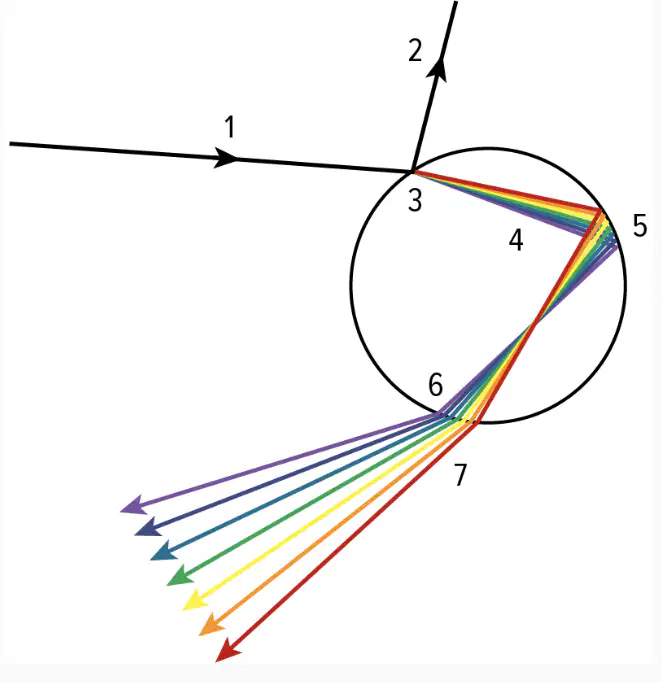
What produced the light represented by ray 2?
a)
It was absorbed by the drop.
b)
It was reflected from the drop.
c)
It was refracted by the drop.
d)
It was transmitted by the drop.
44.
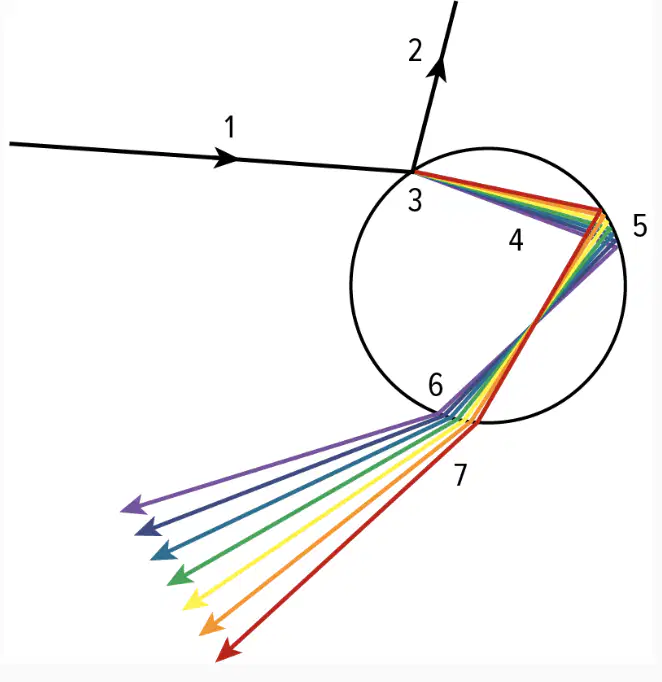
What caused the spread of colors at point 7?
a)
absorbtion
b)
reflection
c)
refraction
d)
transmission
45.
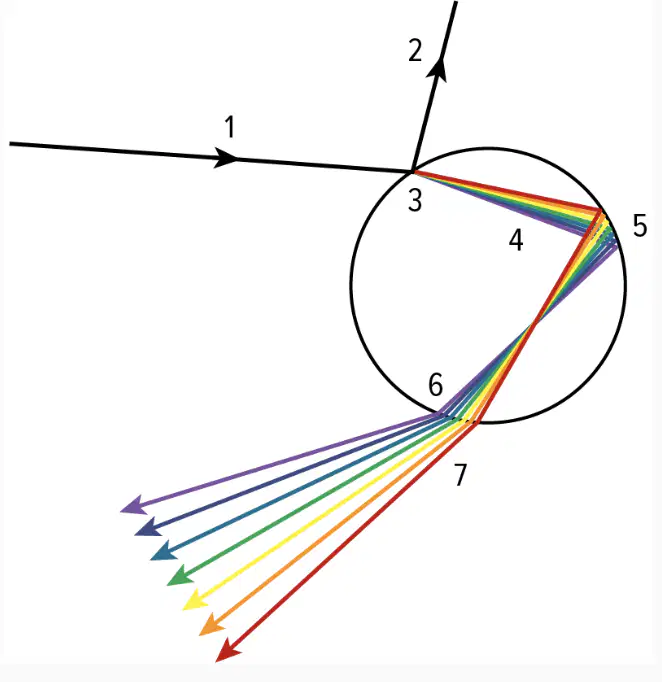
What colors of light make up ray 1?
a)
the primary colors of light- red, blue and green
b)
the secondary colors of light- cyan, magenta and yellow
c)
no colors, the ray is black
d)
All of the colors. The ray represents white light.
46.
__________ is the change in direction of a wave as it changes speed while moving from one medium to another.
a)
Refraction
b)
A Lens
c)
A Concave Lens
d)
A Convex Lens
47.
__________ is a transparent object with at least one curved side that causes light to change direction.
a)
Refraction
b)
A Lens
c)
A Concave Lens
d)
A Convex Lens
48.
__________ is a lens that is thicker in the middle than at the edges.
a)
Refraction
b)
A Lens
c)
A Concave Lens
d)
A Convex Lens
49.
__________ is a lens that is thicker on the edges than in the middle.
a)
Refraction
b)
A Lens
c)
A Concave Lens
d)
A Convex Lens
50.
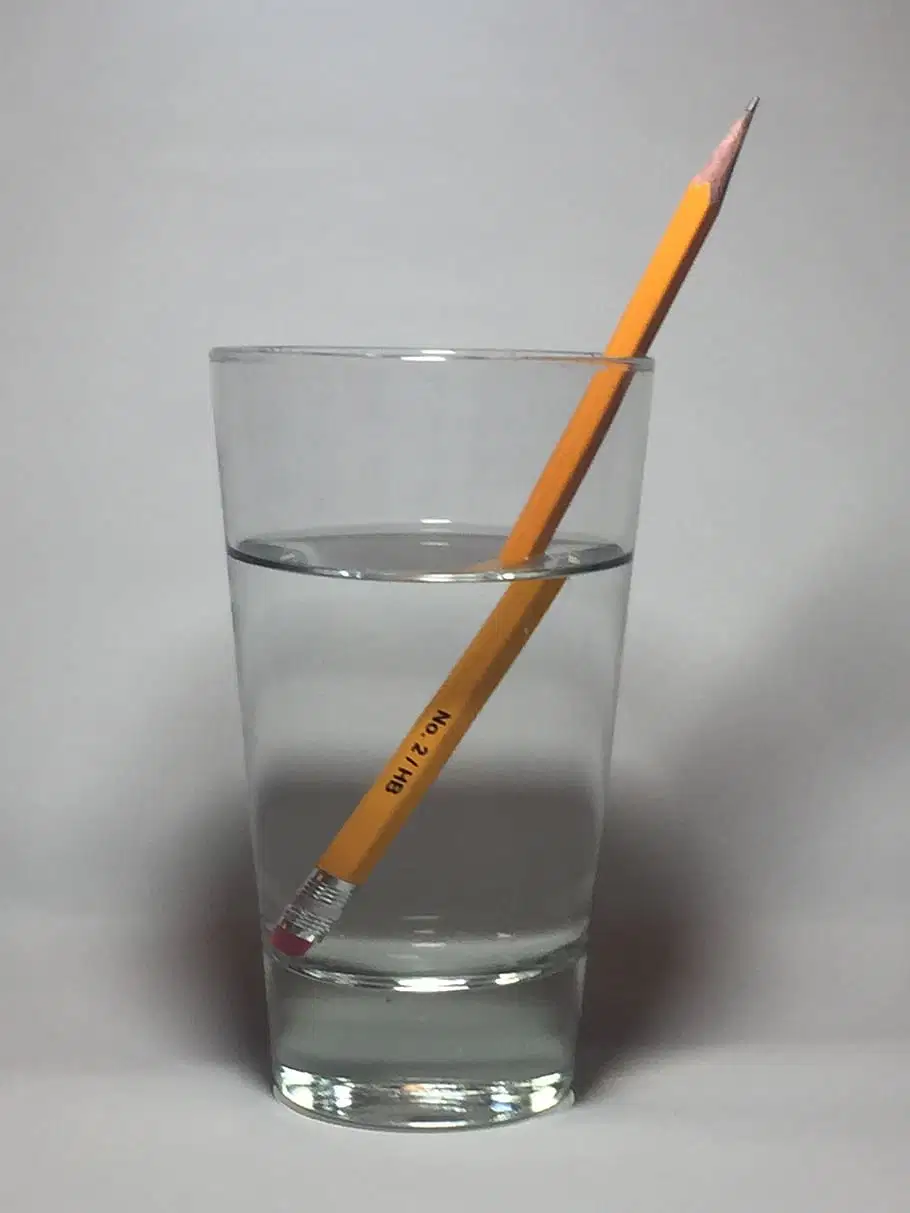
This picture best illustrates _______________.
a)
Refraction
b)
A Lens
c)
A Concave Lens
d)
A Convex Lens
51.
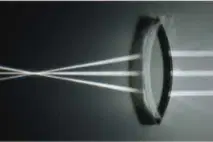
This picture best illustrates _______________.
a)
Refraction
b)
A Lens
c)
A Concave Lens
d)
A Convex Lens
52.
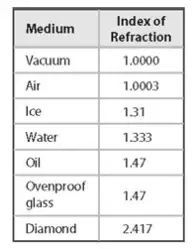
Using the table below, which would cause light to bend the most after traveling through air?
a)
Vacuum
b)
Water
c)
Oil
d)
Diamond
53.
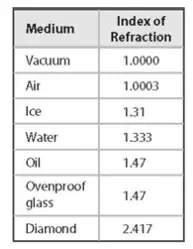
Using the table below to answer the question. True or false: When light travels from air to oil, it bends toward the normal.
a)
True
b)
False
54.
The human eye has two ___________ lenses.
a)
concave
b)
convex
55.
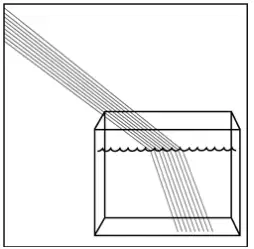
In the figure shown, the light waves change direction as a result of _____.
a)
reflection
b)
absorption
c)
defraction
d)
refraction
56.
A medium that has a high index of refraction is sometimes called __________.
a)
fast
b)
slow
c)
high
d)
low
57.
A concave lens _____________.
a)
curves inward
b)
curves outward
c)
is not transparent
58.
The part of the eye that can change its structure to form a focused image is the __________.
a)
pupil
b)
cornea
c)
iris
d)
retina
59.
When parallel light rays hit a convex lens, they __________.
a)
are refracted and spread out
b)
are refracted and pass through a focal point
60.
Which of the following items has lenses?
a)
glasses
b)
cameras
c)
human eyes
d)
all of the above
61.
The Law of Reflection states that when a wave is reflected from a surface, _______________________.
a)
the angle of the reflection is greater than the angle of incidence.
b)
the angle of the reflection is complimentary to the angle of incidence.
c)
the angle of the reflection is equal to the angle of incidence.
d)
the angle of the reflection is less than the angle of incidence.
62.
A __________ is an image that forms from light rays that diverge or change direction.
a)
virtual image
b)
regular reflection
c)
diffuse reflection
d)
real image
63.
A __________ is the reflection of light from a smooth, shiny surface.
a)
virtual image
b)
regular reflection
c)
diffuse reflection
d)
real image
64.
A __________ is reflection of light from a rough surface.
a)
virtual image
b)
regular reflection
c)
diffuse reflection
d)
real image
65.
A __________ is one that forms where rays converge.
a)
virtual image
b)
regular reflection
c)
diffuse reflection
d)
real image
66.
The inside of a spoon (where the food goes) would be an example of __________.
a)
a concave mirror
b)
a convex mirror
c)
a regular reflection
d)
a defuse reflection
67.
The outside of a spoon (the part that doesn't hold the food) would be an example of __________.
a)
a concave mirror
b)
a convex mirror
c)
a regular reflection
d)
a defuse reflection
68.
A mirror that curves inward is called a __________.
a)
a concave mirror
b)
a convex mirror
c)
a regular reflection
d)
a defuse reflection
69.
A mirror that curves outward is called a __________.
a)
a concave mirror
b)
a convex mirror
c)
a regular reflection
d)
a defuse reflection
70.
A reflection from a pond with ripples would be an example of a/an __________.
a)
a concave mirror
b)
a convex mirror
c)
a regular reflection
d)
a defuse reflection
71.
All sound waves are longitudinal.
a)
True
b)
False
72.
___________ is the number of times a wave pattern repeats in a given amount of time.
a)
Loudness
b)
Frequency
c)
Amplitude
d)
Intensity
73.
Waves transfer matter.
a)
True
b)
False
74.
____________ is the bouncing of waves off a surface.
a)
Absorption
b)
Reflection
c)
Refraction
d)
Transmission
75.
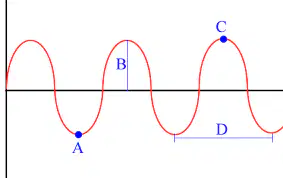
What is letter A?
a)
Crest
b)
Trough
c)
Amplitude
d)
Wavelength
76.
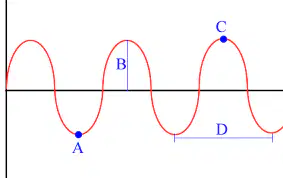
What is letter B?
a)
Crest
b)
Trough
c)
Amplitude
d)
Wavelength
77.
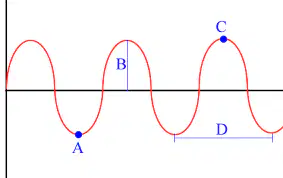
What is letter D?
a)
Crest
b)
Trough
c)
Amplitude
d)
Wavelength
78.
Which of the following correctly describes wavelength?
a)
Wavelength is the distance between two corresponding points in a repeating wave.
b)
Wavelength is the vertical distance between a trough and a crest.
c)
Wavelength is the number of troughs that pass a specific point per second.
79.
Waves have either amplitude or frequency, but not both.
a)
True
b)
False
80.
__________ is electromagnetic radiation that you can see.
a)
Light
b)
Radiant Energy
c)
Frequency
d)
Wavelength
81.
__________ is energy carried by an electromagnetic wave.
a)
Light
b)
Radiant Energy
c)
Frequency
d)
Wavelength
82.
If an object or substance is __________, you can see through it.
a)
transparent
b)
translucent
c)
opaque
83.
If an object or substance is __________, some light can pass through it.
a)
transparent
b)
translucent
c)
opaque
84.
If an object or substance is __________, you cannot see through it.
a)
transparent
b)
translucent
c)
opaque
85.
Which of the following would be an example of low frequency wave?
a)
Radio waves
b)
X-rays
c)
Ultraviolet Rays
d)
Gamma Rays
86.
Which would be an example of a high frequency wave?
a)
Radio Waves
b)
Infrared Waves
c)
Microwaves
d)
Gamma Rays
87.
True or False: Light travels faster than sound.
a)
True
b)
False
88.
What does the amplitude of a light wave tell us?
a)
how much energy the wave has
b)
how bright the light is
c)
how fast the light is moving
89.
The energy of an electromagnetic wave is related to its __________.
a)
amplitude
b)
frequency
c)
wavelength
90.
A window would be an example of a __________ object
a)
transparent
b)
translucent
c)
opaque
91.
Which metric prefix would you use to measure something large?
a)
kilo
b)
centi
c)
milli
92.
The most common base units in the metric system are __________, __________ and __________.
a)
kilos, centis and decis
b)
liquids, solids and gasses
c)
mass, length and volume
d)
meters, liters and grams
93.
How many meters are in 2 kilometers?
a)
1 meter
b)
200 meters
c)
20 meters
d)
2000 meters
94.
True or False: A decimeter, a centimeter and a millimeter are all smaller than a meter.
a)
True
b)
False
95.
How many centimeters are in a meter?
a)
100 centimeters
b)
10 centimeters
c)
1000 centimeters
d)
1 centimeter
96.
A thousandth of a liter is a __________.
a)
milliliter
b)
centiliter
c)
kiloliter
d)
deciliter
97.
How many grams are in 1 kilogram?
a)
1000 grams
b)
100 grams
c)
10 grams
98.
What base unit is most appropriate to measure length?
a)
meter
b)
centi
c)
gram
d)
kilo
99.
What base unit is most appropriate to measure mass?
a)
meter
b)
centi
c)
gram
d)
kilo
100.
What is volume?
a)
the amount of matter something has
b)
the amount of something from one end to the other
c)
the amount of space something takes up
101.
Kolton can run 10 kilometers in one hour. How many meters can he run in one hour?
a)
100 meters
b)
1,000 meters
c)
10,000 meters
d)
100,000 meters
102.
What would be the most appropriate metric unit to measure the space between school and The Strip?
a)
miles
b)
kilometers
c)
kiloliters
103.
What would be the most appropriate metric unit to measure the amount of liquid in a spoon?
a)
Liter
b)
milliliter
c)
millimeter
d)
tablespoon
104.
What is the best metric unit to measure the mass of a person?
a)
pounds
b)
ounces
c)
grams
d)
kilograms
105.
True or False: There are 100 degrees between the boiling point of water and the melting point of ice on the Celsius scale.
a)
True
b)
False
106.
True or False: The Kelvin scale measures mass of an object.
a)
True
b)
False
107.
Chris has 5 liters and 25 milliliters of gas for his lawn mower. How much gas does he have in milliliters?
a)
5000 mL
b)
2500mL
c)
5025mL
d)
50.25mL
e)
1 hour
108.
Meagan has 3 kilograms and 288 grams of flour for her bakery. How many grams of flour does she have?
a)
3,288 grams
b)
328 grams
c)
3.28 grams
d)
0.3288 grams
109.
How many milliliters are in a kiloliter?
a)
100
b)
1,000
c)
10,000
d)
1,000,000
110.
What tool do we use to measure volume?
a)
graduated cylinder
b)
triple beam balance
c)
meter stick
100 %