
 Worksheets
Prove Mastery Nervous System Level 1
Total questions: 22
Worksheet time: 11mins
Name
Class
Date
1.
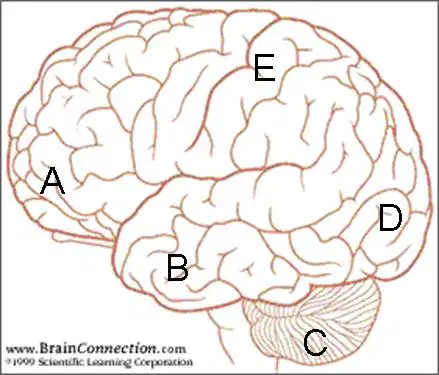
Area D in the diagram is the:
a)
cerebellum
b)
Frontal lobe
c)
Occipital lobe
d)
Parietal lobe
2.
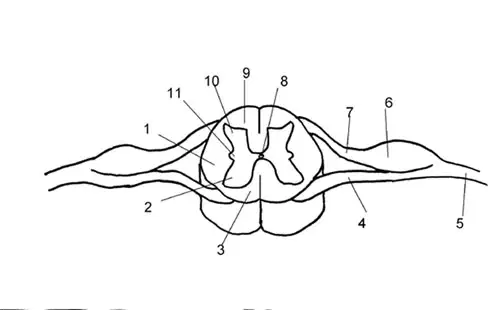
A spinal nerve is indicated by number _____.
a)
1
b)
2
c)
5
d)
7
3.
The midbrain:
a)
contains centers for visual and hearing reflexes.
b)
is a relay center for sensory input from body.
c)
regulates muscular coordination.
d)
regulates heart rate, respiration, and blood. pressure
4.
The medulla oblongata:
a)
contains centers for visual and hearing reflexes.
b)
is a relay center for sensory input from body.
c)
regulates muscular coordination.
d)
regulates heart rate, respiration, and blood. pressure
5.
The cerebellum:
a)
contains centers for visual and hearing reflexes.
b)
is a relay center for sensory input from body.
c)
regulates muscular coordination.
d)
regulates heart rate, respiration, and blood. pressure
6.
The place where an impulse from one nerve cell is communicated to another nerve cell is the:
a)
cell body
b)
receptor
c)
synapse
d)
effector
7.
Impulses travel fastest in neurons that are:
a)
myelinated
b)
unmyelinated
c)
sensory
d)
motor
8.
The gaps between the myelin sheath on the axon are called:
a)
axon terminals
b)
bipolar synapses
c)
nodes of Ranvier
d)
sinoatrial nodes
9.
A simple spinal reflex goes along which of the following reflex arcs?
a)
effector, afferent neuron, association neuron, efferent neuron, receptor
b)
receptor, afferent neuron, association neuron, efferent neuron, effector
c)
effector, efferent neuron, association neuron, afferent neuron, receptor
d)
receptor, efferent neuron, association neuron, afferent neuron, effector
10.
The term central nervous system refers to the:
a)
autonomic and peripheral nervous systems
b)
brain, spinal cord, and peripheral nerves
c)
brain and cranial nerves
d)
brain and spinal cord
11.
Which of the following is NOT a function of the autonomic nervous system?
a)
innervation of visceral organs
b)
regulation and control of vital activities
c)
innervation of glands
d)
conscious control of motor activities
12.
The ventricles of the brain:
a)
are spaces of the brain that are filled with blood.
b)
are only found in the forebrain.
c)
are regions of the brain that contain the arbor vitae.
d)
are spaces that contain cerebrospinal fluid.
13.
Ventral spinal cord roots contain __ fibers, while the dorsal roots contain __ fibers.
a)
motor; sensory
b)
sensory; motor
c)
peripheral; central
d)
central; peripheral
14.
Elevated ridges on the surface of the cerebral hemispheres are called:
a)
ganglia
b)
fissures
c)
gyri
d)
sulci
15.
The thalamus, hypothalamus, and epithalamus collectively constitute the__:
a)
brain stem
b)
cerebrum
c)
diencephalon
d)
cerebellum
16.
The vagus nerve:
a)
carries impulses to and from the abdominal and thoracic areas.
b)
carries sensory impulses for smell.
c)
carries sensory impulses for vision.
d)
carries motor impulses that control movements of eyeball, eyelids, and internal eye muscles.
17.
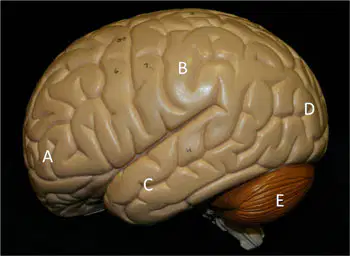
Identify the part of the brain labeled "A."
a)
Frontal lobe
b)
Temporal lobe
c)
Parietal lobe
d)
Occipital lobe
18.
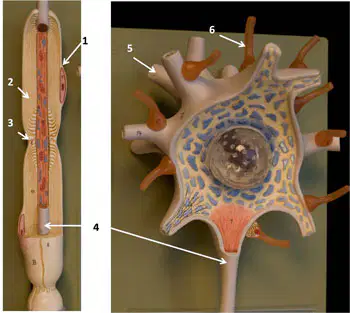
Identify the structure labeled "5."
a)
dendrite
b)
axon terminal
c)
myelin sheath
d)
node of Ranvier
19.
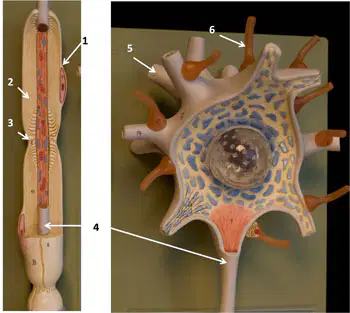
Identify the structure labeled "2."
a)
dendrite
b)
axon terminal
c)
myelin sheath
d)
node of Ranvier
20.
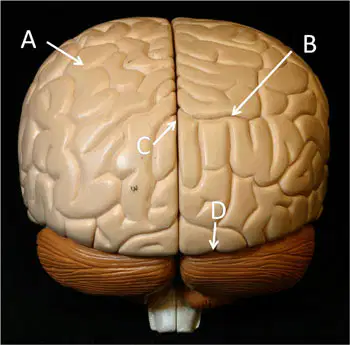
Identify the structure labeled "B."
a)
transverse fissure
b)
longitudinal fissure
c)
cerebellum
d)
gyrus
e)
sulcus
21.
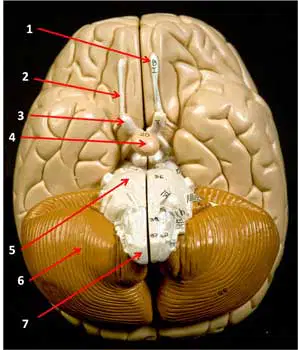
Identify structure #2.
a)
optic nerve
b)
mammillary body
c)
pons
d)
olfactory nerve
22.
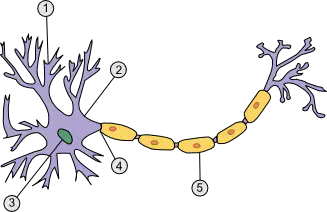
Identify the structure labeled "4." (long tail-like structure)
a)
axon
b)
axon terminal
c)
schwann cell
d)
dendrite
100 %

