
NEW
Font size
 Worksheets
Review- World History Checkpoint #6
Total questions: 18
Worksheet time: 10mins
A certificate that said a person would not be punished for his or her sins.
indulgence
reformation
perspective
get out of jail free card

Bought a certificate of indulgence to be pardoned for publicly arguing with the Church.
Prepared a list of 95 arguments against indulgences because salvation could not be earned.
Decided to become a lawyer and fight against the Church in court.

Which of the following best describes, "the spirit of the renaissance"?
"People should work hard and stick to tradition."
"People are not creative and shouldn't try new things."
"People are capable of learning and should create new things."
"knowledge is reserved only for those in positions of authority.”
Which is the main idea of the Enlightenment?
All individuals have natural rights and governments should be limited in power.
It is necessary for governments to maintain absolute control over citizens and the means of production.
The king has a divine right to rule.
The American Revolution and the French Revolution are turning points in history because these revolutions
led to the abolition of slavery in their respective countries.
marked the end of European influence in the West Hemisphere.
served as inspiration for peoples in other parts of the world seeking democracy and independence based on human rights.
Which of the following provided inspiration for the Declaration of Independence and served as the model for the first ten amendments to the U.S. Constitution?
Code of Hammurabi
Common Sense

An absolute monarch would most likely believe which of the following:
"Governments that ignore the will of the people MUST be overthrown!"
"Power is derived from the people"
"I am the state"
"Governments should have no say in its citizens' private affairs"
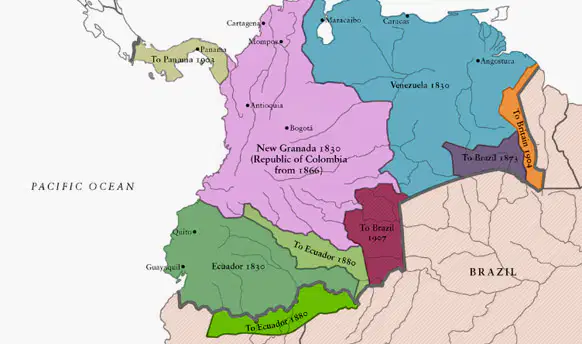
What is Simón Bolívar best known for?
He was essentially a robinhood leader who stole from the rich and gave to the poor
He was the king of Spain and make sure people paid their taxes.
Led Venezuela, Colombia, Ecuador, Panama, and Bolivia to independence from Spain.
Was a ruthless, unfair, dictator that wanted to expand into new territories.
How did the American and French Revolution affect South Americans ?
How did new taxes cause so tension between the colonies and Great Britain?
Colonists wanted representation in Parliament (British government)
Colonists wanted to elect their own king
The new taxes were only fair in the southern colonies
Taxes were seen as evil
One of the main purposes of the Declaration of Independence was to establish Governments for the representation of all people.
True
False
The __________ introduced ideas about people being equal and having a voice in government.
Reformation
Industrialization
Enlightenment
This is the idea that “the people” give the government power to protect their natural rights and must live by the rules?
Separation of Powers
Checks and Balances
Social Contract
Rule of Law
Imagine you're a time traveler, and you've landed in the era of great philosophers. One of them argues that individuals have natural rights to life, liberty, and property. Can you guess who he is?
Baron de Montesquieu
John Locke
Thomas Paine
Louis XIV

What is the time period where people developed new ideas about human existence, including basic rights and how government should be structured?
Middle Ages
Dark Ages
Millennium
Enlightenment

