
 Worksheets
Social Studies Ch. 3 Review
Total questions: 27
Worksheet time: 14mins
secede
to separate from
a careful plan
a person who moves from one country to another
to approve
ratify
a law
to give up and agree to stop fighting
to approve officially
someone who represents a group of people
strategy
to approve officially
a plan of government
a military unit usually made of several groups of soldiers
a careful plan
surrender
to give up and agree to stop fighting
someone who represents a group of people
a plan of government
to approve officially
immigrant
someone who represents a group of people
a person who moves from one country to another
a military unit usually made of several groups of soldiers
a group of people who are not in the military, but are trained as soldiers
ordinance
a careful plan
a plan of government
a law
someone who represents a group of people
constitution
a careful plan
a law
a plan of government
to approve officially
militia
a military unit usually made of several groups of soldiers
a group of people who are not in the military, but are trained as soldiers
a person who moves from one country to another
someone who represents a group of people
delegate
a military unit usually made of several groups of soldiers
a group of people who are not in the military, but are trained as soldiers
a person who moves from one country to another
someone who represents a group of people
regiment
a military unit usually made of several groups of soldiers
a group of people who are not in the military, but are trained as soldiers
a person who moves from one country to another
someone who represents a group of people
What caused Britain to increase the taxes the colonists had to pay?
Britain needed money to pay its debts after the French and Indian War.
The colonists were making a lot of money trading with other countries.
King George III wanted the colonists to pay for their land in America.
The colonists threatened to buy sugar from France instead of Britain.
Which of the following stated that no colonists could move west of the Appalachian Mountains?
the Declaration of Independence
the Northwest Ordinance
the Proclamation of 1763
the Louisiana Purchase
Who led a group of Americans to victory at Fort Vincennes in Indiana?
Henry Hamilton
Jonathan Jennings
George Washington
George Rogers Clark
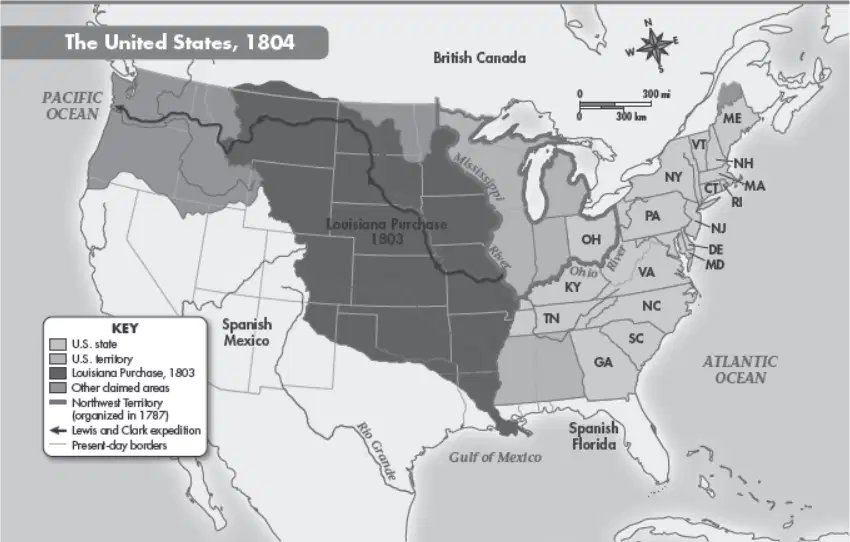
Which is true of the Louisiana Purchase?
It doubled the number of states in the United States.
It doubled the size of the United States.
It doubled the population of the United States.
It doubled the number of rivers in the United States.
Harmonists tried to create a _____ in Indiana, which means a place where everything is perfect.
utopia
treaty
homestead
state
Which group of people was the most harmed when thousands of pioneers moved to Indiana?
white settlers
immigrants
Native Americans
soldiers
How did the building of canals improve life in Indiana?
They made it easier for settlers to move farther west into the Louisiana Territory.
They connected every important city in Indiana to the Mississippi River.
They gave farmers a way to move their crops to market faster.
They made it harder for robbers to attack boats and steal cargo.
Which Native American refused to sign the Treaty of Greenville?
Turtle
Tecumseh
Sacajawea
Little Bear
Which of the following major improvements in transportation was built between 1811 and 1827?
the Underground Railroad
the Erie Canal
the National Road
the National Railroad
The South was largely a farming region that used enslaved Africans to work in cotton fields. How were Northern states such as Indiana different?
The North used enslaved workers in factories rather than on farms.
The North didn’t have any farms, so they didn’t need slaves.
The North used free labor because people needed the work.
The North didn’t approve of slavery, so they outlawed it.
What was the name of the secret network that helped fugitive slaves from the South travel to free states?
the Erie Canal
the National Railroad
the National Road
the Underground Railroad
Who was the first governor of Indiana?
Thomas Jefferson
Jonathan Jennings
George Rogers Clark
William Henry Harrison
Which president was elected in 1860 and was against slavery?
John Quincy Adams
Thomas Jefferson
Andrew Johnson
Abraham Lincoln
What date did Indiana become the 19th state?
December 25, 1816
December 11, 1816
July 4, 1776
September 11, 1776
What date was the Declaration of Independence signed?
December 25, 1816
December 11, 1816
July 4, 1776
September 11, 1776
How did the viewpoints of Southerners differ from those of President Lincoln and the Republican party?
Southerners built factories and did not need slaves.
Southerners developed a great number of railroads and wanted slaves to work them.
Southerners were against slavery.
Southerners wanted to be able to purchase slaves to help them farm their plantations.
How did differing viewpoints lead to the Civil War?
The Missouri Compromise drew an imaginary line through the Louisiana Purchase, outlawing slavery south of the line. The Southerners disagreed with this decision.
Following Lincoln's election, Southerners viewed Lincoln's election as a threat to slavery, states' rights, and their way of life.
The colonists disagreed with the taxes that Great Britain was forcing them to pay.
King George II issued the Proclamation of 1763, which said that no colonists could live west of an imaginary line along the Appalachian mountains.

