
Font size
 Worksheets
MX6 Reviewer G7
Total questions: 67
Worksheet time: 36mins

This is the distance between two crests. What is this called?
amplitude
wavelength
longitude
trough

What does this picture represent?
wavelength
echolocation
amplitude
peak

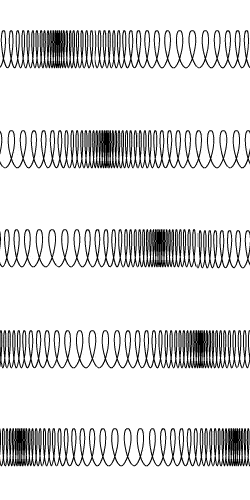
Which transverse wave has the highest frequency?
1
2
3
4
What does a wave carry from place to place?
energy
matter
people
If the wavelength of a wave increased, what would happen to the frequency?
decrease
increase
stay the same
A wave that can travel through matter and empty space is a:
electromagnetic wave
longitudinal wavy
transverse wave
mechanical
What type of wave is this?
Longitudinal
Transverse
Electromagnetic
x ray


Increasing the amplitude means you are increasing the _______________ of a wave.
frequency
amplitude
energy
wavelength
What is the amplitude of a wave?
how often a wave passes a certain point
the distance from the middle of the wave to a crest or a trough
the highest point of a wave
chick-fil-a
The wavelength of a sound wave is 20m. The frequency is 5 Hz. What is the wave speed?
4 m/s
100 m/s
25 m/s
15 m/s
Number of waves passing a given point in a certain amount of time, measured in Hertz (Hz)
wavelength
frequency
amplitude
wave speed
The highest point of the transverse wave.
amplitude
crest
trough
These are waves that travel through a medium like air, water and solids.
electromagnetic waves
mechanical waves
surface waves
The type of EM wave with the longest wavelength
gamma rays
microwaves
radio waves
infrared
EM waves used in remote controls and night vision goggles
microwaves
ultraviolet rays
infrared
visible light
EM waves used in TV broadcasting and cellphone communication.
microwaves
radio waves
infrared
x rays
EM waves with the highest frequency and energy level
radio waves
microwaves
x rays
gamma rays
The color of light with the lowest frequency
red
violet
EM waves used in bluetooth headsets and broadband wireless internet.
infrared
radio waves
microwaves
Identify the type of Electro Magnetic waves used in laser and fiber optics
microwaves
radio waves
x rays
none of these
What kind of wave is an electromagnetic wave?
a transverse wave
a combination of longitudinal and transverse wave
a longitudinal wave
a shock wave
The waves responsible in the production of vitamin D in our skin.
Infrared Waves
Ultraviolet Waves
Microwaves
X-rays
Sound is a form of energy. How is it produced?
by waiting
by vibrating objects
Do sound waves travel through a medium?
YES
NO
It is the highness or lowness of sound or a musical note.
Timbre
Loudness
Pitch
It is the unit used for frequency.
Hertz (Hz)
decibel (dB)
A _____ frequency sound has a higher pitch. A lower frequency sound has a _____ pitch.
higher, higher
lower, higher
higher, lower
lower, lower
The human ear can only sense within the frequency range of _____.
20 Hz to 20,000 Hz
1,000 Hz to 100, 000 Hz
Vibrational frequencies beyond 20,000 Hz is called _____.
infrasonic frequencies
ultrasonic frequencies
Extremely low frequencies are known as _____
infrasonic frequencies
ultrasonic frequencies
It determines the s loudness or volume of a sound wave.
frequency
amplitude
A high amplitude sound means _____ sound, and a low amplitude sound means _____ sound.
softer, louder
louder, softer
louder, louder
softer, softer
The unit of intensity level for sound _____.
Hertz (Hz)
decibel (dB)
It is a quality of a musical sound which is used for differentiating two sounds with the same frequency.
Timbre
Loudness
Pitch
It is a sound wave that is distorted and not pleasing to the senses.
Music
Noise
A material that can transmit light waves.
opaque
transparent
translucent
The bending of light as it travels from one medium to another medium of different densities.
reflection
refraction
interference
diffraction
The spreading of light as it enters the opening of a barrier.
reflection
refraction
interference
diffraction
The process of separating the colors of white light using a prism.
reflection
interference
dispersion
diffraction
The third color of white light if they are arranged from longest to shortest wavelength.
blue
green
yellow
indigo
The third color of white light if they are arranged from shortest to longest wavelength.
yellow
blue
green
orange
The resulting color of light when blue is mix with green.
magenta
yellow
cyan
orange
The turning back of light upon hitting a barrier or an obstacle.
refraction
diffraction
reflection
interference
The color of an object is the color/s of white light being ________________by the object.
absorbed
reflected
transmitted
What happens to the speed of light when a pencil placed in a glass of water appears broken at the surface of the water?
it stops
it is decreasing
it is increasing
t does not change
Which of the following is an example of an illuminated object?
moon
light bulb
fireflies
stars
What does the law of reflection say?
The angle of incidence equals the angle of reflection.
All waves incident on a mirror are reflected.
Waves incident on a mirror are partially reflected.
The angle a ray is reflected from a mirror is random.
Which of the following describes the image formed by a plane mirror?
real, upright, same size as the object
real, inverted, and reduced
virtual, upright, & same size as the object
virtual, inverted and enlarged
What causes refraction?
bending
displacement of images
different wave speed
diffused reflection

When you see the color black...
All colors are reflecting
All colors are absorbed
The color blacl is reflecting
the color black is absorbed

White when
the color white reflects
the color black is absorbed
all colors are reflected
no colors are reflected
The sky is blue because...
blue is the color most scattered or reflected by our atmosphere.
red is the color most scattered or reflected by our atmosphere.
blue is the color most absorbed by our atmosphere.
blue is complimentary to orange.
The function of the human eye is to _______.
focus light rays to produce images of objects
capture sound waves and convert them to images
capture electrical energy and transform it to brain waves
capture light waves and convert them to mechanical energy
The part of the ear is a thin muscle that vibrates is called the
ear drum
ear canal
hammer
Which part of the ear is a tube that looks like a snail and it changes sound into nerve impulses that are sent to the brain?
pinna
anvil
cochlea
The part of the ear that carries sound from the pinna to the ear drum is called the
cochlea
ear canal
hammer
The three bones that amplify sound in the ear are called the hammer, anvil, and
cochlea
oval window
stirrup
The part of the ear that catches sound is called the
pinna
ear drum
cochlea
What is the tube that connects the middle ear to the throat?
semicircular canals
auditory nerve
Eustachian tube
The ________________ carries sound information from the cochlea to the brain.
auditory canal
auditory nerve
ear drum

